
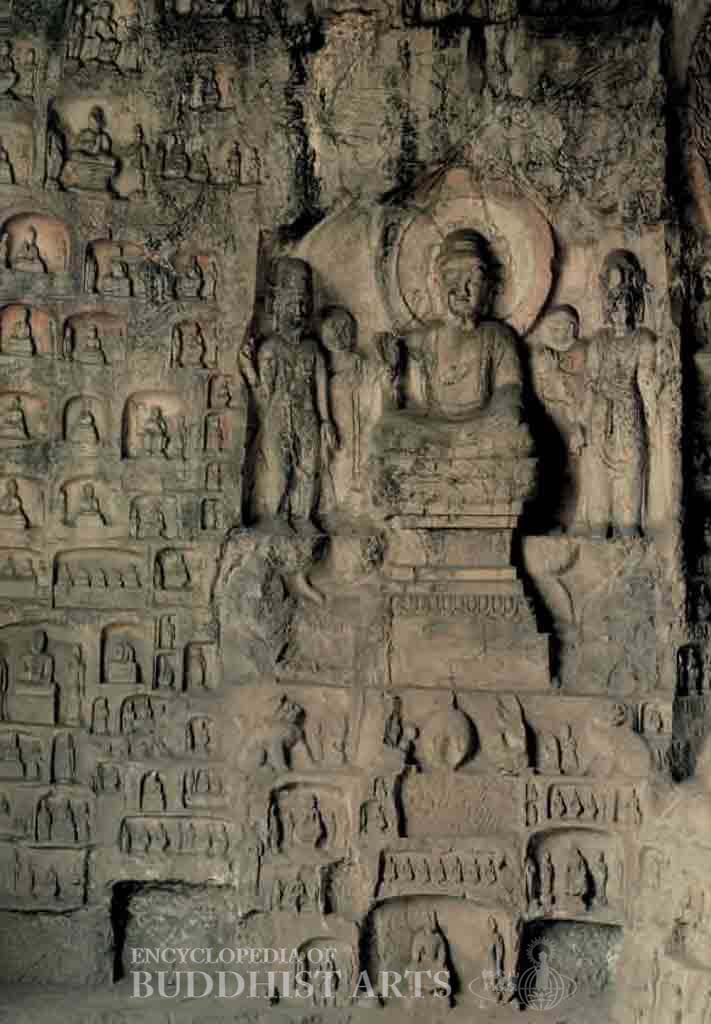
Longmen Grotto 159: Niches (south wall)
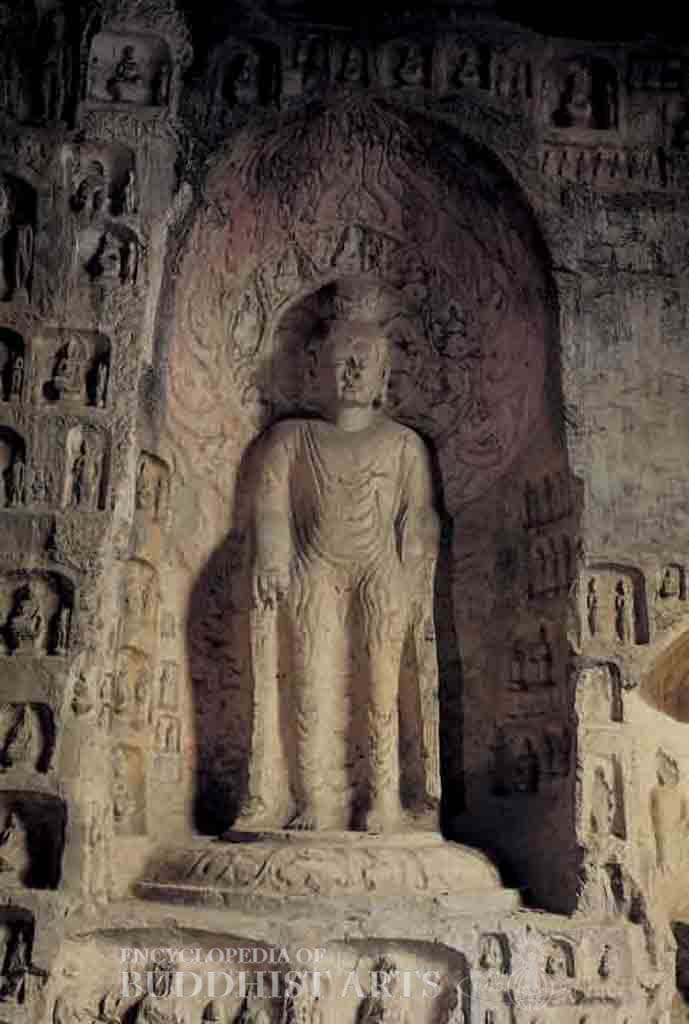
Longmen Grotto 159: Standing Buddha (north wall niche)
Longmen Grotto 159
CHINA, Henan, Luoyang
Grotto 159, also referred to as South Binyang Grotto, is located in the northern area of the Yi River’s west bank, next to Grotto 140. Construction began around 500 during the Northern Wei dynasty. The grotto was completed in the Sui (581–618) and Tang (618–907) dynasties. In 641, the Prince of Wei, Li Tai, dedicated the grotto to his mother, Empress Zhangsun. Measuring 8.72 m in width, 9.85 m in height, and 8.18 m in depth, the grotto has an apsidal layout and a domed ceiling. A lotus encircled by eight apsaras and surrounded by patterned concentric rings is depicted at the center of the ceiling. Reliefs of ten deities on the lower sections of the front (east), north, and south walls were carved during the Northern Wei dynasty.
The main Amitabha statue on the back (west) wall and the many niches surrounding it were carved during the Sui and Tang dynasties. Amitabha has a round face, a low, flat usnisa, and wears monastic robes with long, loose sleeves. Seated in full lotus position on a rectangular lotus throne, Amitabha is flanked by two disciples who wear similar monastic robes. One joins palms while the other holds an object. Two attendant Bodhisattvas stand next to the disciples. The Bodhisattvas have petal-shaped nimbuses carved with lotus petal and flame patterns. They wear floral headdresses, various ornaments, and stoles drape over their shoulders. One hand is depicted in front of the chest while the lowered hand holds an object.
Large niches are located in the center of both walls, the north of which features a standing Buddha with a high usnisa, and round face. He wears a monastic robe with dense folds that covers both shoulders. The south wall niche has an ogee arched lintel and houses a Buddha, two disciples and two Bodhisattvas. The Buddha has a double-collared monastic robe, a high usnisa, and a full face. Two disciples clad in robes with long, loose sleeves, join palms and face the Buddha, who sits in full lotus position on a lotus throne. Attending Bodhisattvas on either side stand on inverted lotus pedestals. According to a stele outside the grotto, the two large niches were carved during the time of Emperor Zhenguan (reigned 627–649) by the Prince of Wei, Li Tai.
There are over 150 Buddha niches on the walls of the cave. Among them, more than 20 were carved during the Sui dynasty, six were completed in 641, and over 70 created after that year.
For more details, go to the Encyclopedia of Buddhist Arts: Caves R-L, page 669.
Cite this article:
author = Hsingyun and Youheng and Johnson, Peter and Mankuang and Huntington, Susan and Edson, Gary and Neather, Robert,
booktitle = {Encyclopedia of Buddhist Arts: Caves R-L},
pages = 669,
title = {{Longmen Grotto 159}},
volume = 6,
year = {2016}}