
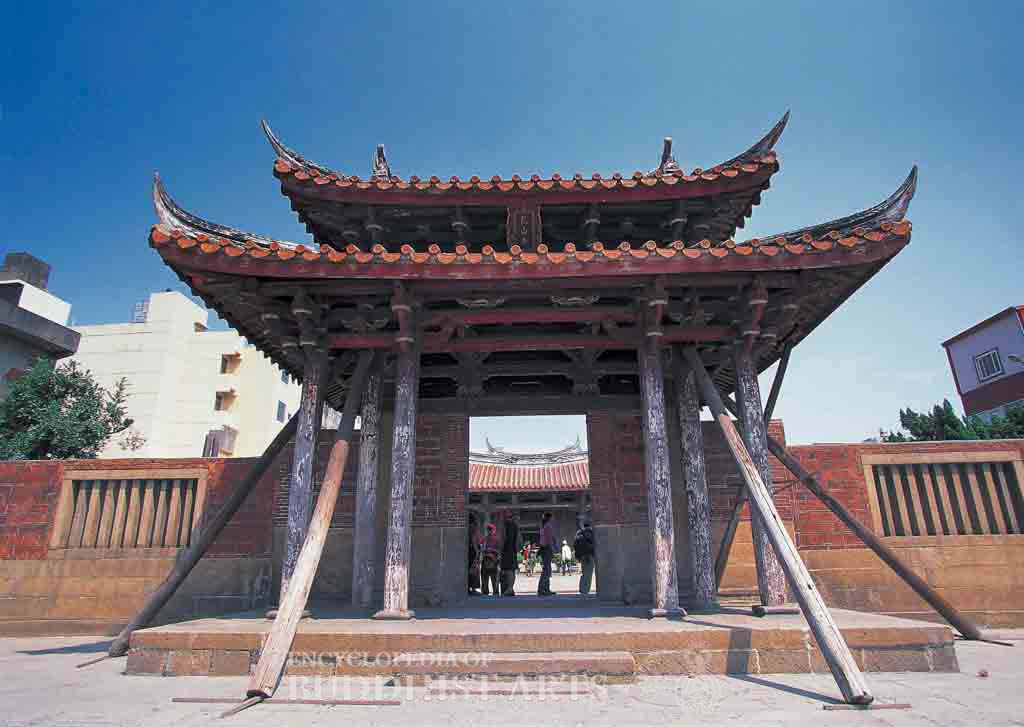
Longshan Temple: Main Temple Gate
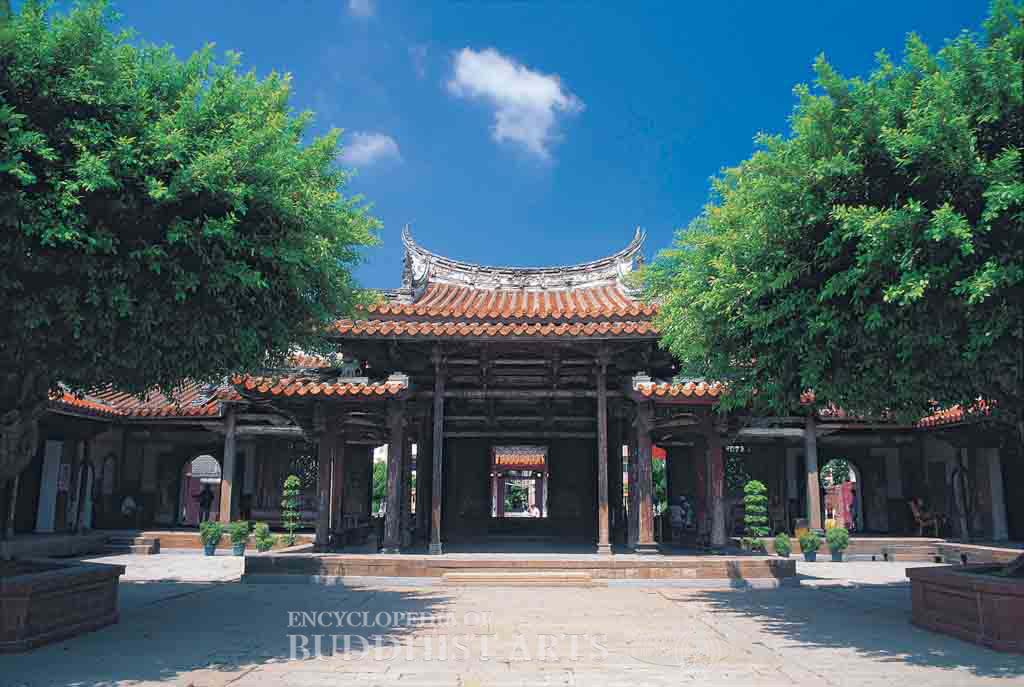
Longshan Temple: Five Door Hall
Longshan Temple
TAIWAN, Changhua
Longshan means Dragon Mountain. The temple was founded in 1653 and moved to its present site in 1786. The temple was reconstructed from 1829 to 1831 and expanded to its present scale. It was listed as a Historic Monument of Taiwan in 1983.
The west-facing temple occupies 5,300 sq m and comprise an extensive complex of large buildings. The layout is symmetrical along a central axis, on which stand the main temple gate, Five Door Hall, stage, worship hall, main hall, and rear hall. The main temple gate has a double-eave hip roof. It is open and supported by columns. The five-bay wide Five Door Hall has double eaves with additional lower eaves at the sides. In front of the hall, there is a pair of columns carved with coiling dragons: one faces up, while the other looks down. The stage has an octagonal caisson ceiling supported by 16 multi-tier bracket sets. It was built in 1831 and is considered to be the earliest caisson ceiling in Taiwan. The main hall has a double-eave hip-and-gable roof and a height of about 12 m. A statue of Avalokitesvara Bodhisattva is enshrined within the hall. The rear hall has a flush gable roof and houses a wooden statue of Amitabha Buddha originally from Hongwanji Temple in Japan.
There are nine pairs of Dharma protectors painted between 1958 and 1964 by Kuo Hsin-Lin with his son and nephew. These images, including Skanda, Sangharama, and the Four Heavenly Kings, are painted on the main hall, Five Door Hall, and the rear hall.
For more details, go to the Encyclopedia of Buddhist Arts: Architecture G-L, page 692.
Cite this article:
author = Hsingyun and Youheng and Johnson, Peter and Mankuang and Lancaster, Lewis,
booktitle = {Encyclopedia of Buddhist Arts: Architecture G-L},
pages = 692,
title = {{Longshan Temple}},
volume = 2,
year = {2016}}