
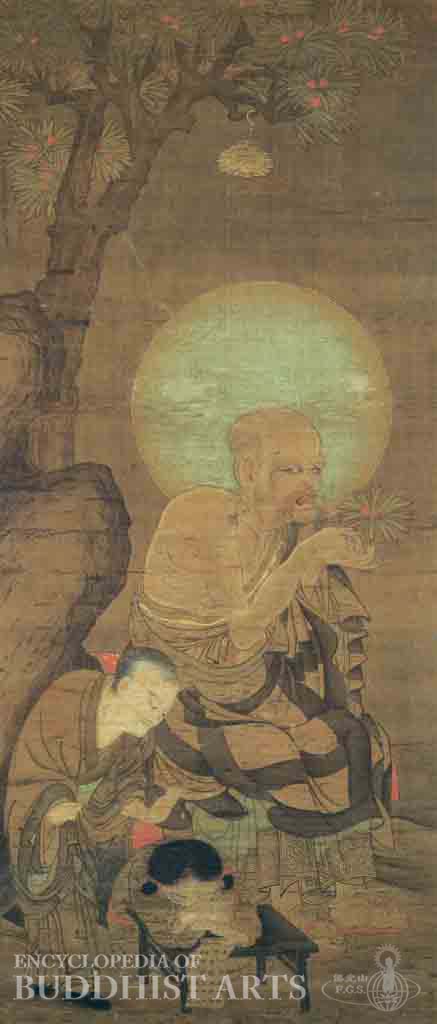
Sixteen Arhats - First Arhat by Jin Dashou; Southern Song dynasty
Ink and color on silk
Jin Dashou
CHINA, Zhejiang, Ningbo; Southern Song dynasty
Jin Dashou was a painter and native of Mingzhou (present day Ningbo, Zhejiang). During the Southern Song dynasty (1127–1279), in which he is believed to have lived, Ningbo was a commercial harbor where Buddhist temples were dense and often requested artwork. Thus, a number of painters proficient in the painting of Buddhist art arose. While these painters, such as Lu Zhongxin, Lu Zhongyuan, and Zhang Sixun, were not particularly well-known in the history of Chinese painting, their signatures were discovered on several Song (960–1279) and Yuan (1271–1368) dynasties paintings that were brought to Japan. Perhaps due to the lack of historical documentation, Jin is considered by many research scholars to be the same person as Jin Chushi. However, because the two names appear on different pieces of artwork, they are often documented separate from one another.
Jin’s paintings were delicately drawn in rich colors. His unique depiction of the Sixteen Arhats is comprised of sixteen different paintings, ten of which are kept at the Tokyo National Museum in Japan, one of which is at the Museum of Modern Art, Gunma in Takasaki, Japan, and five of which remain undiscovered. An influential piece, Sixteen Arhats served as the model for many subsequent Japanese arhat paintings. The work was listed as an Important Cultural Property of Japan in 1937.
For more details, go to the Encyclopedia of Buddhist Arts: People, page 118.
Cite this article:
author = Hsingyun and Youheng and Youlu and Pokorski, Stefanie and Yichao and Mankuang and Miaohsi,
booktitle = {Encyclopedia of Buddhist Arts: People },
pages = 118,
title = {{Jin Dashou}},
volume = 19,
year = {2016}}