
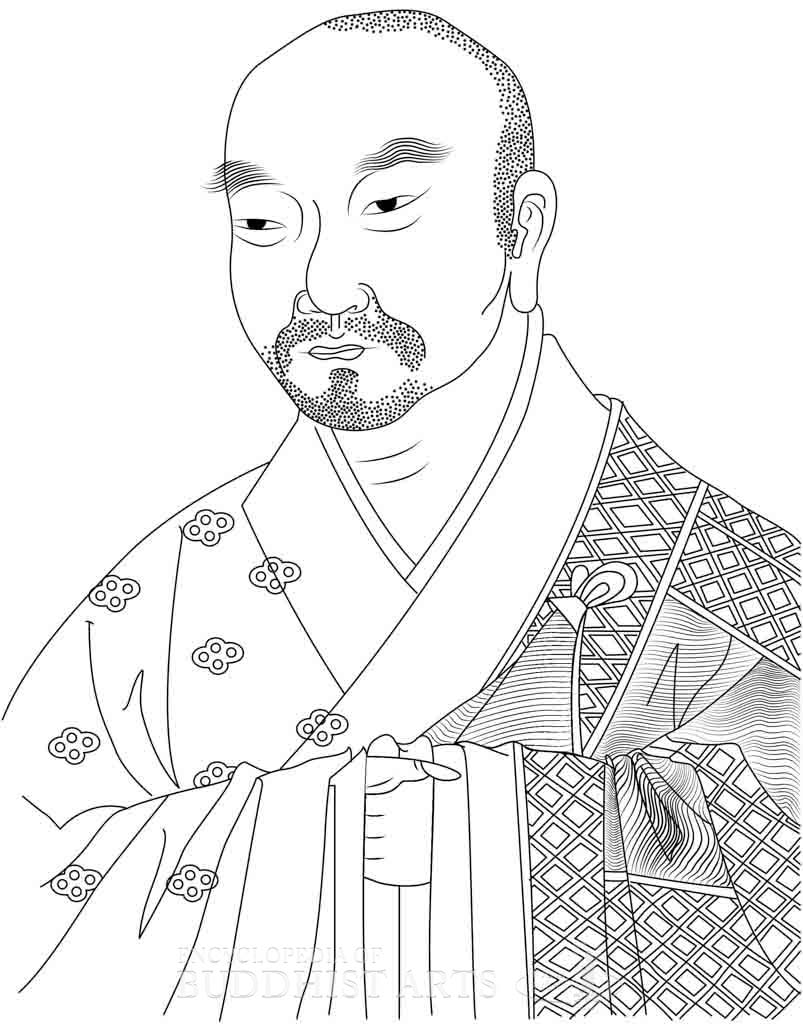
Dahui Zonggao
Dahui Zonggao
CHINA, Anhui, Xuancheng; Song dynasty
Dahui Zonggao was a well-known master from the Linji school of Chan Buddhism. A native of Xuanzhou, Ningguo (present day Xuancheng, Anhui), he became a monk at the age of 17 and inherited the teachings of Chan Master Yuanwu Keqin. Reputed for his skills in debate, he advocated the Kanhua Chan, which is phrase-observing meditation over a gong’an. In 1126 of the Song dynasty, he was bestowed the title Buddha Sun Master and honored the purple robe. In 1137, he became the abbot of Nengren Temple on Jingshan.
Due to accusations of his association with rival Jin forces, Dahui was deprived off his monastic status and exiled to Hengzhou (present day Hunan). During this period, he compiled a series of Chan dialogues and gong’ans into his master work entitled, Treasury of the True Dharma Eye. In 1150, he was deported to Meizhou (present day Guangdong) where infectious diseases were prevalent and resources were scarce. Five years later, his sentence was remitted and he returned to monastic life. He received the title of Chan Master Dahui (Great Wisdom) in 1158 when Emperor Xiaozong (reigned 1162–1189) of the Southern Song dynasty took refuge in Buddhism, and in 1163, he was given the title Chan Master Pujue (Universal Enlightenment). As the founder of the Dahui lineage, he had a tremendous impact on Japanese Zen Buddhism. His calligraphic works, which possess a tranquil and natural quality, include Letter from Master Dahui Zonggao to Wuxiang, which was written during his time in Meizhou and currently kept at the Tokyo National Museum in Japan, and Letter, which is kept at the Hatakeyama Memorial Museum of Fine Art in Tokyo, Japan; both pieces are listed as National Treasures of Japan.
For more details, go to the Encyclopedia of Buddhist Arts: People, page 32.
Cite this article:
author = Hsingyun and Youheng and Youlu and Pokorski, Stefanie and Yichao and Mankuang and Miaohsi,
booktitle = {Encyclopedia of Buddhist Arts: People },
pages = 32,
title = {{Dahui Zonggao}},
volume = 19,
year = {2016}}