
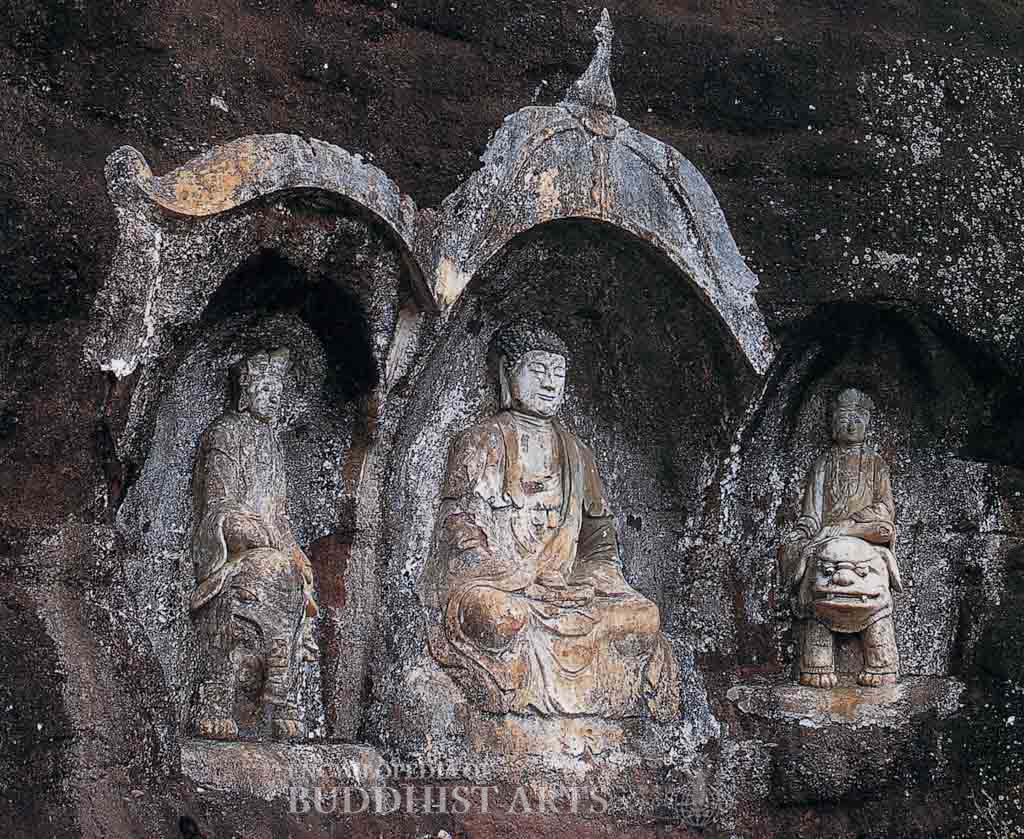
Tongtianyan Rock Carvings: Niche 129 - Vairocana Buddha and Bodhisattvas
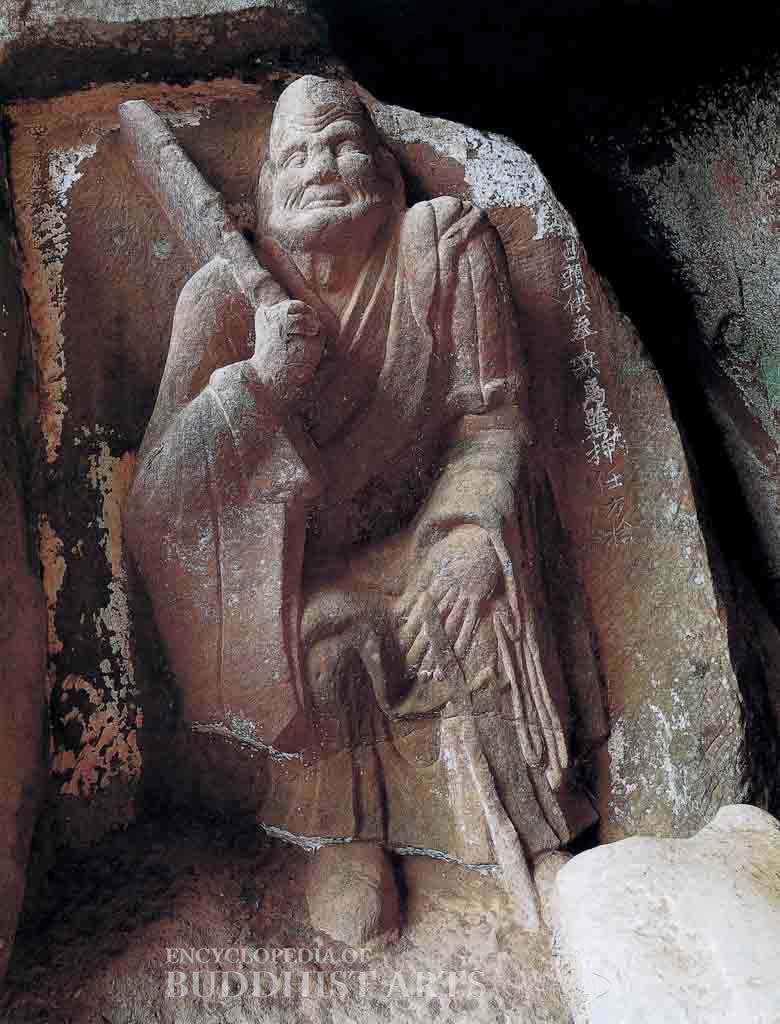
Tongtianyan Rock Carvings: Arhat
Tongtianyan Rock Carvings
CHINA, Jiangxi, Ganzhou
Carving at Tongtianyan began in the Late Tang period (846–907) and continued until the Northern Song dynasty (960–1127). The collection includes a total of 315 grotto niches and 128 inscriptions across the Wangguiyan (Forget to Return Cliff), Longhuyan (Dragon and Tiger Cliff), Guanxinyan (Observe Mind Cliff), Tongtianyan (Reach Heavens Cliff), and Cuiweiyan (Green Micro Cliff). Arched niches enshrine the Dipamkara and Vairocana Buddhas, as well as various Bodhisattvas and Arhats. The Tongtianyan Rock Carvings were listed as a National Cultural Heritage Site in 1988.
Guanxinyan has a small grotto that was once known as Wang Yangming’s place of teaching, while Wangguiyan and Longhuyan contain 10 niches with almost perfectly perserved Arhat statues.
The statues at Tongtianyan mainly surround Niche 129. This large structure takes the shape of three connected pagodas. Enshrined within is Vairocana Buddha along with flanking Bodhisattvas. Vairocana Buddha has a usnisa, curled hair, and a round face. The figure’s monastic robe has long, loose sleeves covering both shoulders and a ribbon tied in front of the chest. The Buddha sits in full lotus position on a lotus throne. The niche on the right of the Buddha holds Manjusri Bodhisattva. The Bodhisattva sits upon a blue lion and wears a monastic robe with long, loose sleeves covering both shoulders. The left niche contains Samantabhadra Bodhisattva wearing a crown and seated atop a white elephant. Surrounding the large niche are approximately 100 smaller ones containing around 300 Arhat statues. Unfortunately, they have been severely weathered.
Cuiweiyan has more carvings of Arhats along with niches with Maitreya and Buddha carved in fine detail. These statues are designed for local citizens to pray for blessings and liberate the deceased.
For more details, go to the Encyclopedia of Buddhist Arts: Caves T-Z, page 1464.
Cite this article:
author = Hsingyun and Youheng and Johnson, Peter and Mankuang and Huntington, Susan and Edson, Gary and Neather, Robert,
booktitle = {Encyclopedia of Buddhist Arts: Caves T-Z},
pages = 1464,
title = {{Tongtianyan Rock Carvings}},
volume = 9,
year = {2016}}