
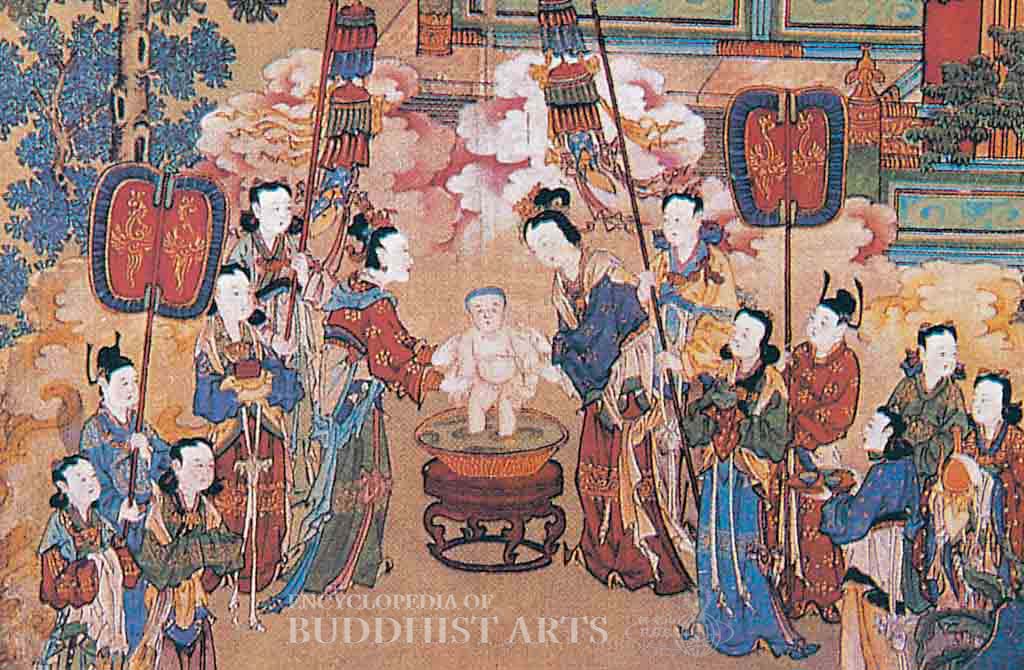
Chongshan Temple: Life of the Buddha - Bathing of the Prince
Ink and color on paper
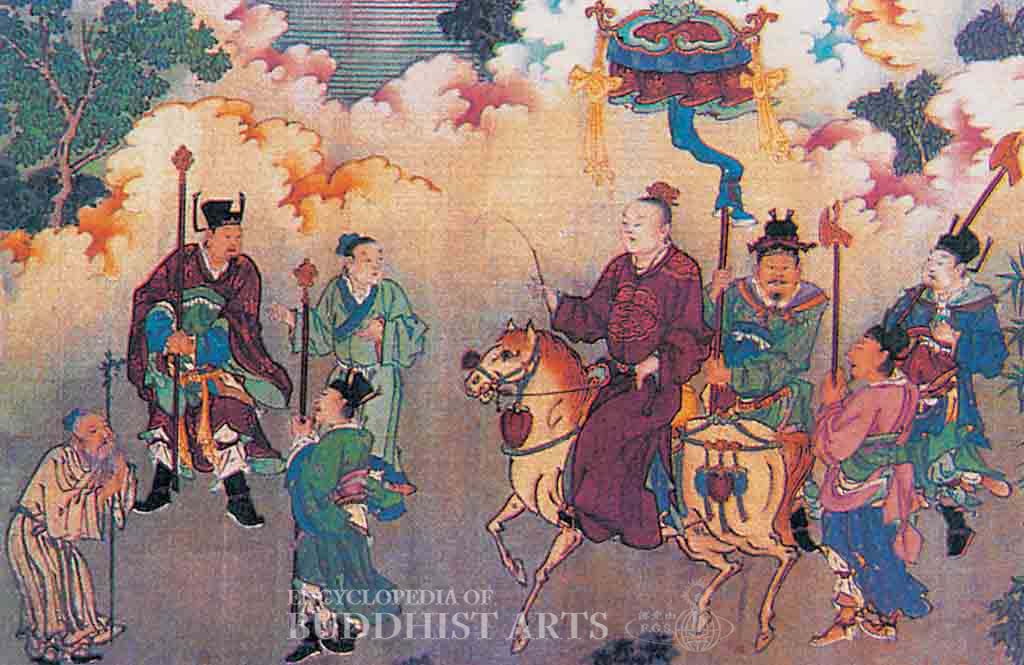
Chongshan Temple: Life of the Buddha - Encountering Old Age
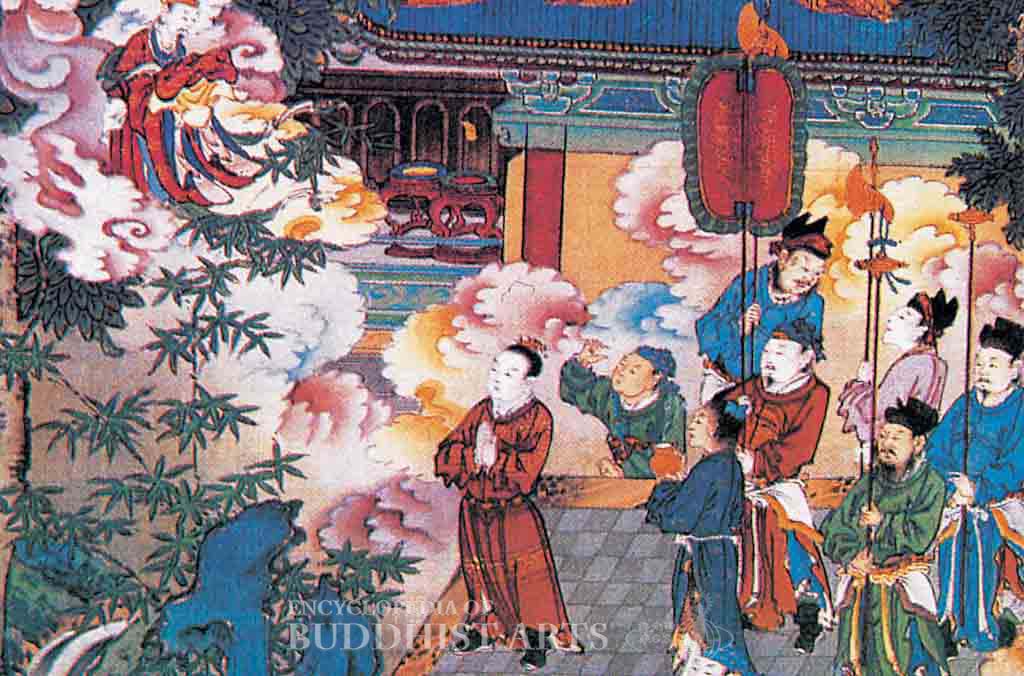
Chongshan Temple: Life of the Buddha - Offering of the Robe
Chongshan Temple: Life of the Buddha
CHINA, Shanxi, Taiyuan; Ming dynasty
When Chongshan Temple was built in 1383 during the Ming dynasty, murals depicting the Life of the Buddha and the Fifty-Three Visits of Sudhana were painted along the side corridors of the Great Hero Hall. In 1483, the murals were copied and collected to form a set of master copies for future replication. They are bound into a book now kept in a wooden cabinet in the Great Compassion Hall. The temple burned down in 1864 of the Qing dynasty (1644–1911), with only the Great Compassion Hall and some minor buildings surviving. Thus, the original murals have been lost.
The set is composed of 80 paintings, each 37 cm high and 58 cm wide, that narrate the life of Sakyamuni Buddha from his birth to his final passing into parinirvana. The images, each labelled with a caption in the upper left corner, include Bathing the Prince and Encountering Old Age. The former shows the baby Prince Siddhartha standing atop a golden bath, accompanied by Queen Maya, palace maids, and attendants. The latter shows the prince encountering a silver-haired elder walking with a bent back and leaning on a staff. Beside the prince are attendants carrying a parasol and halberds. In The Offering of the Robe, a heavenly being descends on clouds to deliver the robe, the prince stands with his palms joined, and the attendants on guard hold halberds and court fans.
The clothes, architecture, weapons, furnishings, gardens, and trees are portrayed in characteristic early Ming style. The images are neatly arranged and are painted with vibrant colors and delicate strokes, a rarity among master copies of Chinese temple murals. These features render them important objects for the study of mural design.
For more details, go to the Encyclopedia of Buddhist Arts: Painting A-H, page 156.
Cite this article:
author = Hsingyun and Youheng and Youlu and Wilson, Graham and Manho and Mankuang and Huntington, Susan,
booktitle = {Encyclopedia of Buddhist Arts: Painting A-H},
pages = 156,
title = {{Chongshan Temple: Life of the Buddha}},
volume = 14,
year = {2016}}