
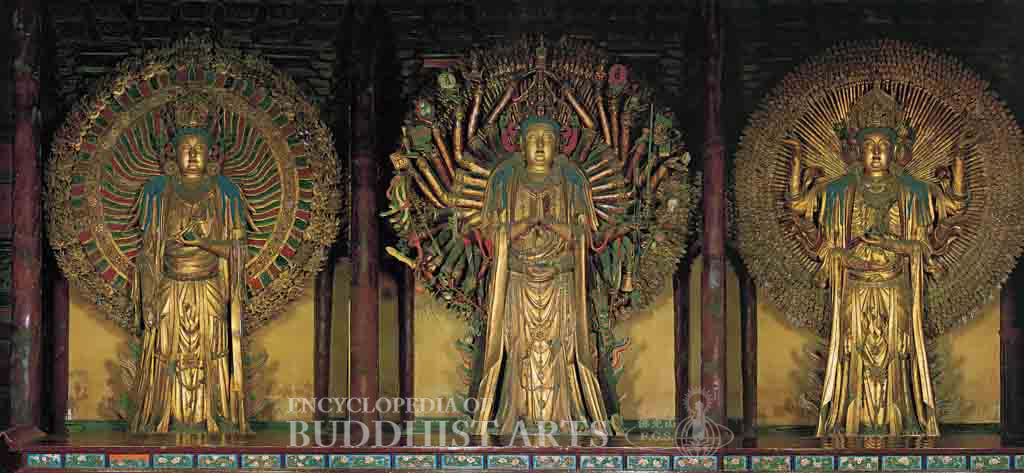
Chongshan Temple Great Compassion Hall: Three Great Bodhisattvas
Clay and wood
Chongshan Temple Great Compassion Hall: Three Great Bodhisattvas
CHINA, Shanxi, Taiyuan; Ming dynasty
These Bodhisattva statues are located within the Great Compassion Hall. The Three Great Bodhisattvas refer to Avalokitesvara, Manjusri, and Samantabhadra.
Avalokitesvara, in the center, is depicted with a thousand arms and a thousand eyes. The four main hands form the anjali (reverence) mudra and the dhyana (meditation) mudra. The other arms fan out, like a mandorla, with each holding an object. The eleven heads of Avalokitesvara have been piled on the main head. The three heads facing the front are human, while the three on the right have tusks and the three on the left have wrathful expressions. The head at the back is joyful and the last head depicts the Buddha. This form of Avalokitesvara is described in detail in the Sutra on the Vajrayana Teachings of Avalokitesvara Bodhisattva.
Manjusri, on the right, is depicted with six main arms. The smaller arms all hold bowls containing a Buddha figure each. This form is mentioned in the Sutra on Manjusri with Thousand Arms and Thousand Bowls.
Samantabhadra has no additional arms. The Bodhisattva’s mandorla consists of waves of radiating light followed by flames around the edges. The image of radiating light is based on the Sutra on Samantabhadra’s Dharani for Prolonging Life.
For more details, go to the Encyclopedia of Buddhist Arts: Sculpture A-F, page 257.
Cite this article:
author = Hsingyun and Youheng and Lovelock, Yann and Chou, Yuan and Huntington, Susan and Edson, Gary and Neather, Robert,
booktitle = {Encyclopedia of Buddhist Arts: Sculpture A-F},
pages = 257,
title = {{Chongshan Temple Great Compassion Hall: Three Great Bodhisattvas}},
volume = 10,
year = {2016}}