
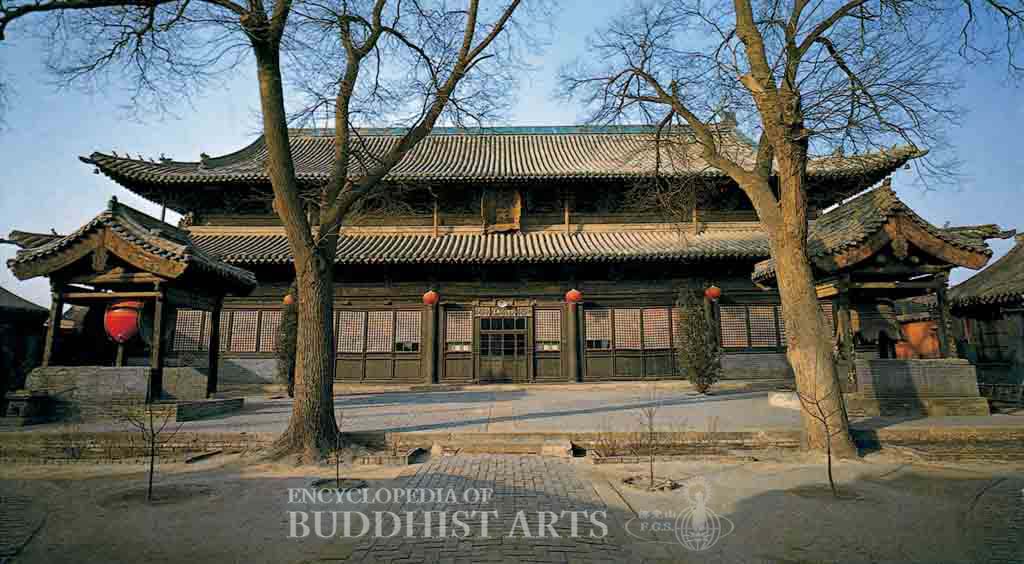
Chongshan Temple: Great Compassion Hall
Chongshan Temple
CHINA, Shanxi, Taiyuan
This is a typical, large-scale Ming dynasty (1368–1644) temple built by imperial decree. Although the exact year of its construction is unknown, inscriptions state that it was restored in 1383. The temple was destroyed by fire in 1864 during the Qing dynasty, with only the Great Compassion Hall and some minor buildings remaining. It was listed as a key Buddhist temple in the Han region of China in 1983.
The original layout of the temple can be found in a plan of the temple drawn in 1482 during the Ming dynasty. Facing south with a rectangular, symmetrical layout, it measured approximately 570 m long and 290 m wide. The seven-by-four bay Great Compassion Hall is the most perfectly preserved Ming dynasty timber structure in China. It has a double-eave hip-and-gable roof covered with green glazed tiles. Statues of the Three Great Bodhisattvas, namely Thousand-Armed, Thousand-Eyed Avalokitesvara, Thousand-Bowl Manjusri, and Samantabhadra, are enshrined within the hall. It also houses 30,000 fascicles of various versions of the Tripitaka, making it one of the most important Buddhist sutra repositories in China.
For more details, go to the Encyclopedia of Buddhist Arts: Architecture A-F, page 162.
Cite this article:
author = Hsingyun and Youheng and Johnson, Peter and Mankuang and Lancaster, Lewis,
booktitle = {Encyclopedia of Buddhist Arts: Architecture A-F},
pages = 162,
title = {{Chongshan Temple}},
volume = 1,
year = {2016}}