
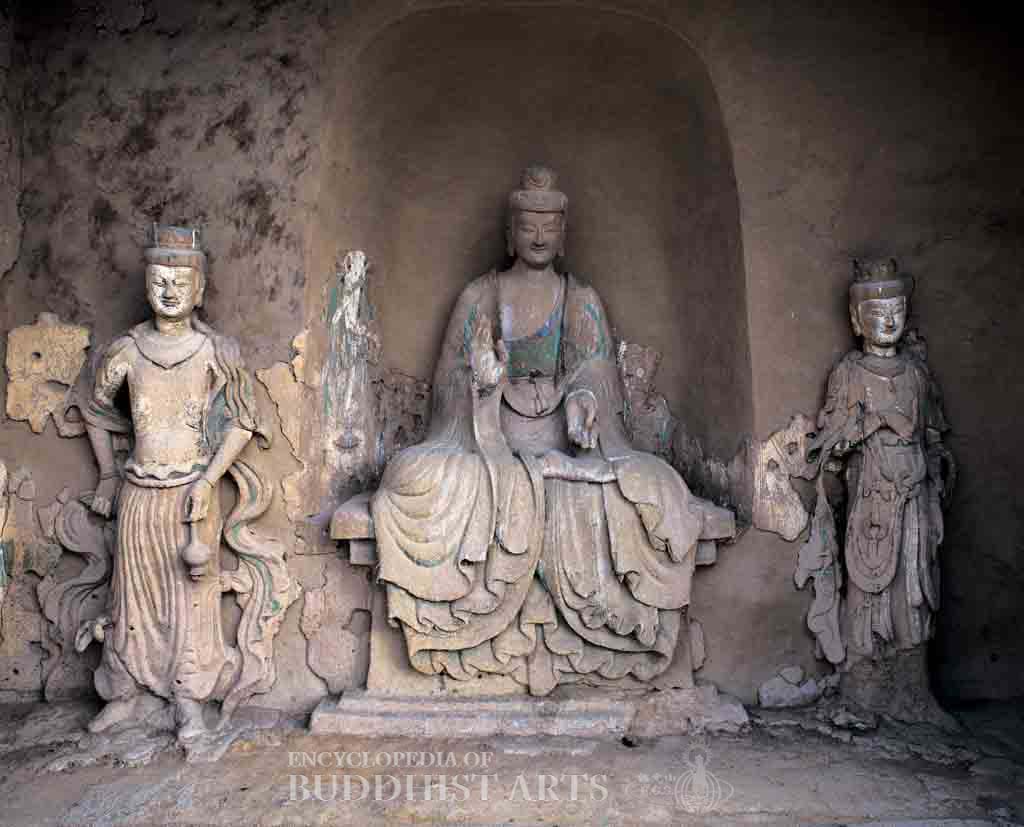
Maijishan Grotto 44: Buddha and Bodhisattvas (back wall)
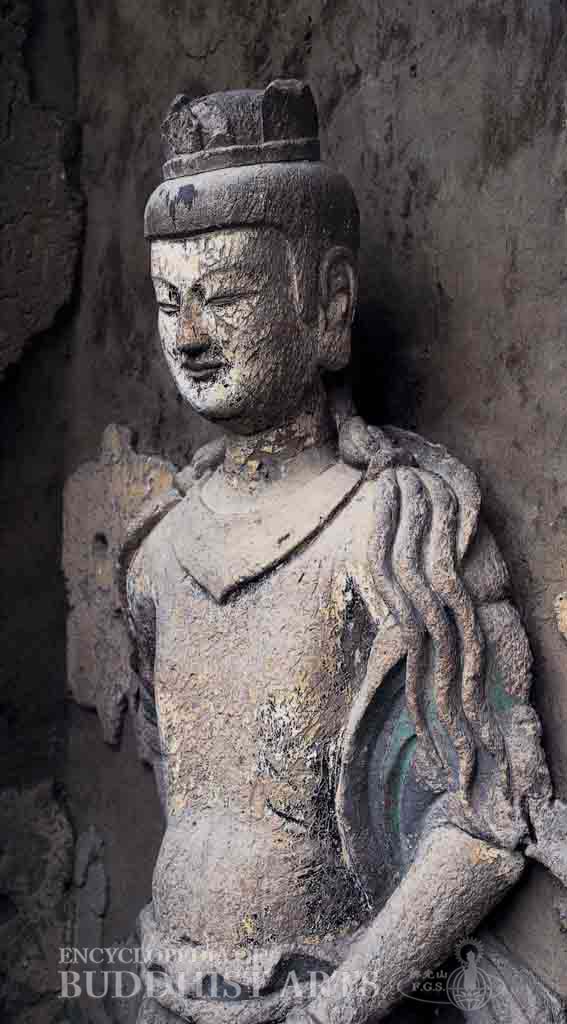
Maijishan Grotto 44: Attendant Bodhisattva (back wall, left side)
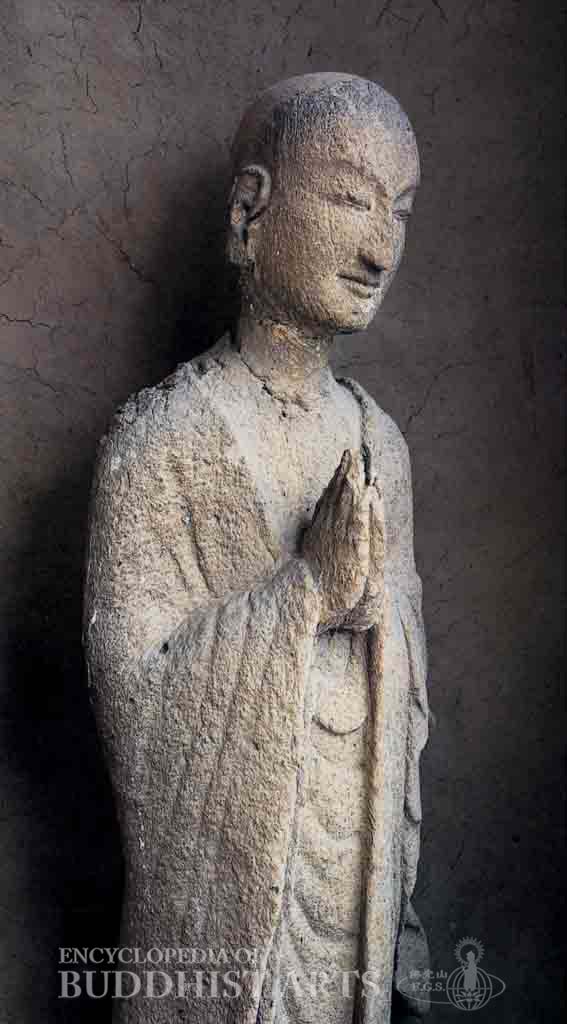
Maijishan Grotto 44: Ananda (right wall)
Maijishan Grotto 44
CHINA, Gansu, Tianshui
This grotto from the Western Wei dynasty (535–556) is located on the west side of the east cliff. The rectangular grotto measures 3.2 m in width, 2.25 m in height, and 1.9 m in depth and has a pyramidal ceiling. The front section has collapsed and only the sculptures in the rear section are preserved. An arched niche in the center of the back wall houses a seated Buddha who is flanked by two attendant Bodhisattvas. There is a disciple by the right wall.
The 1.6 m high Buddha, with a tall usnisa and spiraled hair, sits in full lotus position on a Sumeru throne. The eyes and eyebrows are long and slender. The nose is prominent and the lips are thin. The head tilts slightly forward and the eyes gaze downward. The Buddha is portrayed with a gentle and amiable expression. An outer monastic robe covers the Buddha’s shoulders and an inner robe is tied at the chest. The right hand forms the abhaya (fearlessness) mudra and the left hand displays the varada (wish-granting) mudra. The lower portion of the robe, with elegant hems, drapes down in neatly arranged folds over the throne. Each line of the eminently decorated robe is carved smoothly. The usnisa, chest, and robe all retain residual original coloring.
The two attendant Bodhisattvas, 1.3 m in height, are adorned with three-petal headdresses and embellished with necklaces. Their plaited hair flows naturally down to their elbows. They wear stoles with dhotis covering their lower bodies. With a solemn yet elegant and peaceful countenance, the Bodhisattvas hold either a vase or a corner of the garment. The somewhat deteriorated disciple at the right wall, 1.07 m in height, may be Ananda. A robe covers the shoulders. With palms joined, the disciple appears simple and gentle. The grotto is highly adorned and the style is representative of the Western Wei dynasty (535–556).
For more details, go to the Encyclopedia of Buddhist Arts: Caves M-Mo, page 750.
Cite this article:
author = Hsingyun and Youheng and Johnson, Peter and Mankuang and Huntington, Susan and Edson, Gary and Neather, Robert,
booktitle = {Encyclopedia of Buddhist Arts: Caves M-Mo},
pages = 750,
title = {{Maijishan Grotto 44}},
volume = 7,
year = {2016}}