
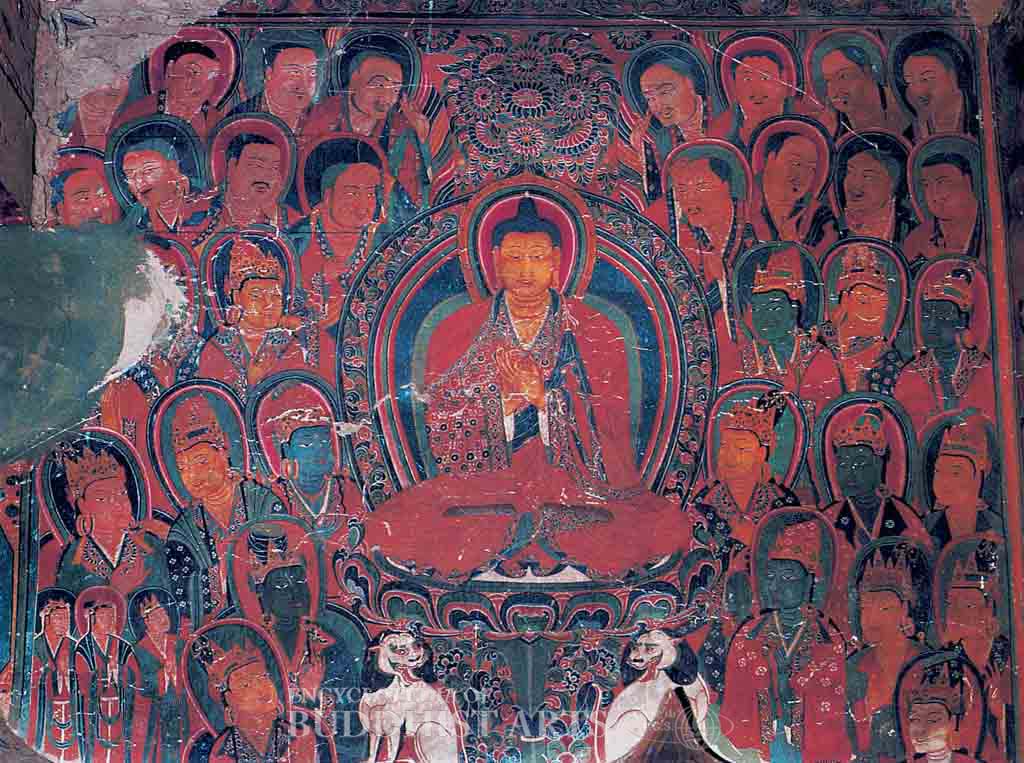
Dratang Monastery Central Hall Murals: Inner Shrine - Buddha Teaching the Dharma (south wall, upper right side); Late 11th century; 176 x 246 cm
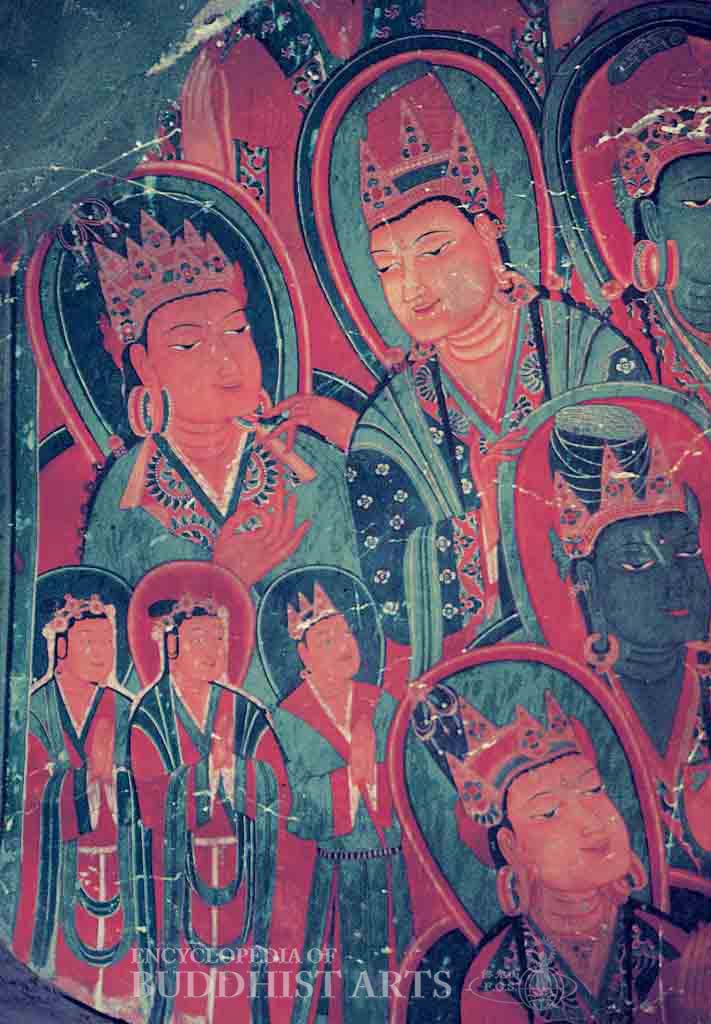
Dratang Monastery Central Hall Murals: Inner Shrine - Figures Making Offerings (south wall, upper right side); Late 11th century
Dratang Monastery Central Hall Murals
CHINA, Tibet, Lhoka
These murals are found at Dratang Monastery, which has been badly damaged, with only the central hall still remaining. This two story hall is composed of an entrance hall, an assembly hall, an inner shrine, and a circumambulation passage. The murals in the entrance hall, assembly hall, and circumambulation passage were restored during the regency of Reting Rinpoche. The inner shrine is decorated with late 11th century murals that cover over 90 percent of the walls. They are regarded as valuable examples of early Tibetan Buddhist art.
The upper and lower registers of the murals on the west wall of the inner shrine feature assemblies of beings listening to the teachings of the Buddha. The north and south walls have similar illustrations, with Sakyamuni Buddha depicted sitting in lotus position upon a lotus throne surrounded by his disciples, Bodhisattvas, and figures making offerings. The Buddha figure is relatively large in size, with an oval-shaped face topped with a usnisa and hands that form the vitarka (teaching) mudra. The Buddha wears a robe and brown boots ornamented with circular floral patterns. The nimbus and the aureole have multiple layers. The nimbus is bordered by flames, and vine-like decorations are painted within the outer ring of the aureole. The lotus throne has detailed petals and is guarded by a pair of snow lions. Above the Buddha, there is a small tree bursting with patterns of flowers.
The surrounding figures have orange, yellow, green, or brown skin. They wear red and green Tibetan clothing and elaborate accessories. Smooth lines are used to portray the figures, who are depicted in a style similar to that of Indian Pala period (circa 8th–12th century) paintings, with high-bridged noses, deep set eyes, and red lower lips and palms. In the upper right section of the mural on the south wall, there are three smaller smiling donor figures standing in profile facing towards the Buddha. The crowned figure has a blue nimbus; behind him are two female figures wearing floral headdresses. The mural is dominated by red and green tones and features vivid portrayals of the individual figures.
For more details, go to the Encyclopedia of Buddhist Arts: Painting A-H, page 198.
Cite this article:
author = Hsingyun and Youheng and Youlu and Wilson, Graham and Manho and Mankuang and Huntington, Susan,
booktitle = {Encyclopedia of Buddhist Arts: Painting A-H},
pages = 198,
title = {{Dratang Monastery Central Hall Murals}},
volume = 14,
year = {2016}}