
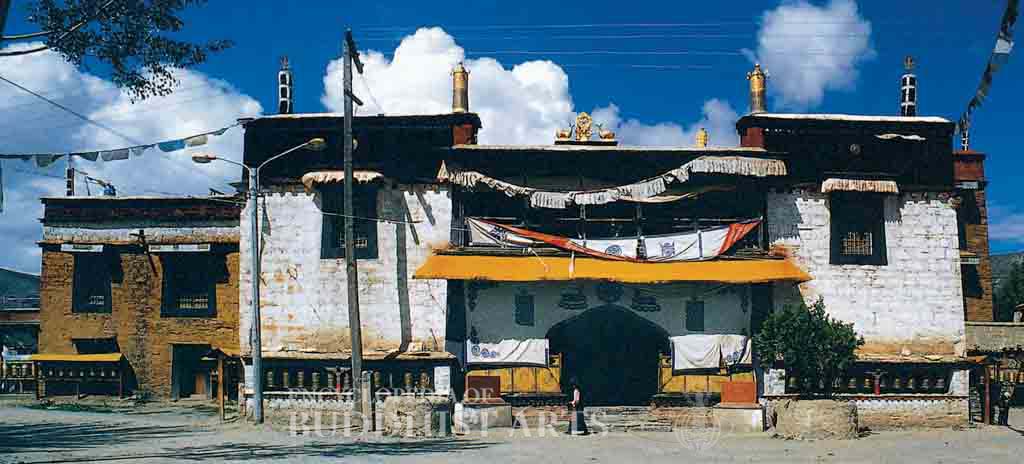
Dratang Monastery: Central Hall
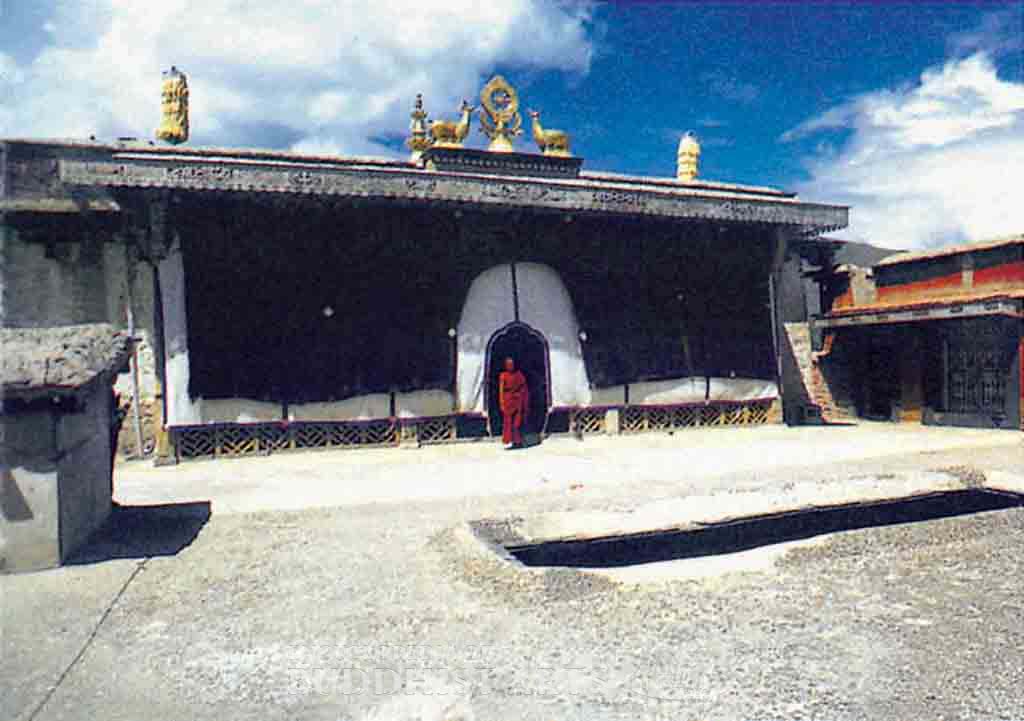
Dratang Monastery: Central Hall - Second Story
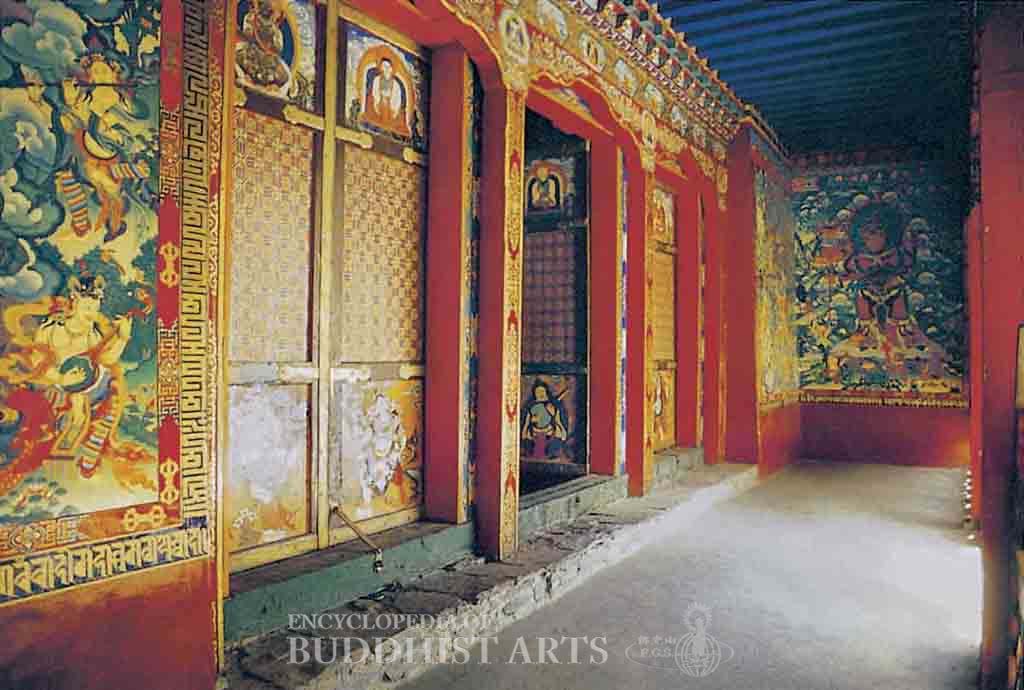
Dratang Monastery: Central Hall - Second Story
Dratang Monastery
CHINA, Tibet, Lhoka
The monastery was built in 1081 by Drapa Ngonshe, who founded the Drapa School. The monastery came under the Sakya school in the middle of the 13th century. It has been damaged and repaired a number of times throughout its history. It was listed as a National Cultural Heritage Site in 1996.
The temple was built according to the layout of a mandala and had three surrounding walls. However, only the elliptical outer wall, which is 750 m in circumference, remains intact. Both the prayer wheel path and the courtyard have been destroyed, and only the central hall remains.
The two-story central hall faces east with an entrance hall at the front and the assembly hall at the rear. Behind the assembly hall there is an inner shrine with a circumambulation passage. The murals along the entrance hall, the assembly hall and the circumambulation passage were renovated and repainted during the rule of Jamphel Yeshe Gyaltsen (reigned 1934–1941). Apart from the addition and replacement of columns and the removal of sculptures in recent years, the assembly hall is generally well-preserved, with murals filling the entire hall. These provide a rare glimpse of Buddhist art of the 15th century, before the rise of the Gelug school.
There are murals on the south, north, and west walls of the inner shrine, covering more than 90 percent of the walls with a total of ten paintings. Each painting is composed with a seated Sakyamuni Buddha in the center, flanked by Bodhisattvas, disciples, and figures paying respect to the Buddha. The spaces between the figures are filled with flowers and grasses. The colors of these paintings have faded. The works of art preserved at the monastery are important sources for the study of murals, foreign influences, and costumes of Tibet.
For more details, go to the Encyclopedia of Buddhist Arts: Architecture A-F, page 252.
Cite this article:
author = Hsingyun and Youheng and Johnson, Peter and Mankuang and Lancaster, Lewis,
booktitle = {Encyclopedia of Buddhist Arts: Architecture A-F},
pages = 252,
title = {{Dratang Monastery}},
volume = 1,
year = {2016}}