
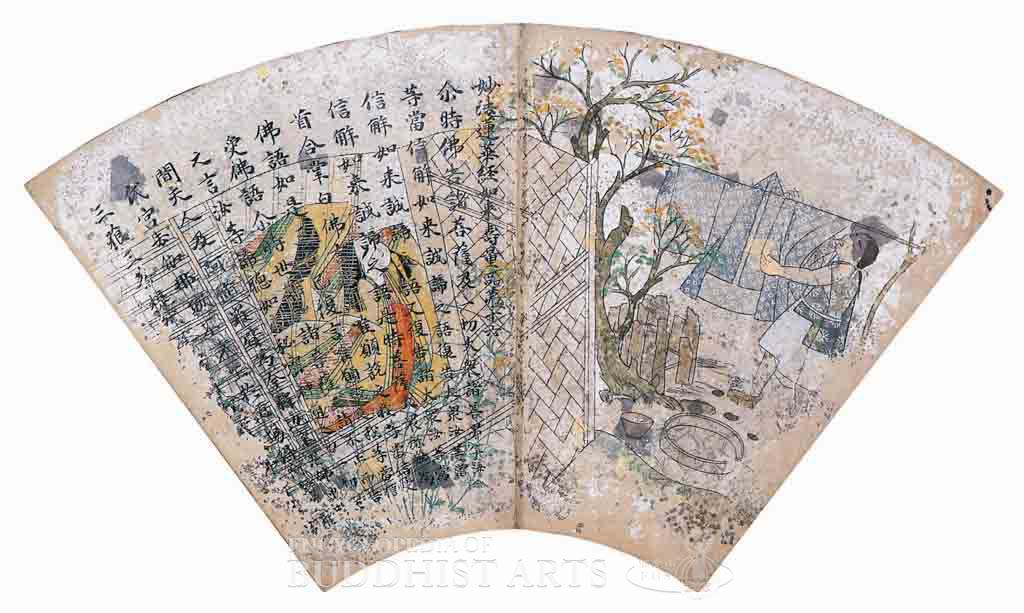
Shitennoji Temple: Fan-Shaped Booklets of the Lotus Sutra - Fascicle 6 - Page 1
Ink and color on paper
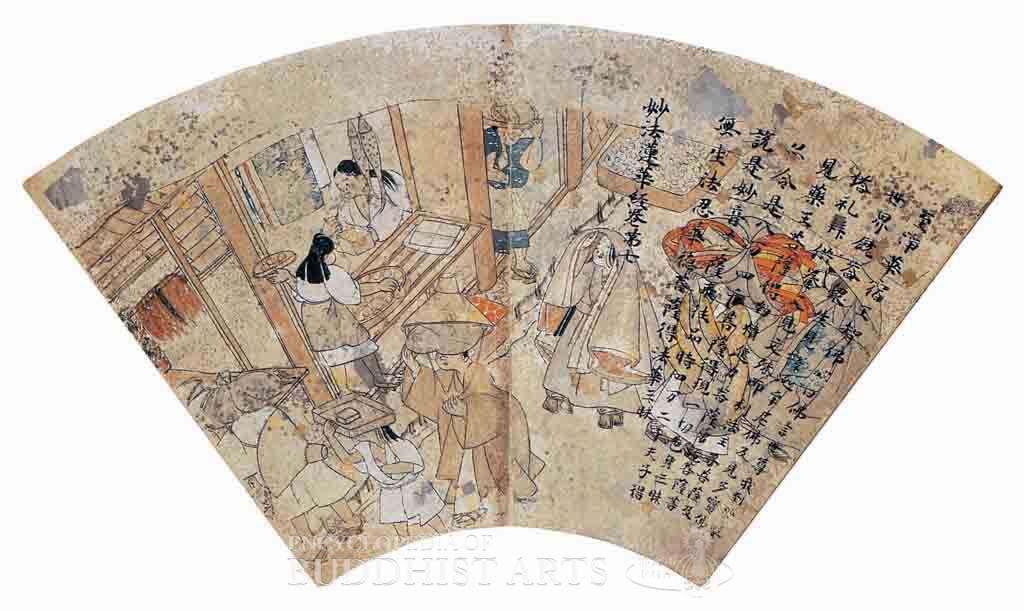
Shitennoji Temple: Fan-Shaped Booklets of the Lotus Sutra - Fascicle 7 - Page 11
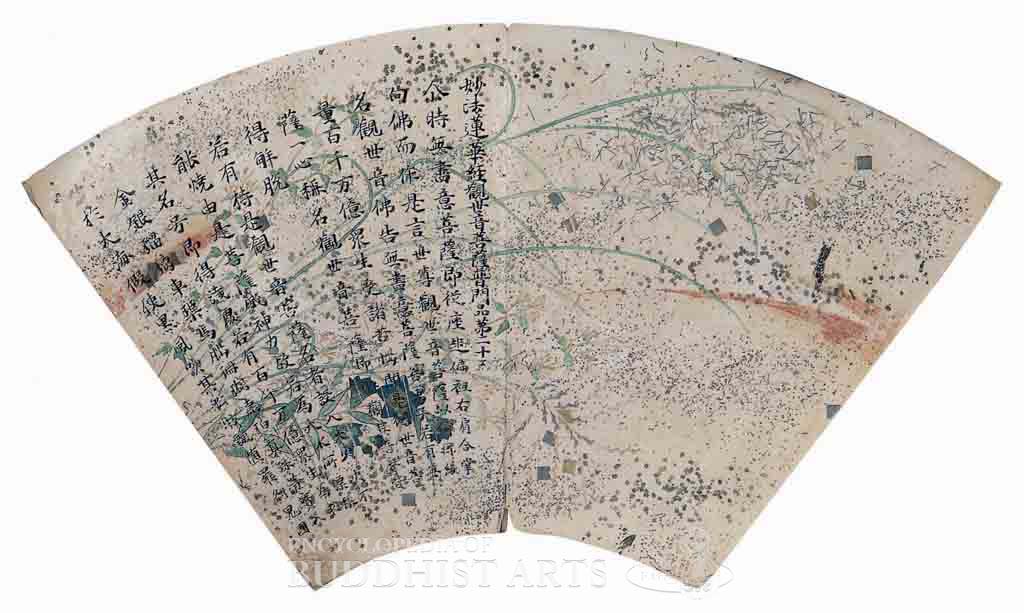
Shitennoji Temple: Fan-Shaped Booklets of the Lotus Sutra - Fascicle 8 - Page 1
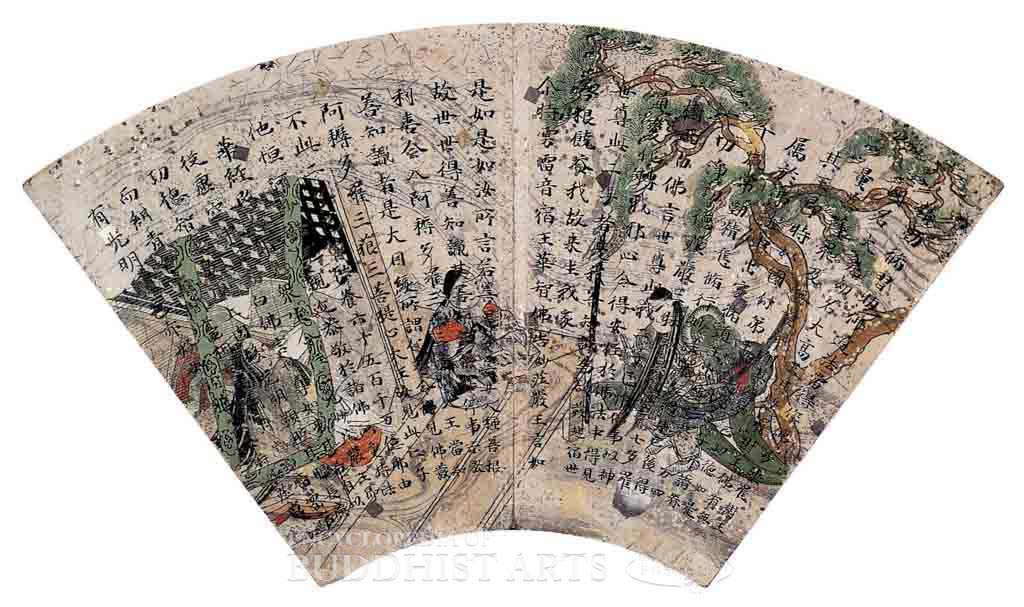
Shitennoji Temple: Fan-Shaped Booklets of the Lotus Sutra - Fascicle 8 - Page 7
Shitennoji Temple: Fan-Shaped Booklets of the Lotus Sutra
JAPAN, Osaka; Heian period
Known as the Senmen Koshakyo, this is a set of ten fan-shaped illustrated booklets made in the 12th century. During the Heian period (794–1185), the Lotus Sutra was highly venerated, and it was fashionable for nobles seeking spiritual protection to transcribe the sutra onto fans made of refined paper and adorned with decorative finishes. In this set, the Lotus Sutra fills eight of the ten booklets, while the Sutra of Innumerable Meanings and the Samantabhadra Meditation Sutra are each written in one booklet, serving as the introductory and final fascicles respectively. Five of the booklets, including Fascicles 1, 6, and 7 of the Lotus Sutra, the Sutra of Innumerable Meanings, and the Samantabhadra Meditation Sutra, are kept at Shitennoji Temple in Osaka, while one book made up Fascicle 8 of the Lotus Sutra is kept in the Tokyo National Museum. These two collections were listed as National Treasures of Japan in 1951 and 1952.
The paintings on the fans are unrelated to the Sutra texts. Most of the illustrations portray the daily life of nobles and peasants, folk tales, flowers, birds, and scenery. They are done in Yamato painting style and are colored with mica powder and sprinkles of finely grounded gold, silver, and grains. The facial features of the figures are drawn using the hikime-kagihana (line for an eye, hook for a nose) technique, and their clothes are decorated with elegant patterns. On each page, the sutra text is written in grids of 24 columns and 17 rows marked with thin bamboo pieces attached to the back of the page. A booklet was made by folding the fan-shaped pages in half and binding several of them together.
For more details, go to the Encyclopedia of Buddhist Arts: Painting P-Z, page 827.
Cite this article:
author = Hsingyun and Youheng and Youlu and Wilson, Graham and Manho and Mankuang and Huntington, Susan,
booktitle = {Encyclopedia of Buddhist Arts: Painting P-Z},
pages = 827,
title = {{Shitennoji Temple: Fan-Shaped Booklets of the Lotus Sutra}},
volume = 16,
year = {2016}}