
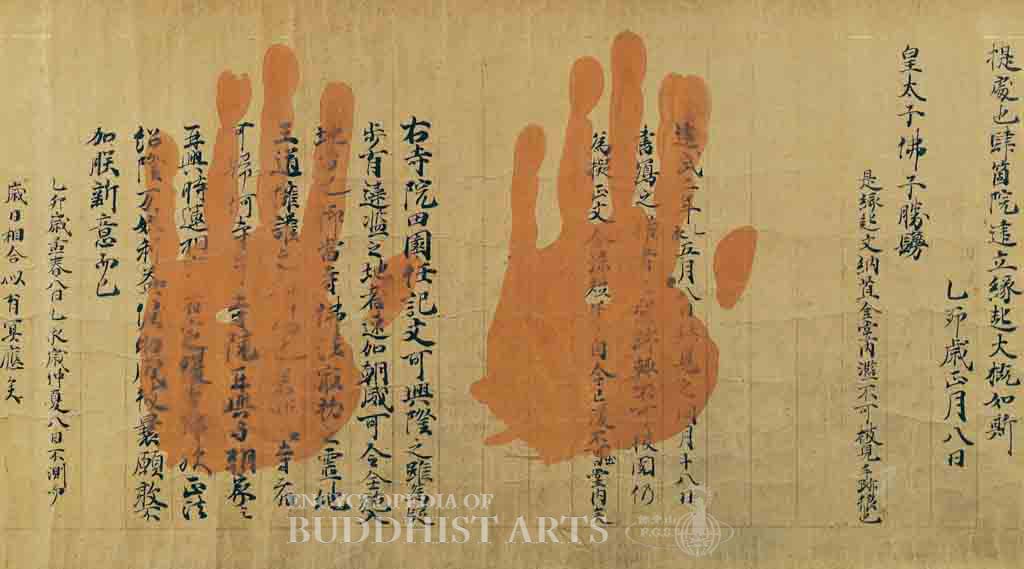
Imperial Letter by Emperor Go-Daigo; Kamakura period, dated 1335
Ink on paper
Emperor Go-Daigo
JAPAN, Kyoto; Kamakura period
Emperor Go-Daigo (reigned 1318–1339), whose original name was Takaharu, was the 96th Emperor of Japan. He was the son of Emperor Go-Uda (reigned 1274–1287) of the Kamakura period. A renowned reformer of the Japanese feudal government, his administration and policies were not favored by the ruling Shogunate, and he was exiled to a deserted island in Oki (present day Shimane). With help from the Muromachi Shogunate generals Ashikaga Takauji and Nitta Yoshisada, Emperor Go-Daigo escaped from exile in 1333. Upon returning to Kyoto, he continued to initiate restoration efforts and worked tirelessly to implement a civilian government before passing away at the age of 52.
A devout Buddhist, Emperor Go-Daigo was well-versed in the teachings of Vajrayana Buddhism. His calligraphy was greatly influenced by his religious beliefs, as well as the styles of Emperor Go-Uda and Master Kukai. His works were stylish and expressed the dignified style of Song Chinese calligraphy.
Emperor Go-Daigo’s legacy of calligraphic works include Credentials Conferred by Master Kukai, kept at Daigoji Temple in Kyoto; Imperial Letter by Emperor Go-Daigo, kept at the Shitennoji Temple in Osaka, and Will and Testament by Emperor Go-Daigo, kept at Daitokuji Temple. Also, several copies of his edict still exist. The edict features a calligraphic style that is vigorous and forceful, in addition to providing valuable historical information regarding the emperor’s reasons for following Buddhism and for persevering in his ideals on government and ruling.
For more details, go to the Encyclopedia of Buddhist Arts: People, page 55.
Cite this article:
author = Hsingyun and Youheng and Youlu and Pokorski, Stefanie and Yichao and Mankuang and Miaohsi,
booktitle = {Encyclopedia of Buddhist Arts: People },
pages = 55,
title = {{Emperor Go-Daigo}},
volume = 19,
year = {2016}}