
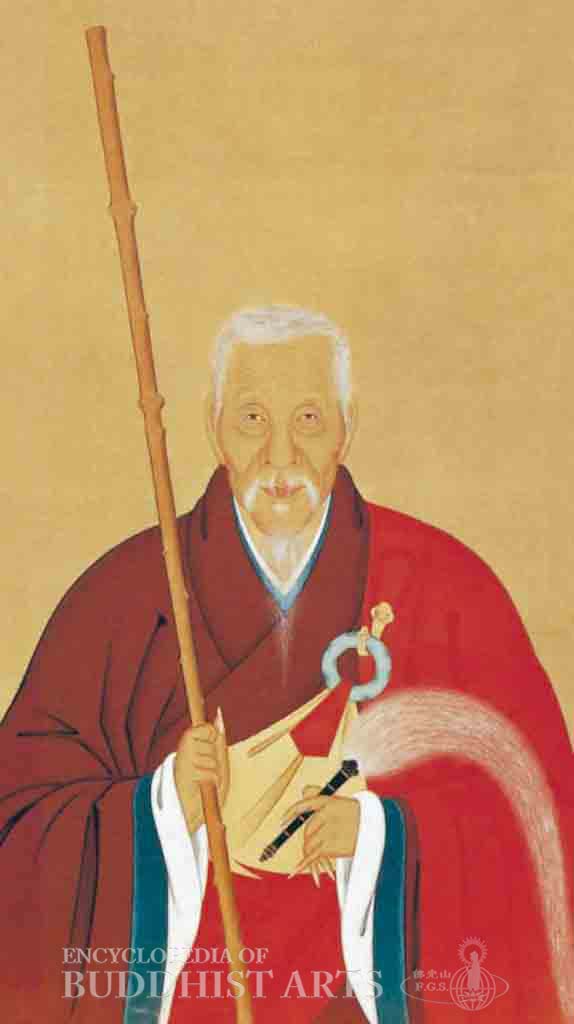
Master Yinyuan Longqi by Kita Genki; Edo period, dated 1671
Ink and color on silk
Kita Genki
JAPAN, Kagoshima; Edo period
Kita Genki was a figurative painter of the Obaku school from Satsuma (present day Kagoshima). He learned to paint from his father Kita Doku, and subsequently inherited his father’s career. Between mid-17th and early 18th century, he was based in Nagasaki and traveled between Edo (present day Tokyo), Aichi, and Manpukuji Temple in Kyoto.
Kita painted mainly religious figures, and he particularly enjoyed depicting the Three Brushes of Obaku, which was comprised of Chan masters Yinyuan Longqi, Mu’an Xingtao, and Jifei Ruyi; three eminent monastic calligraphers in Japan. He was greatly influenced by the style of Western paintings and thus his depictions were realistic and vibrant with rich colors, showing special attention to the shadows on the faces and clothing. Kita employed the unique “boneless” method of painting without first rendering outlines, yet his portraits were still accurate and realistic. His style of painting was immensely influential in Japan.
Over 200 pieces of Kita’s paintings are extant. These include three separate portraits of Three Brushes of Obaku, his earliest works painted in 1663 and currently collected at Ryuoji Temple in Nara. Another set of paintings with the same figures is kept at Horinin Temple in Kyoto. Kita also portrayed Master Yinyuan Longqi alongside his teachers, Miyun Yuanwu and Feiyin Tongrong. This set of paintings, in addition to yet another painting of Master Yinyuan Longqi, are listed as Important Cultural Properties of Japan and kept at Manpukuji Temple in Kyoto.
For more details, go to the Encyclopedia of Buddhist Arts: People, page 140.
Cite this article:
author = Hsingyun and Youheng and Youlu and Pokorski, Stefanie and Yichao and Mankuang and Miaohsi,
booktitle = {Encyclopedia of Buddhist Arts: People },
pages = 140,
title = {{Kita Genki}},
volume = 19,
year = {2016}}