
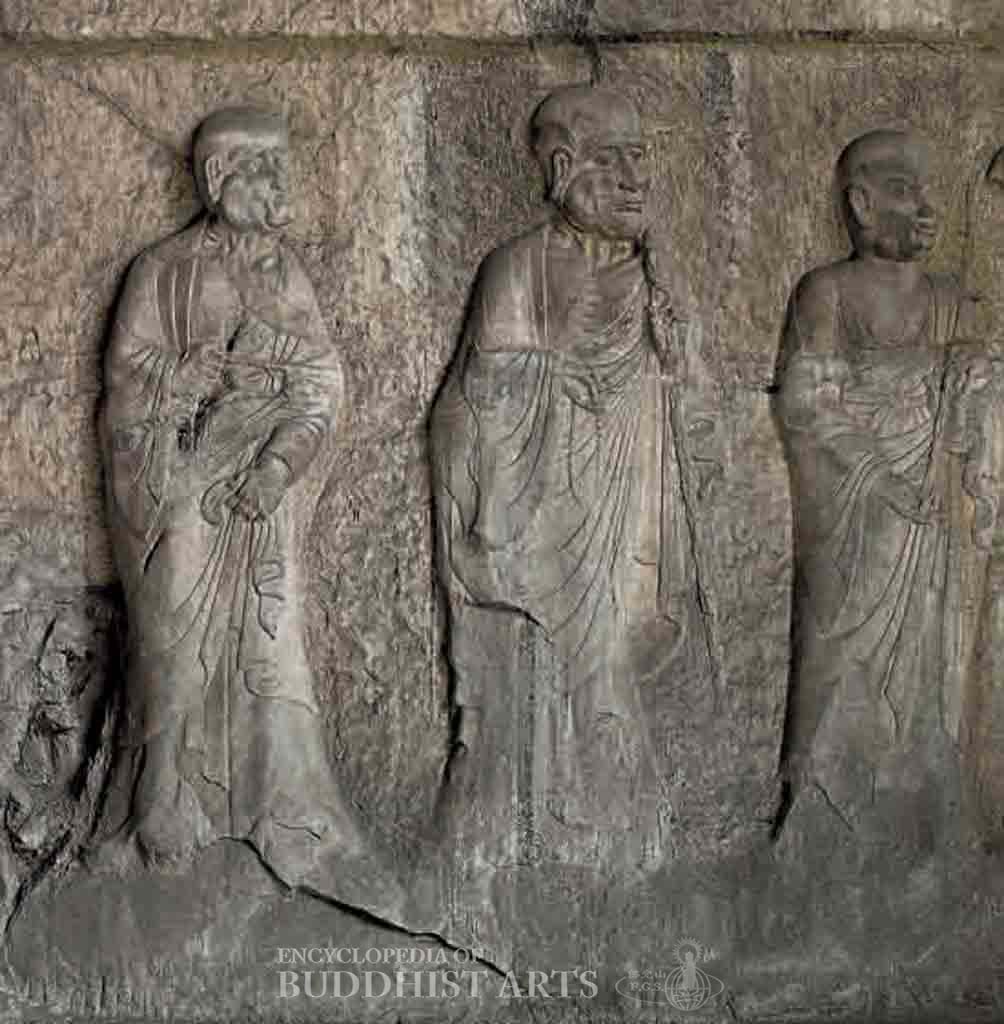
Longmen Grotto 2194: Arhats - Ananda, Madhyantika, and Sanakavasa (south wall)
Stone
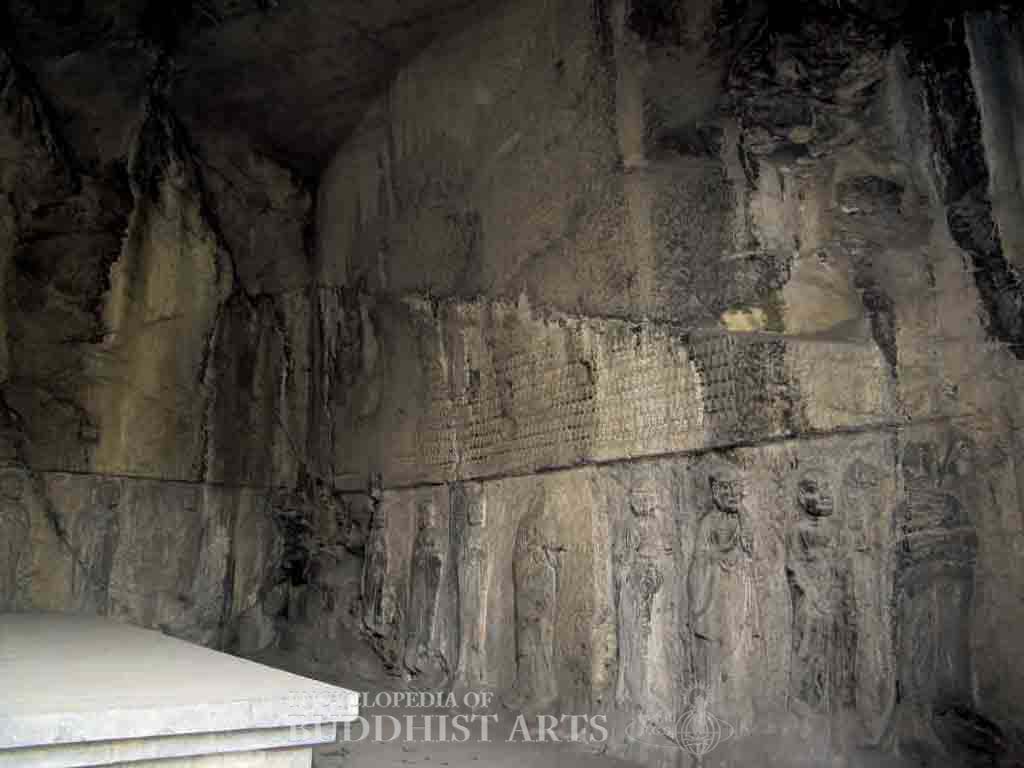
Longmen Grotto 2194: Arhats (south wall)
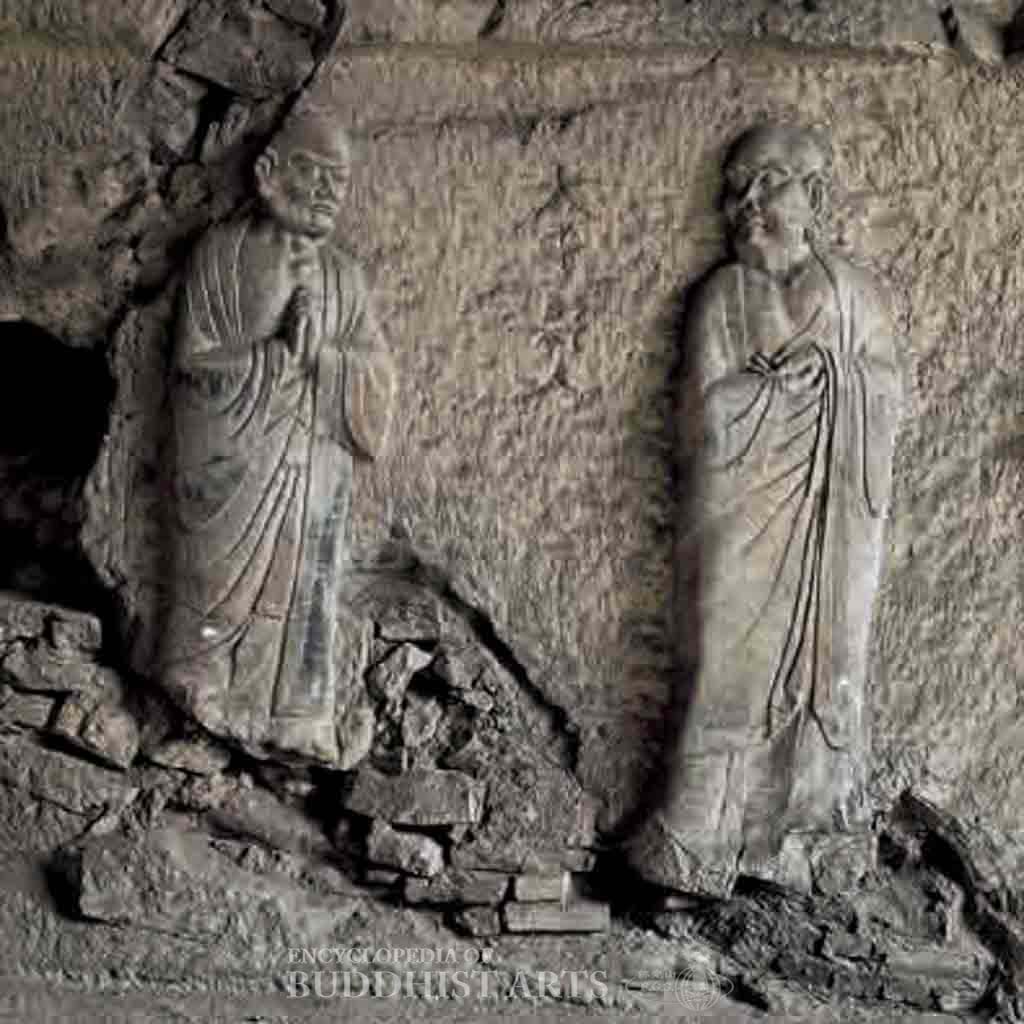
Longmen Grotto 2194: Arhats - Mikkaka and Buddhanandi (south wall)
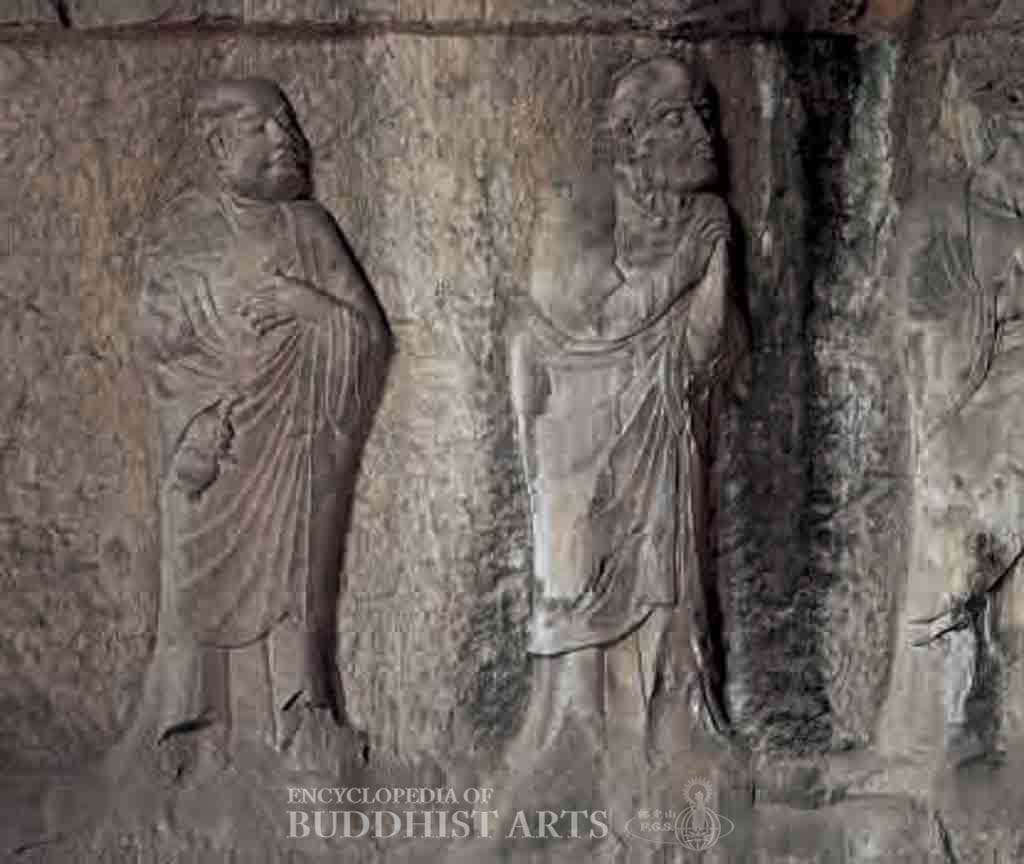
Longmen Grotto 2194: Arhats - Upagupta and Vasumitra (north wall)
Longmen Grotto 2194: Arhats
CHINA, Henan, Luoyang; Tang dynasty
Twenty-nine Arhats are carved in relief on the lower walls of this grotto, eleven on the back (east) wall and nine on each of the north and south walls. The images, approximately 1.8 m in height, differ in facial features, postures, and expressions. Prized as exceptional works of the Tang dynasty, the figures are thought to depict the Twenty-Nine Patriarchs from India as chronicled in Buddhist scriptures such as the Record of the Dharma Jewel Through the Generations and the Account of the Causes and Conditions of the Dharma-Treasury Transmission.
The Arhats wear monastic robes with long, loose sleeves, which either cover both shoulders or bare the right shoulder. On the far right of the south wall, only remnants of an Arhat’s hands holding a lotus flower remain. The second Arhat from the right is depicted as a young monk with delicate features who holds a lotus stem before his chest. These two Arhats likely depict Mahakasyapa and Ananda. The third figure, thin and slightly hunchbacked, is thought to be the elder Madhyantika, who holds a monk’s staff in the left hand and prayer beads in the right. The fourth Arhat, perhaps Sanakavasa, is depicted as a middle-aged monk who holds an object with the right hand in front of the chest while the left hand grasps the hem of his robe. The fifth Arhat, with a damaged head, is presumably Upagupta, who holds a sutra box in the left hand. The sixth Arhat, who holds prayer beads in front of the chest with both hands, is probably the elder Dhrtaka. The seventh Arhat has hands crossed before his chest and turns back as if in conversation with the eighth elder monk behind him, whose hands gesture a greeting. These two are thought to be Mikkaka and Buddhanandi. The ninth Arhat image is badly weathered and is likely Buddhamitra.
On the far right of the east wall is presumed to be Parsvika, who holds a jewel in the left hand and a handkerchief in the right. The second Arhat, probably Punyayasas, clasps his hands before the chest. The third is thought to be Asvaghosa, who grasps his robe’s hem with the left hand. The next two Arhats, with hands crossed before their chests, are presumed to be Kapimala and Nagarjuna. The sixth Arhat, Kanadeva, holds a handkerchief in the left hand and prayer beads in the right. The seventh Arhat, presumably Rahulata, holds a monk’s staff and turns around to converse with the eighth Arhat, probably Sanghanandi, who looks forward with chin raised and gestures with the left hand. The next is presumably Gayasata, who holds an incense burner in both hands, followed by the tenth Arhat, assumed to be Kumarata, who touches his chest and turns to converse with the eleventh Arhat, likely Jayata, who follows with a sutra box held in both hands.
On the north wall, the first Arhat on the right, probably Vasubandhu, holds a jewel while the second Arhat, likely Manorhita, holds one hand before his chest and grasps his robe with the other hand. The two both look back at the third Arhat, presumably Haklena, portrayed as an elder monk. The fourth Arhat, thought to be Arasimah, has a round face and stands facing to the side. The fifth Arhat, likely Basiasit, holds a sutra box and prayer beads, while the sixth Arhat, perhaps Upagupta, wears a robe that bares the right shoulder and holds his hands at the chest level. The seventh, assumed to be Vasumitra, touches his chest with one hand and holds a vase in the other. The eighth Arhat is probably Samgharaksa, who holds a sutra box in his left hand. The ninth and last Arhat is likely Bodhidharma, who holds a sutra box and wears a robe that bares the right shoulder.
For more details, go to the Encyclopedia of Buddhist Arts: Caves R-L, page 720.
Cite this article:
author = Hsingyun and Youheng and Johnson, Peter and Mankuang and Huntington, Susan and Edson, Gary and Neather, Robert,
booktitle = {Encyclopedia of Buddhist Arts: Caves R-L},
pages = 720,
title = {{Longmen Grotto 2194: Arhats}},
volume = 6,
year = {2016}}