
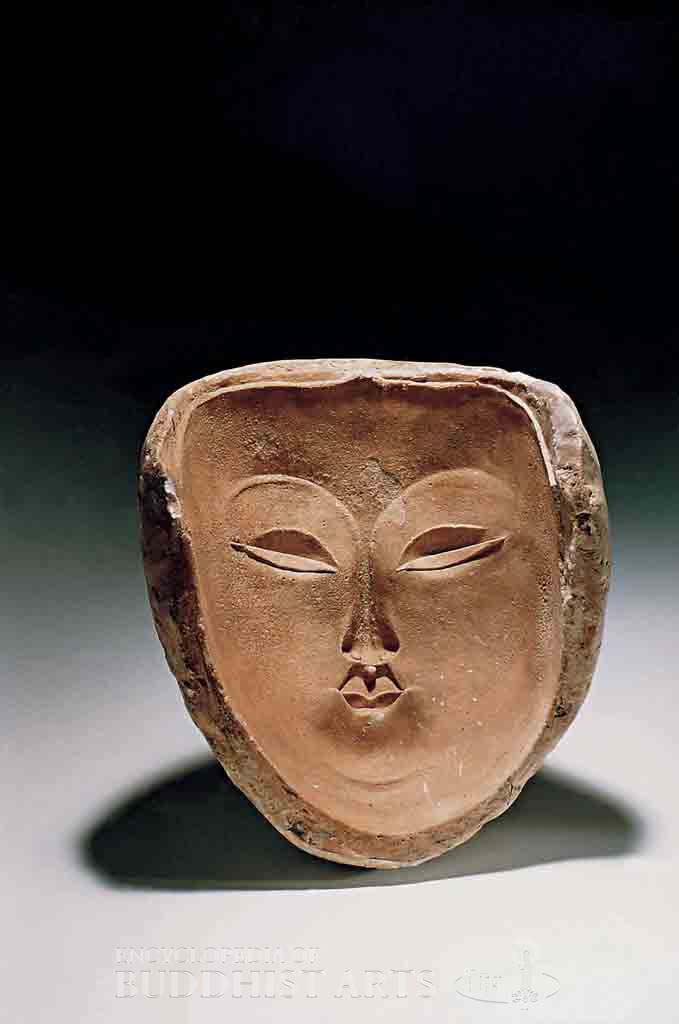
Duwa: Casting Molds - Facial Mold
Plaster
Duwa: Casting Molds
CHINA, Xinjiang, Hotan
This facial mold was among those discovered in 1980 in a region where their use in making religious statuary was common. Other molds for making ears and feet, as well as deer were also discovered. Semi-circular cylinders for applying patterns were also found. Most recovered pieces are made of plaster but some have clay added to increase their strength. A stone grinder was unearthed at the same time.
An urna rendered in the center of the forehead suggests the mold was used to produce Buddhas and other sacred figures in Buddhism.
For more details, go to the Encyclopedia of Buddhist Arts: Sculpture A-F, page 308.
Cite this article:
Hsingyun, et al. "Duwa: Casting Molds." Encyclopedia of Buddhist Arts: Sculpture A-F, vol. 10, 2016, pp. 308.
Hsingyun, Youheng, Yann Lovelock, Yuan Chou, Susan Huntington, Gary Edson, and Robert Neather. 2016. "Duwa: Casting Molds" In Encyclopedia of Buddhist Arts: Sculpture A-F, 10:308.
Hsingyun, Youheng, Lovelock, Y., Chou, Y., Huntington, S., Edson, G., & Neather, R.. (2016). Duwa: Casting Molds. In Encyclopedia of Buddhist Arts: Sculpture A-F (Vol. 10, pp. 308).
@misc{Hsingyun2016,
author = Hsingyun and Youheng and Lovelock, Yann and Chou, Yuan and Huntington, Susan and Edson, Gary and Neather, Robert,
booktitle = {Encyclopedia of Buddhist Arts: Sculpture A-F},
pages = 308,
title = {{Duwa: Casting Molds}},
volume = 10,
year = {2016}}
author = Hsingyun and Youheng and Lovelock, Yann and Chou, Yuan and Huntington, Susan and Edson, Gary and Neather, Robert,
booktitle = {Encyclopedia of Buddhist Arts: Sculpture A-F},
pages = 308,
title = {{Duwa: Casting Molds}},
volume = 10,
year = {2016}}