
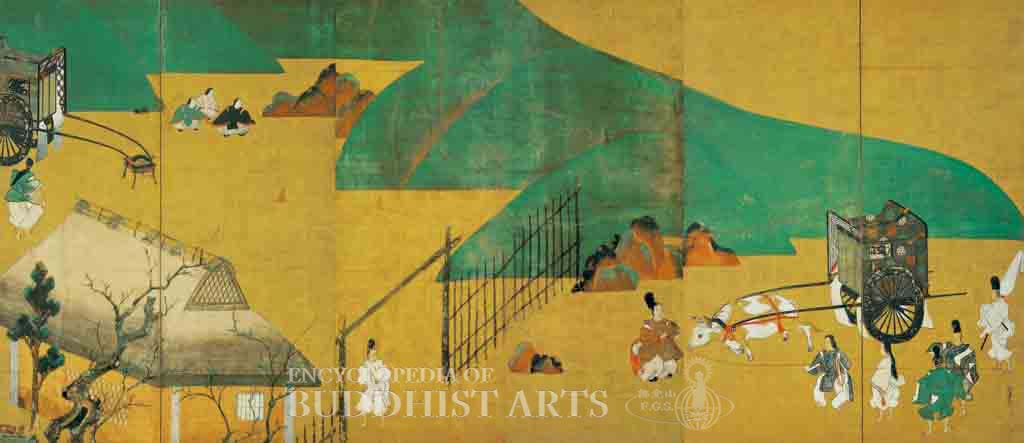
Gatehouse by Tawaraya Sotatsu; Edo period
Color on gold paper
Tawaraya Sotatsu
JAPAN, Kyoto; Momoyama to Edo period
Tawaraya Sotatsu was an artist who was also known as Sotatsu Nonomura or Tiaseiken. He was often in the company of prominent individuals such as court noble Mitsuhiro Karasuma, Japanese Tea Ceremony master Sen Shoan, and the well-known artist, Honami Koetsu.
The establishment of a painting shop in Kyoto named after himself marked the first step in Tawaraya’s career in art. At his studio, he concentrated on fan-painting and creating new paper materials for paintings and scripting of poems. He later devoted his efforts to screen painting and his works were noted by unique compositions with gold leaf backgrounds and colorful paints. This particular style became a new trend in decorative painting and developed into the Rin school style. Tawaraya was also proficient in ink painting using the Chinese technique known as “boneless,” where images were painted without an outline. In 1630, he received an imperial edict from Emperor Go-Mizunoo (reigned 1611–1629) of the Edo period to paint three sets of gold double-panel screens. During the same year, he replicated a mural entitled Tales of Saigyo from the palace. From his signed works, it is known that he had achieved the level of a Hokkyo (Dharma Bridge), the third highest rank for Buddhist artists.
Tawaraya’s representative works, which are listed as National Treasures of Japan, include Wind Deity and Thunder Deity painted on a pair of screens kept at Kenninji Temple in Kyoyo; Waterfowls in a Lotus Pond, collected at the Kyoto National Museum; and Gatehouse and Channel Buoys of the Tale of Genji, painted on a pair of three panels screens currently kept at the Seikado Bunko Art Museum in Tokyo. In addition, White Elephant is kept at Yogenin Temple in Kyoto; Zen Master Choka is collected at the Cleveland Museum of Art in Ohio, USA; Ox Painting is kept at Chomyoji Temple in Kyoto; and Music and Dance, painted on a folding screen, is kept at Daigoji Temple in Kyoto, Japan.
For more details, go to the Encyclopedia of Buddhist Arts: People, page 257.
Cite this article:
author = Hsingyun and Youheng and Youlu and Pokorski, Stefanie and Yichao and Mankuang and Miaohsi,
booktitle = {Encyclopedia of Buddhist Arts: People },
pages = 257,
title = {{Tawaraya Sotatsu}},
volume = 19,
year = {2016}}