
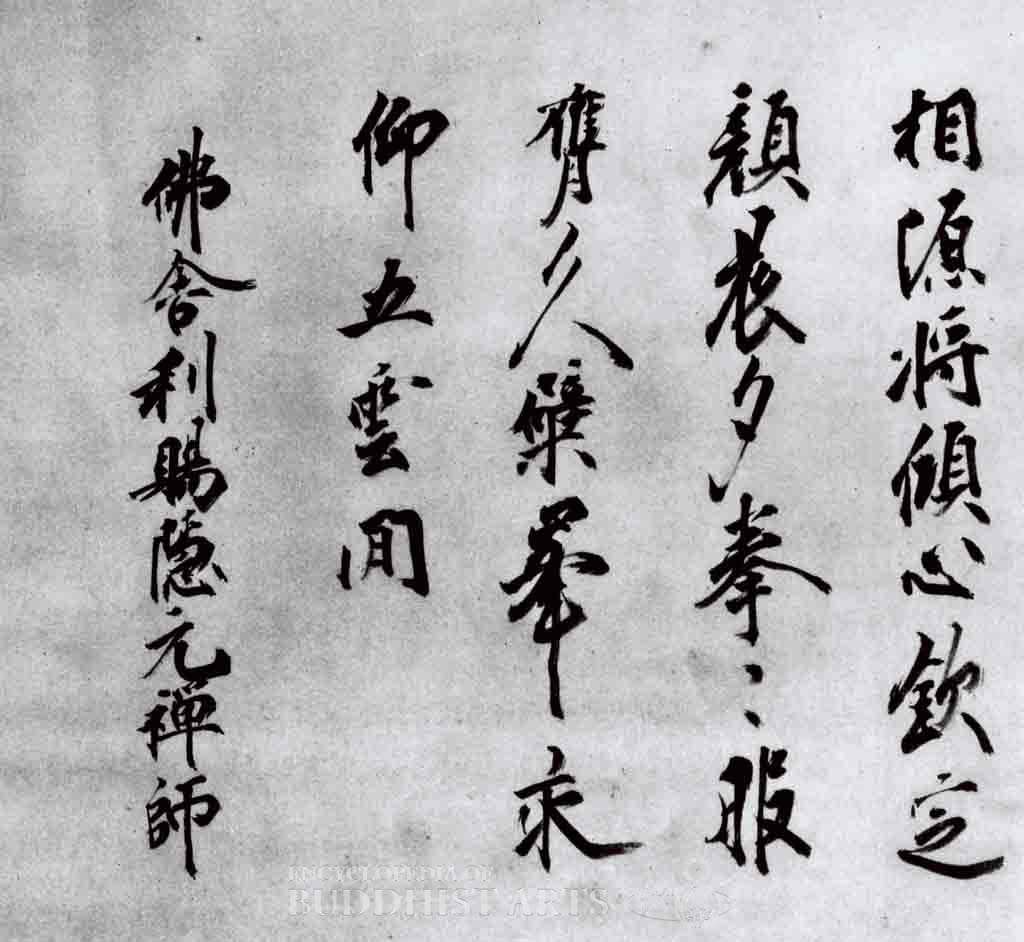
Dedication of Relics to Master Yinyuan Longqi by Emperor Go-Mizunoo (detail); Edo period, dated 1669
Ink on paper
Emperor Go-Mizunoo
JAPAN, Kyoto; Edo period
Emperor Go-Mizunoo (reigned 1611–1629), also known as Tadahito or Kotohito, was the 108th emperor of Japan. However, because of the oppressive imperial system at the time, he abdicated his position in 1629. His then seven year old daughter Princess Okiko succeeded to the throne and became Empress Meisho (reigned 1629–1643).
Emperor Go-Mizunoo was dedicated to the spread of knowledge, technology, and art, and often organized various cultural activities. Under the style name Gyokuro, he authored many poems and songs such as Seagull Nest Collection. He also established the Shugakuin Rikyu at Rakuhoku (present day northern Kyoto), which is one of the few well-known pieces of landscape architecture in Japan. After taking refuge in Buddhism, he extremely admired Zen Master Ichimonji, under whom he renounced in 1651. His calligraphic work, Dedication of Relics to Master Yinyuan Longqi collected in the Shoindo Hall of Manpukuji Temple, shows expertise of his skills.
For more details, go to the Encyclopedia of Buddhist Arts: People, page 56.
Cite this article:
author = Hsingyun and Youheng and Youlu and Pokorski, Stefanie and Yichao and Mankuang and Miaohsi,
booktitle = {Encyclopedia of Buddhist Arts: People },
pages = 56,
title = {{Emperor Go-Mizunoo}},
volume = 19,
year = {2016}}