
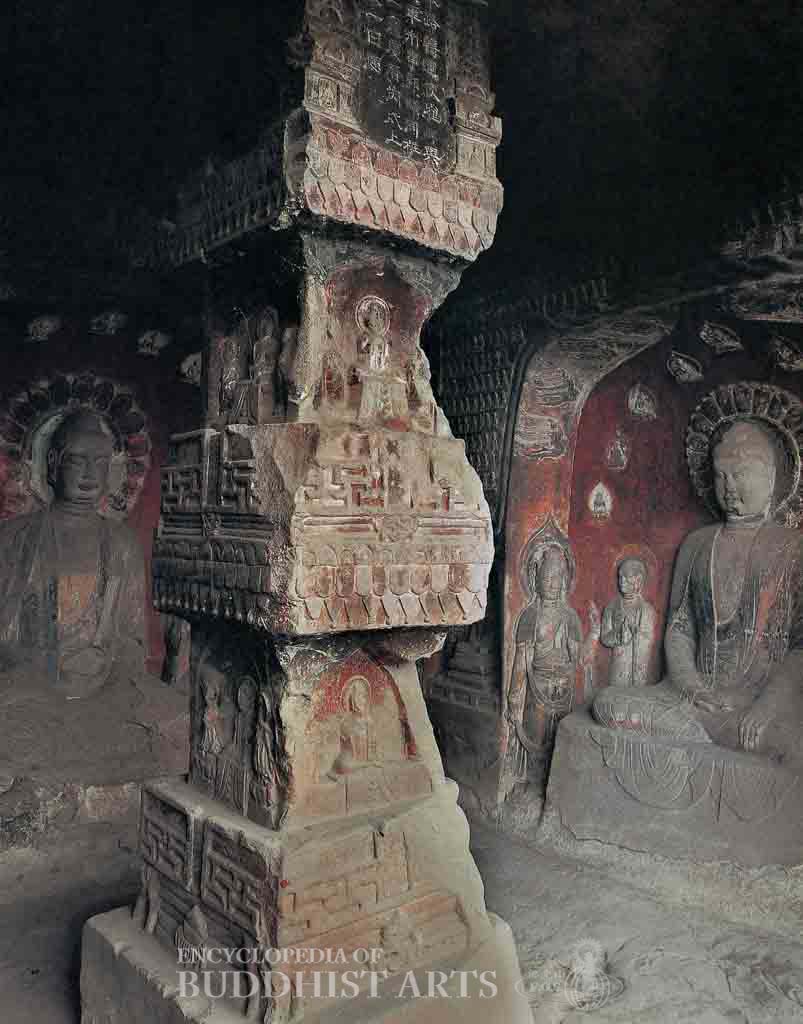
Guangyuan Huangze Temple Cave 45
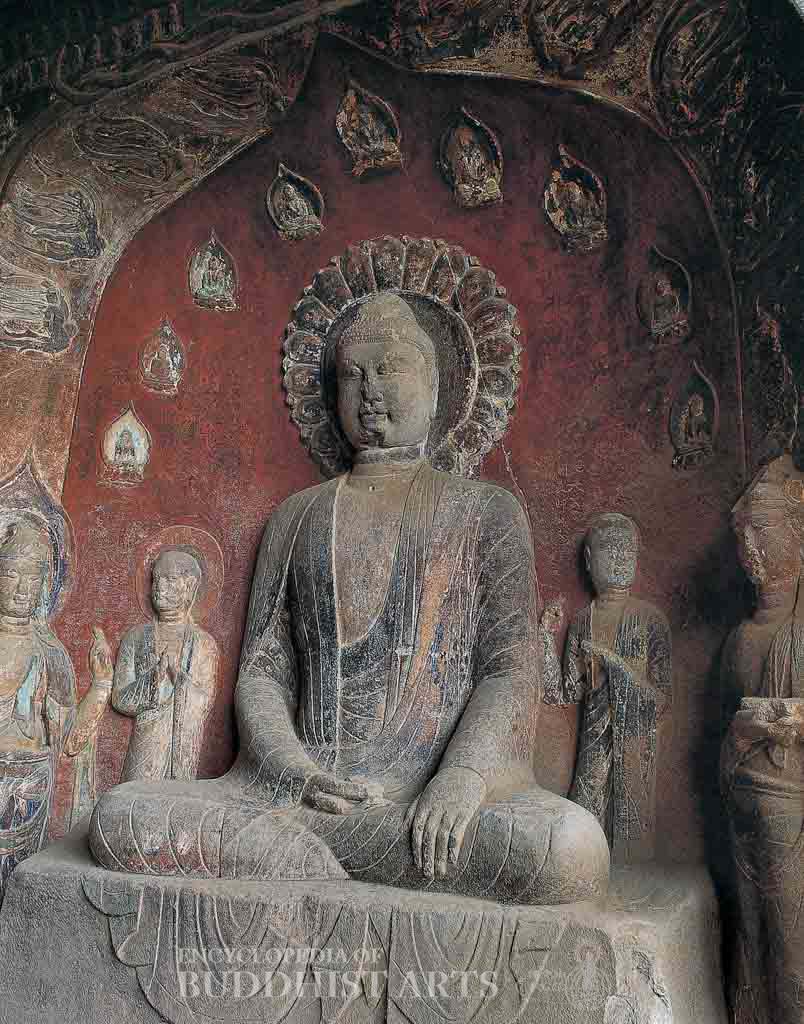
Guangyuan Huangze Temple Cave 45: Buddha Niche (right wall)
Guangyuan Huangze Temple Cave 45
CHINA, Sichuan, Guangyuan
Located to the south of the Great Buddha Building, this square central pillar cave was constructed during the Western Wei (535–556) and Northern Zhou (557–581) dynasties. It was the first cave to be constructed at the site. There are a total of 851 figures carved on the walls of the cave. Some of the small niches were added by later generations.
The cave measures 2.85 m wide, 2.56 m high, and 2.9 m deep. The central pillar is carved in the shape of a pagoda, with six-tusked white elephants at each of the bottom corners. The pillar has two tiers, each designed with a platform surrounded by railings. Niches are located above the platforms on each side of the pillar. There are reliefs of decorative curtains above each niche, while the very top of the pillar is decorated with mountains, flowers, inscriptions, and the stacked rings of a spire. Three walls of the caves are sculpted with niches containing large seated Buddhas with attendant Bodhisattvas and disciples. Each of the Buddhas sits in full lotus position on a rectangular throne with a lotus-patterned nimbus behind their head, surrounded by nine small Buddha images. The niche lintels are carved with a design featuring intertwining dragons, with apsaras above them. Reliefs of the Thousand Buddhas are carved on the walls outside the niches.
For more details, go to the Encyclopedia of Buddhist Arts: Caves R-L, page 401.
Cite this article:
author = Hsingyun and Youheng and Johnson, Peter and Mankuang and Huntington, Susan and Edson, Gary and Neather, Robert,
booktitle = {Encyclopedia of Buddhist Arts: Caves R-L},
pages = 401,
title = {{Guangyuan Huangze Temple Cave 45}},
volume = 6,
year = {2016}}