
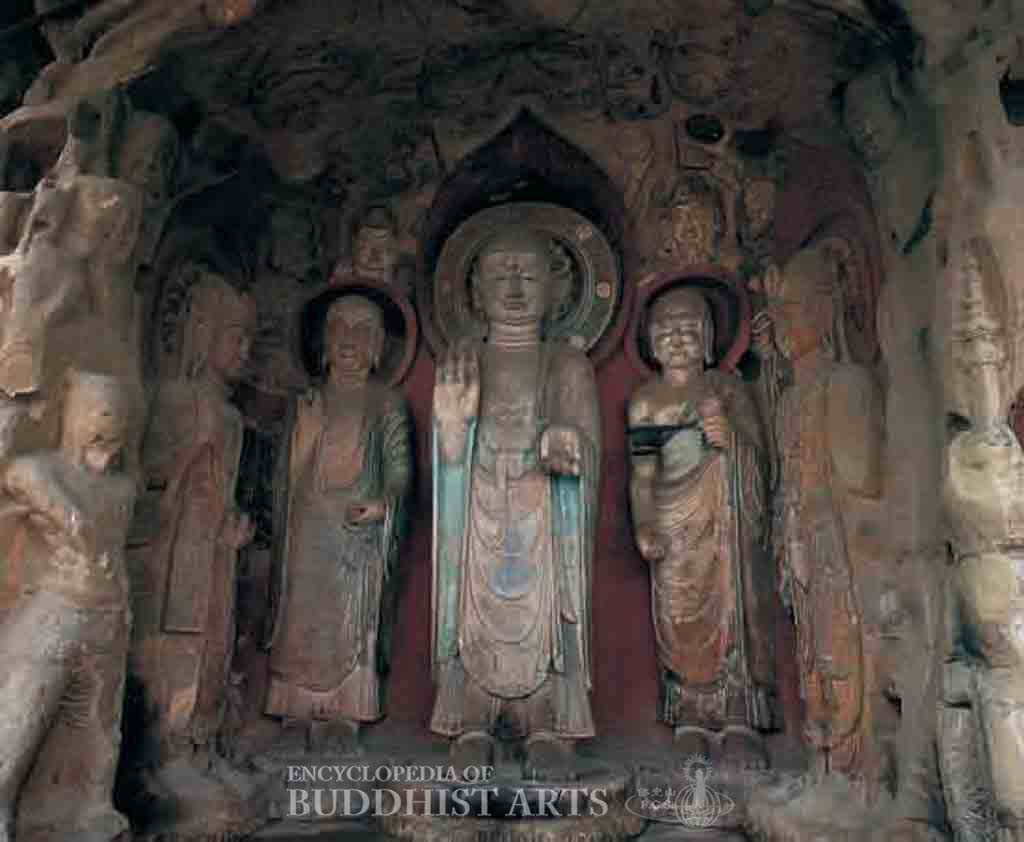
Guangyuan Huangze Temple Cave 28
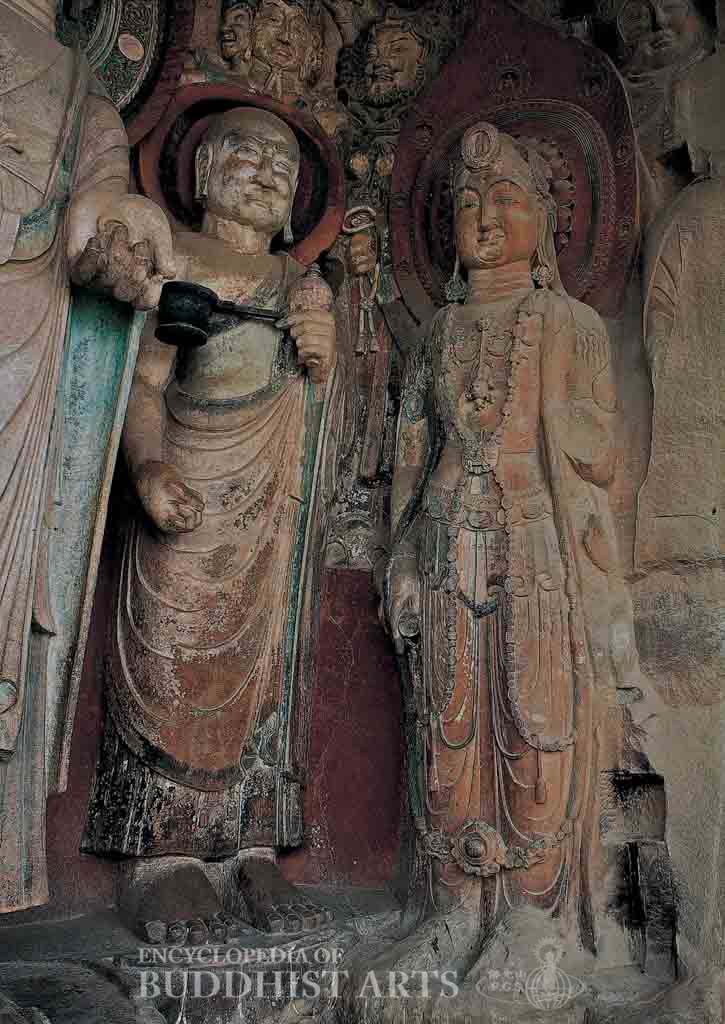
Guangyuan Huangze Temple Cave 28: Avalokitesvara Bodhisattva and Mahakasyapa
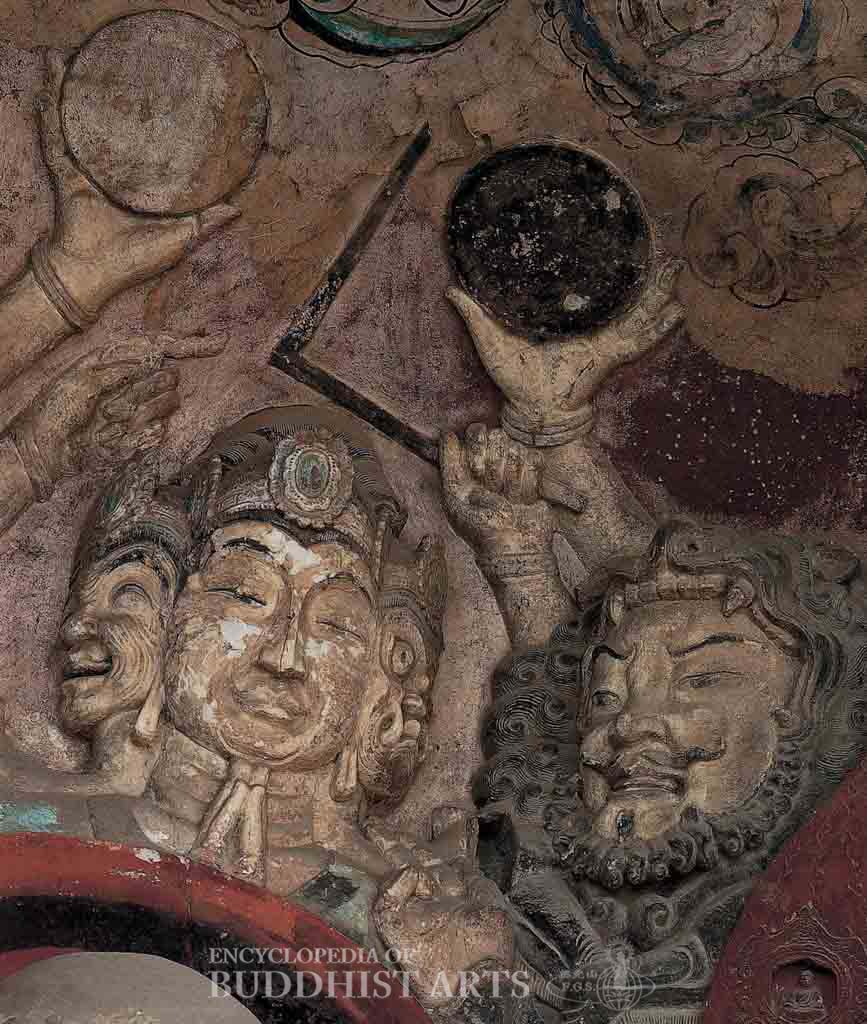
Guangyuan Huangze Temple Cave 28: Asura and Lion Deity
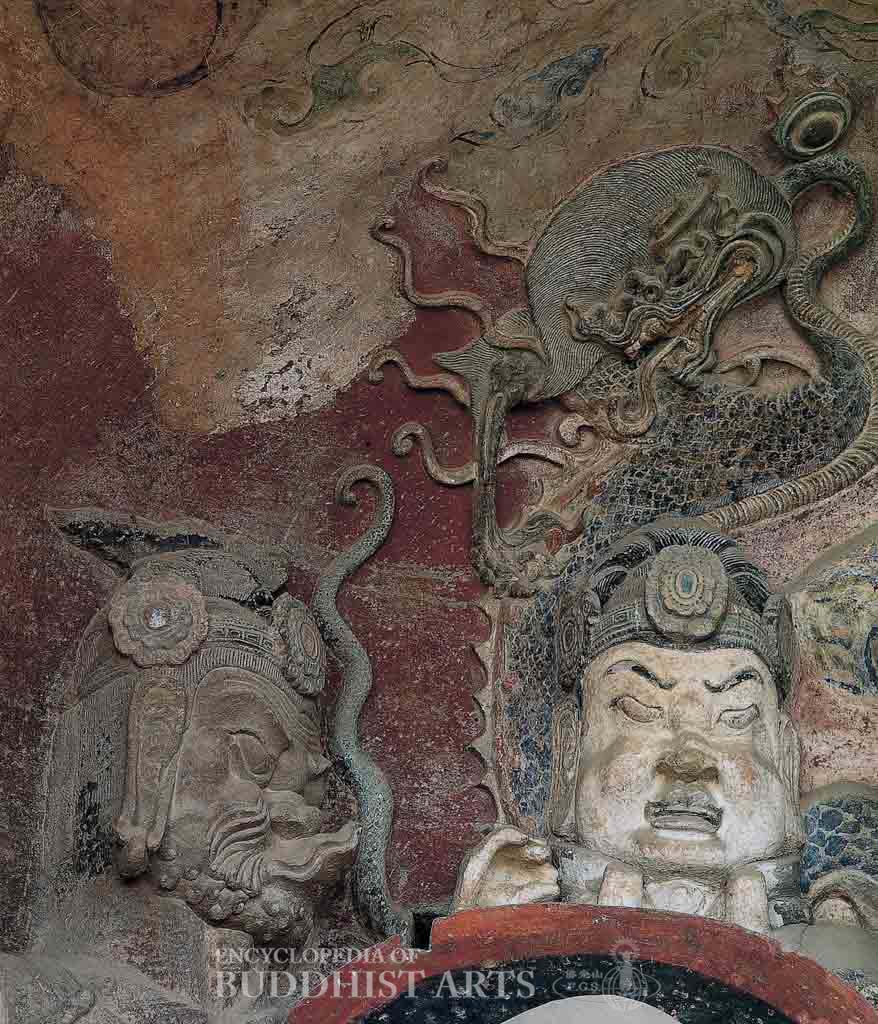
Guangyuan Huangze Temple Cave 28: Naga, Garuda, and Mahoraga (detail)
Guangyuan Huangze Temple Cave 28
CHINA, Sichuan, Guangyuan
Located in Great Buddha Building of Huangze Temple, this cave measures 5.85 m wide, 7 m high, and 3.6 m deep. It is known as the Great Buddha Cave, and is the largest cave in Huangze Temple. The carvings within it are representative of Early Tang period (618–712) sculptural art. The main statues in the cave include a Buddha, two disciples, and two Bodhisattvas, all standing on lotus pedestals. The walls are covered with the Eight Classes of Dharma Protectors, and the entrance is sculpted with two severely weathered warriors.
The central Buddha statue has a round face, tightly curled hair, an urna on the forehead, and a multi-layered nimbus behind the head. The Buddha wears long earrings, an inner robe tied at the waist, and an outer monastic robe. One hand holds a jewel while the other forms the abhaya (fearlessness) mudra. Flanking the Buddha are disciples Mahakasyapa and Ananda, holding an incense burner and prayer beads respectively. Beside the disciples, on the walls of the niche facing inwards, are Avalokitesvara and Mahasthamaprapta Bodhisattvas. They have long hair and wear lavish decorations including long, draped ornaments. Avalokitesvara Bodhisattva, who stands on the right, holds a vase. Mahasthamaprapta Bodhisattva, standing on the left, holds a jewel. There is a relief of a kneeling male donor at the bottom next to Ananda’s feet.
The Dharma protectors carved on the walls are vividly portrayed with unique appearances. They include: a three-headed, six-armed asura holding the sun and moon, a bearded lion deity with a crown of fangs, a naga, a garuda with the head of a bird, and a mahoraga with the body of a snake.
For more details, go to the Encyclopedia of Buddhist Arts: Caves R-L, page 399.
Cite this article:
author = Hsingyun and Youheng and Johnson, Peter and Mankuang and Huntington, Susan and Edson, Gary and Neather, Robert,
booktitle = {Encyclopedia of Buddhist Arts: Caves R-L},
pages = 399,
title = {{Guangyuan Huangze Temple Cave 28}},
volume = 6,
year = {2016}}