
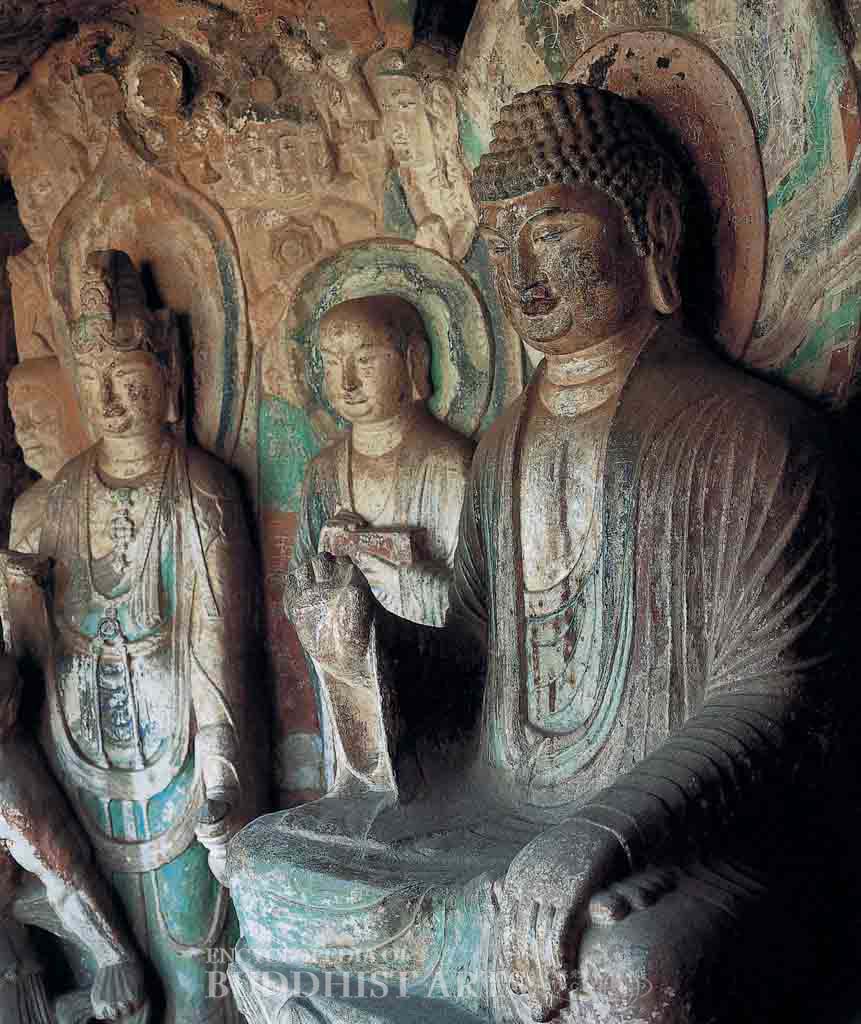
Guangyuan Thousand Buddha Cliff Rock Carvings Cave 689: Buddha, Ananda, and Bodhisattva
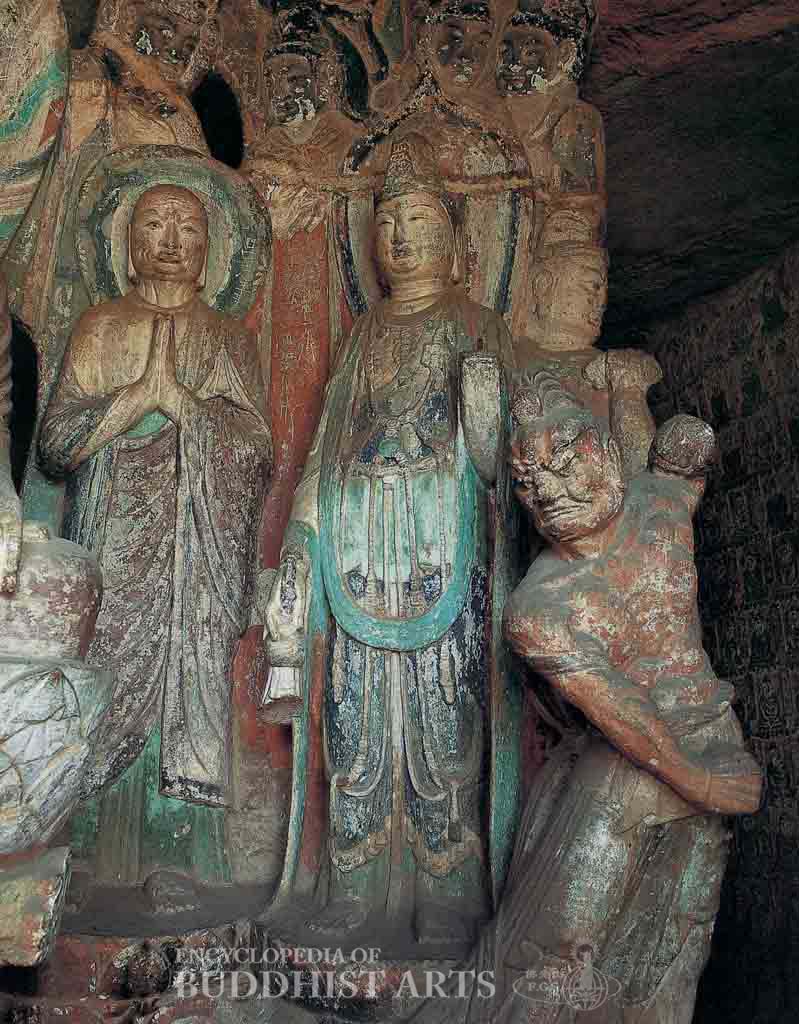
Guangyuan Thousand Buddha Cliff Rock Carvings Cave 689: Attendants (right side)
Guangyuan Thousand Buddha Cliff Rock Carvings Cave 689
CHINA, Sichuan, Guangyuan
Located in the middle tier of the northern section of the Thousand Buddha Cliff, this cave was constructed between 713 and 741 during the Tang dynasty. Two inscriptions in the cave indicate that it was restored during the Song (960–1279) and Yuan (1271–1368) dynasties. The cave measures 3.9 m wide, 2 m high, and 3 m deep. It contains carvings of a Buddha, two disciples, two Bodhisattvas, and two warriors. The wall behind the statues is carved with two Bodhi trees and reliefs of the Eight Classes of Dharma Protectors, while the other three walls of the cave are sculpted with reliefs of the Thousand Buddhas.
The 1.78 m high central Buddha statue sits in full lotus position on a lotus throne, wearing a densely folded monastic robe. The Buddha has a low usnisa, tightly curled hair, a rounded face, full lips, and long earlobes. The expression is serene and kind. One hand reaches down, forming the bhumisparsa (earth-touching) mudra, while the other hand, which is partially damaged, likely formed the abhaya (fearlessness) mudra.
The disciples flanking the Buddha stand on lotus pedestals. Ananda is portrayed on the left holding a sutra, while Mahakasyapa is on the right joining palms. Beside the disciples are two Bodhisattvas wearing headdresses and ornaments. Two warriors stand next to the Bodhisattvas.
For more details, go to the Encyclopedia of Buddhist Arts: Caves R-L, page 407.
Cite this article:
author = Hsingyun and Youheng and Johnson, Peter and Mankuang and Huntington, Susan and Edson, Gary and Neather, Robert,
booktitle = {Encyclopedia of Buddhist Arts: Caves R-L},
pages = 407,
title = {{Guangyuan Thousand Buddha Cliff Rock Carvings Cave 689}},
volume = 6,
year = {2016}}