
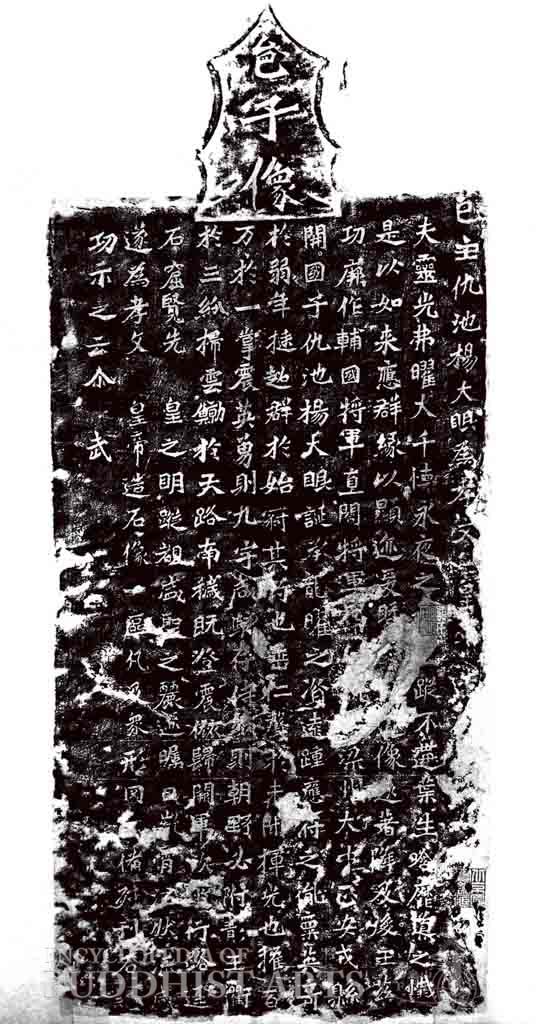
Longmen Grottoes: Four Outstanding Inscriptions - Inscription of Sculpture Commissioned by Yang Dayan
Rubbing
Longmen Grottoes: Four Outstanding Inscriptions - Inscription of Sculpture Commissioned by Yang Dayan
CHINA, Henan, Luoyang; Northern Wei dynasty
Known in full as the Inscription of Sculpture Commissioned by Fuguo General Yang Dayan for Emperor Xiaowen, this work is one of the acclaimed Four Outstanding Inscriptions of the Longmen Grottoes. Neither the date nor name of the writer is given, but it is estimated to have been produced between the years 500 and 508. There are 11 lines of 23 characters each.
Yang Dayan was a general from the Di tribe who was said to be well-versed in battle. He passed by the Longmen Grottoes while returning from a successful expedition to the south and, out of gratitude to Emperor Xiaowen (reigned 471–499) of the Northern Wei dynasty, resolved to erect images of the Buddha and Bodhisattvas on his behalf. Yang named himself as the “yizhu” (master of a county), and commissioned the statuary on the north wall of Grotto 1443 (Guyang Grotto) to be entitled with the three characters “yizixiang” (image of the county master).
The stele calligraphy is rigorous and austere in style, with robust, forceful strokes. The layout is neat, rigid, and dense, which projects a forthright yet pleasant expression. Characters are varied in size and flow in an orderly arrangement with a strong and vibrant presence. Kang Youwei, an intellect and calligrapher of the Qing dynasty, referred to this inscription in his book Extended Treatise on the Two Oars of the Boat of Arts as that pertaining to a young assistant general who has energy, strength, and a well-toned build.
For more details, go to the Encyclopedia of Buddhist Arts: Calligraphy, page 135.
Cite this article:
author = Hsingyun and Youheng and Youlu and Pokorski, Stefanie and Mankuang and Edson, Gary,
booktitle = {Encyclopedia of Buddhist Arts: Calligraphy },
pages = 135,
title = {{Longmen Grottoes: Four Outstanding Inscriptions - Inscription of Sculpture Commissioned by Yang Dayan}},
volume = 17,
year = {2016}}