
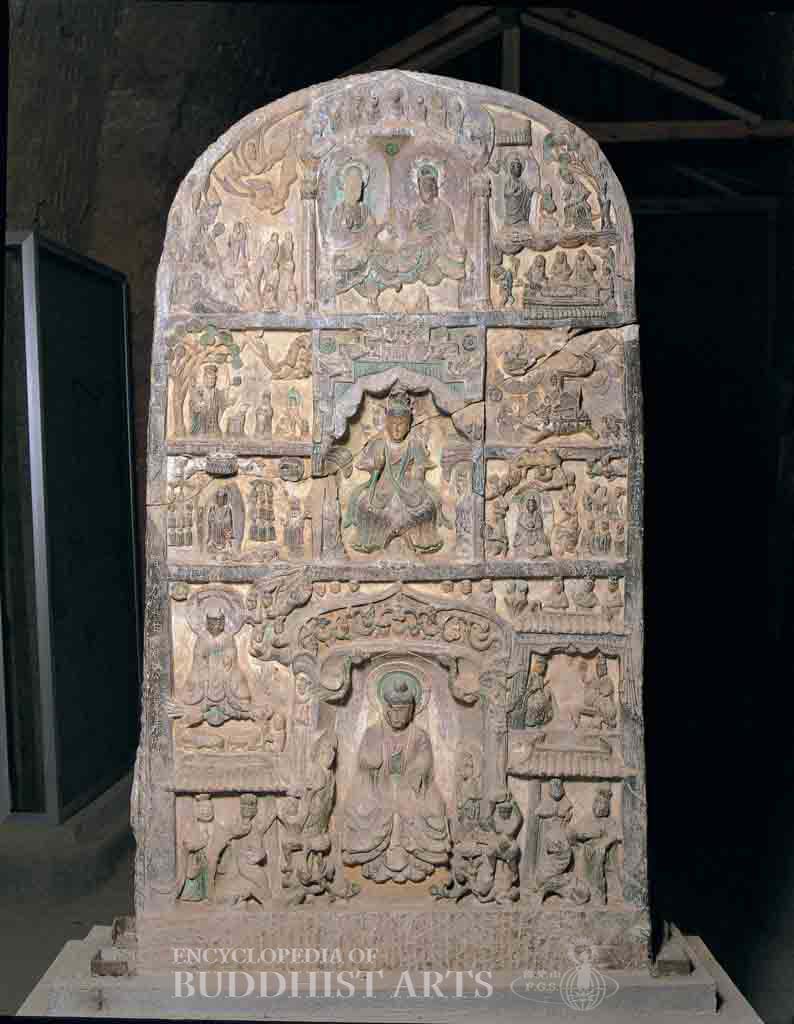
Maijishan Grotto 133: Stele 10
Stone
Maijishan Grotto 133: Stele 10
CHINA, Gansu, Tianshui; Northern Wei dynasty
Carved in the late Northern Wei dynasty (386–534), the stele was originally located under a bracket set opposite the grotto entrance. After restoration in the Song dynasty (960–1279), the stele was repositioned to an area behind the Buddha. There are 12 scenes on the front of the stele, while the back and the sides are not carved.
The front has three registers. In the top register, there are three sections. The left section depicts Suddhodana imploring Siddhartha to remain in the palace, while the middle section portrays Sakyamuni and Prabhutaratna Buddhas. The right section is divided into top and bottom sections, with a carvings of King Asoka Making a Sand Offering and a Bodhisattva in contemplation at the top, and a depiction of the Buddha’s Parinirvana at the bottom.
The middle register has five sections. The large central section depicts a seated Maitreya Bodhisattva. The sides of the middle register are each divided two vertical sections The upper left section portrays Birth of Prince Siddhartha and the lower left section illustrates the Prophecy of Dipamkara Buddha. The upper right exhibits the scene of Queen Maya’s Conception, while the lower right section depicts the Buddha’s Defeat of Mara.
The lower register is divided into sections like the middle register. The central section contains the Buddha teaching the Dharma. The upper left depicts the First Turning of the Dharma Wheel and the upper right illustrates a scene from the Vimalakirti Sutra. A Dharma protector and a lion are shown on each of the lower sections.
For more details, go to the Encyclopedia of Buddhist Arts: Caves M-Mo, page 783.
Cite this article:
author = Hsingyun and Youheng and Johnson, Peter and Mankuang and Huntington, Susan and Edson, Gary and Neather, Robert,
booktitle = {Encyclopedia of Buddhist Arts: Caves M-Mo},
pages = 783,
title = {{Maijishan Grotto 133: Stele 10}},
volume = 7,
year = {2016}}