
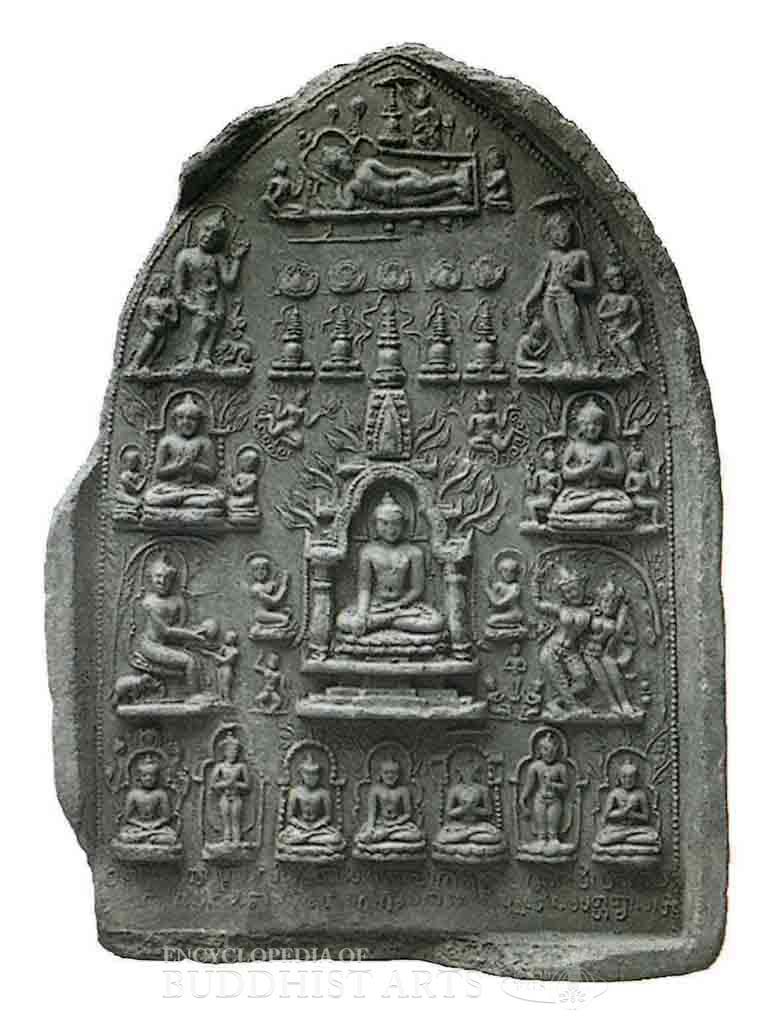
Votive Tablet with the Life of the Buddha
Earthenware
Votive Tablet with the Life of the Buddha
MYANMAR
This votive tablet from Bagan is dated from the 7th to 10th century. Such votive tablets were made in large quantities to assist pilgrims in pursuit of their spiritual practice.
The arch-shaped tablet depicts the eight main events in the Life of the Buddha, and the seven weeks following his enlightenment. The niche in the center houses the Buddha with his right hand in bhumisparsa (earth-touching) mudra to confirm his enlightenment. Flanking the niche are two small kneeling figures, likely the merchants, Tapussa and Bhallika, who offered food to the Buddha after the seventh week of his enlightenment and became his first two disciples. Above, there are two apsaras on either side of a small stupa, above which there is a row of five stupas.
On the right side, Queen Maya is shown giving birth to Prince Siddhartha under the asoka tree, assisted by her sister Mahaprajapati. The subsequent images in a clockwise direction are as follows: a row of seven Buddhas, the monkey offering honey, the first turning of the Dharma wheel, calming the elephant, passing into parinirvana, descending from heaven after visiting his mother, and the miracle at Sravasti.
The seven Buddhas, either standing or seated, represent the first seven weeks of the Buddha’s enlightenment. The image of the seated Buddha touching the earth marks his enlightenment in the first week; the events of the ensuing weeks include gazing at the Bodhi tree while standing in meditation, walking in meditation along a golden path, sitting in meditation in a jeweled chamber, sitting in meditation under a banyan tree, sitting in meditation during a rainstorm while shielded by the Naga King, and receiving a food offering from Tapussa and Bhallika.
For more details, go to the Encyclopedia of Buddhist Arts: Artifacts, page 367.
Cite this article:
author = Hsingyun and Youheng and Youji and Pokorski, Stefanie and Mankuang and Fan, Wen,
booktitle = {Encyclopedia of Buddhist Arts: Artifacts },
pages = 367,
title = {{Votive Tablet with the Life of the Buddha}},
volume = 18,
year = {2016}}