
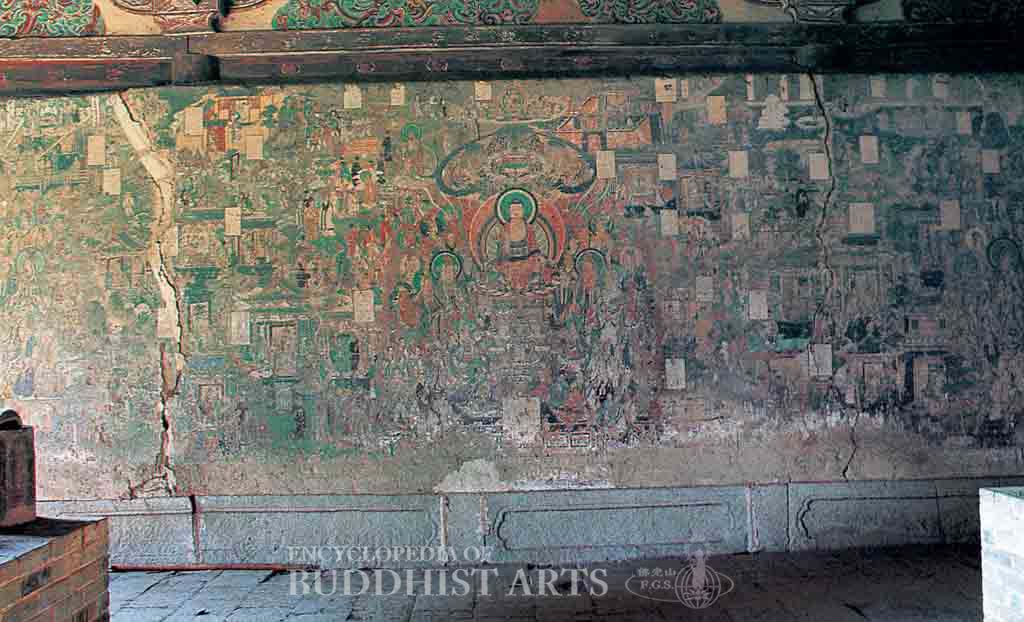
Kaihua Temple Great Hero Hall Murals (west wall)
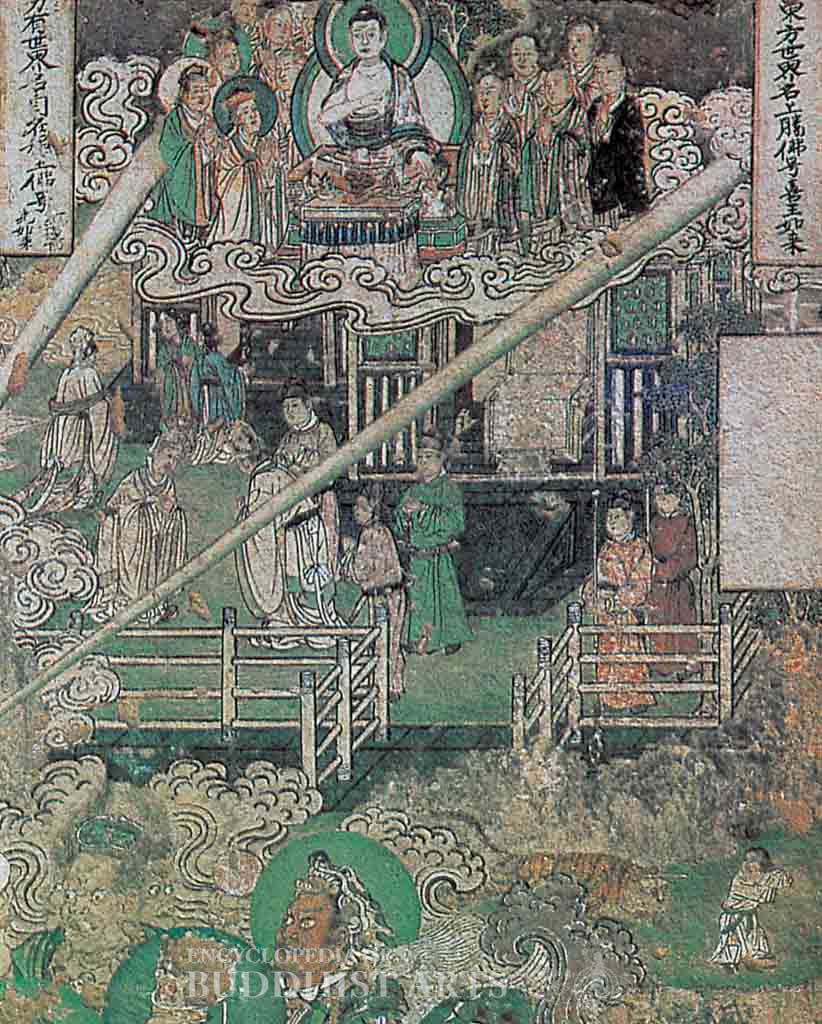
Kaihua Temple Great Hero Hall Murals: Returning Favors Sutra - Chapter on Filial Piety (west wall)
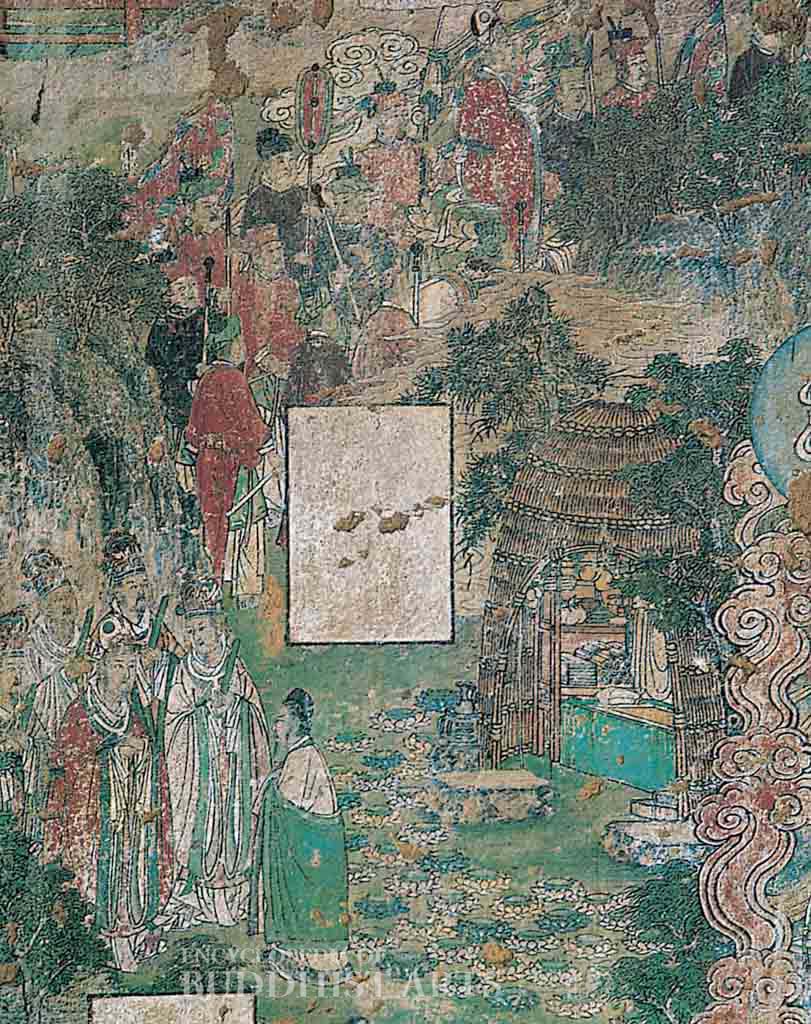
Kaihua Temple Great Hero Hall Murals: Alambusa Jataka (north wall, left side)
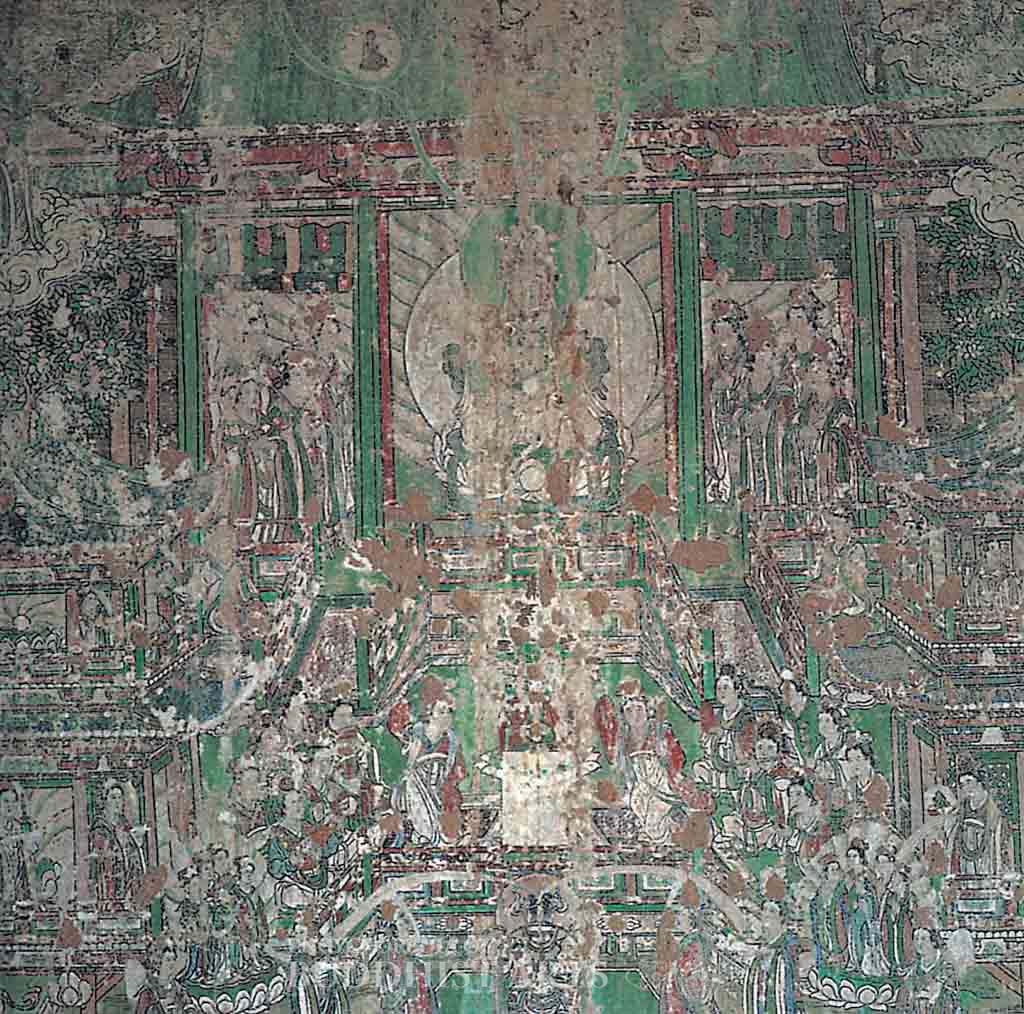
Kaihua Temple Great Hero Hall Murals: Dharma Service of Avalokitesvara’s Enlightenment (north wall, right side)

Kaihua Temple Great Hero Hall Murals: Dharma Service of Avalokitesvara’s Enlightenment - Dancing
Kaihua Temple Great Hero Hall Murals
CHINA, Shanxi, Jincheng; Northern Song dynasty
These murals cover a total area of 88 sq m on the north, east, and west walls of the Great Hero Hall. Due to age, the murals on the north and east walls have faded; some of the figures and scenes are no longer recognizable. According to inscriptions, the murals were painted by the artist Guo Fa and others over the span of a year between 1096 and 1097 during the Northern Song dynasty.
The content of the murals is described on the steles of Kaihua Temple, which indicates that the east wall murals portray scenes from the Avatamsaka Sutra and the west wall is painted with images from the Returning Favors Sutra. Of the illustrations on the east wall, only four murals remain visible with depictions of the Avatamsaka Sutra. The three murals on the west wall are the best preserved and they illustrate respectively the Buddha teaching the Dharma in the center, and illustrations from the Returning Favors Sutra on the sides. Specific depictions include the chapters on Filial Piety, Subduing Deficiencies, Theoretical Commentary, the Bad Prince, and Kindness. The north wall is divided into two sections of images identified by inscriptions. The left section illustrates the Alambusa Jataka and child Junti taking monastic vows, while the right section depicts the Dharma Service of Avalokitesvara Bodhisattva’s Enlightenment, with 39 figures making offerings.
Even though the content of the murals is varied, the backgrounds, the buildings, and the figures are depicted with the same proportions in every image. By means of numerous common background elements such as mountains, water, trees, rocks, clouds, and flowers linking the various scenes, the entire composition is seamlessly unified. The many exquisite halls and pavilions appearing in the paintings can be taken as representations of the palace courts and temples of the time. There are depictions of emperors, empresses, merchants, fishermen, thieves, and others: a vivid portrayal of a large spectrum of society during the Northern Song dynasty. The image of the Dharma service of Avalokitesvara’s enlightenment includes many types of musicians and dancers performing together. The painting clearly distinguishes primary and secondary subjects; important figures are allocated ample space while lesser figures are unobtrusive.
The smooth, rounded “orchid leaf” lines used in the murals are made with freely flowing brushstrokes. The coloring primarily consists of malachite green, azurite, cinnabar, ocher, and other mineral pigments. Cool and warm colors are apportioned thoughtfully. In several places, gold powder has been added into the paint to highlight buildings, animals, Bodhisattvas, the crowned empress, and offerings. The background is a monochromatic cloud pattern painted with a wash technique, giving the impression of depth. With their compositional rigor, refined use of color, and delicate calligraphy, these images are distinguished among Chinese temple murals. They are rare examples of Song dynasty murals that are signed and dated by the artists.
For more details, go to the Encyclopedia of Buddhist Arts: Painting I-O, page 403.
Cite this article:
author = Hsingyun and Youheng and Youlu and Wilson, Graham and Manho and Mankuang and Huntington, Susan,
booktitle = {Encyclopedia of Buddhist Arts: Painting I-O},
pages = 403,
title = {{Kaihua Temple Great Hero Hall Murals}},
volume = 15,
year = {2016}}