
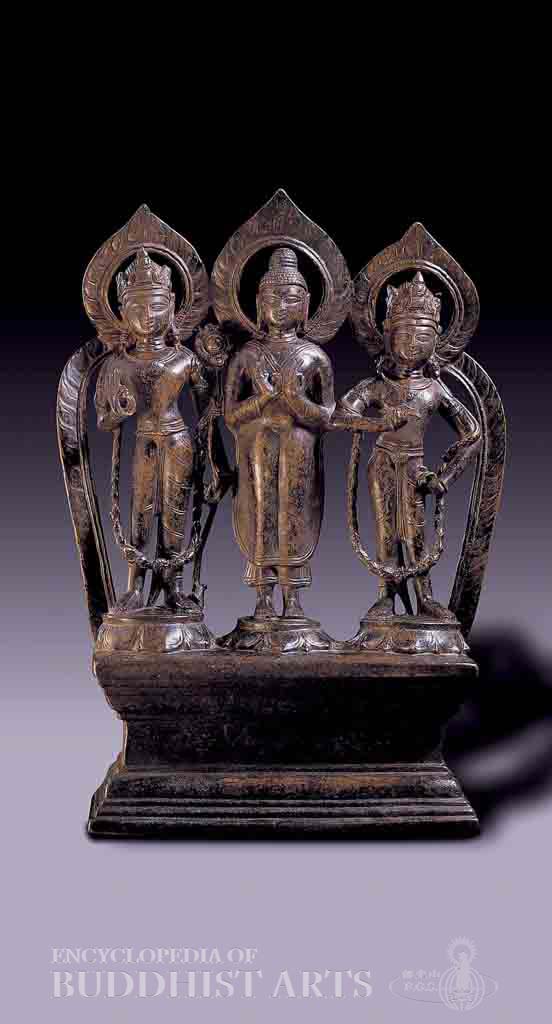
Buddha Triad
Bronze
Buddha Triad
INDIA
The three figures stand on lotus pedestals that nest on a Sumeru platform. Each figure has a nimbus but they share a flaming aureole, which is only visible on either end. The statue in the center is Sakymuni Buddha, recognized by his high usnisa, tightly curled hair, and his hands form the Dharmacakra (Dharma wheel) mudra. The collar of the Buddha’s robe is unconventionally V-shaped.
On the left is Avalokitesvara, recognized by the lotus flower that the Bodhisattva holds in the left hand with a long stalk in the right hand. The attendant on the other side is Vajrapani Bodhisattva, who holds a vajra in the right hand and forms a mudra with the left hand. Both Bodhisattvas wear a headdress, as well as a long garland of flowers that hangs to the knees. They also wear dhotis whose folds are indicated by double incised lines.
Many aspects of this sculpture, such as the lotus pedestal, mandorla, and nimbus show characteristics of the Kashmir style. However, the Buddha’s clothing, the headdresses and adornments of the two Bodhisattvas are too plain to be from Kashmir. It is thought that the sculpture was probably made in Ladakh or the western region of Tibet.
For more details, go to the Encyclopedia of Buddhist Arts: Sculpture A-F, page 218.
Cite this article:
author = Hsingyun and Youheng and Lovelock, Yann and Chou, Yuan and Huntington, Susan and Edson, Gary and Neather, Robert,
booktitle = {Encyclopedia of Buddhist Arts: Sculpture A-F},
pages = 218,
title = {{Buddha Triad}},
volume = 10,
year = {2016}}