
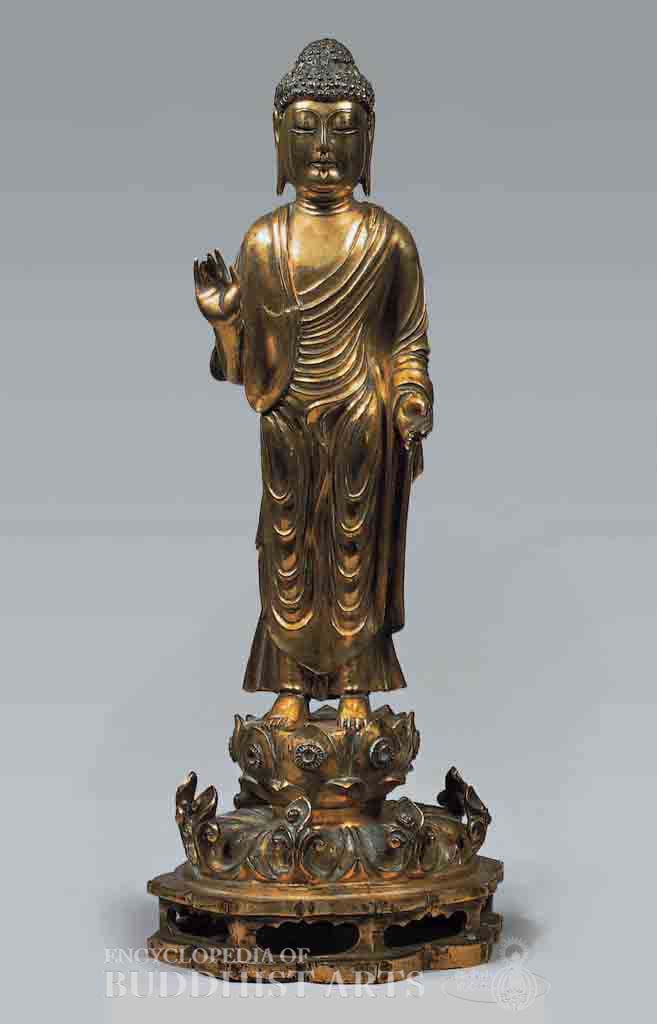
Standing Buddha
Gilt copper alloy
Standing Buddha
KOREA; Unified Silla dynasty
The Buddha stands on a lotus pedestal that rests on a more ornately petaled lotus base incorporated onto an octagonal openwork stand. Characteristics of the status include a large rounded usnisa, extended earlobes, and the three lines on the neck. The facial features consist of simplified curves and straight lines, aiming more at an expression of dignity instead of personality. Both shoulders are covered by the monastic robe, the raised folds of which pool over the thighs and emphasize the legs in their distinctively divided fall, typical of Unified Silla style. The hands are held conventionally in the abhaya (fearlessness) and varada (wish-granting) mudras.
For more details, go to the Encyclopedia of Buddhist Arts: Sculpture St-Z, page 1142.
Cite this article:
author = Hsingyun and Youheng and Lovelock, Yann and Chou, Yuan and Huntington, Susan and Edson, Gary and Neather, Robert,
booktitle = {Encyclopedia of Buddhist Arts: Sculpture St-Z},
pages = 1142,
title = {{Standing Buddha}},
volume = 13,
year = {2016}}