
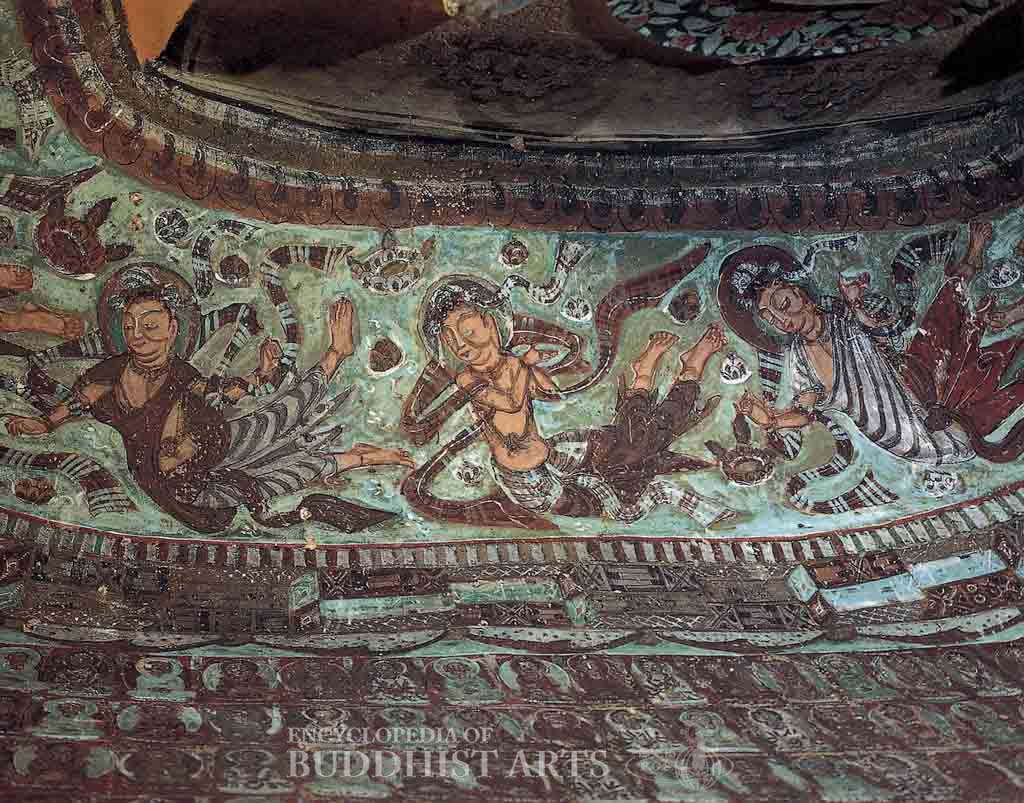
Wenshushan Thousand Buddha Cave: Apsaras
Wenshushan Thousand Buddha Cave: Apsaras
CHINA, Gansu, Zhangye; Northern Liang Kingdom
Apsaras are painted on the ceiling of the cave, but only six remain. They have high eyebrows, long eyes, straight noses, and full lips. They hover in a sky strewn with flower petals. The body of each flying apsara is contorted in a U shape, and they all wear headdresses, flowing stoles, and dhotis, as well as numerous ornaments. Three of the six apsaras play musical instruments, namely the panpipe, flute, and pipa. The other three dance and hold offerings in their hands. This painting style can be found in the Mogao Caves at Dunhuang, as well as the Kizil Caves in Xinjiang.
For more details, go to the Encyclopedia of Buddhist Arts: Caves T-Z, page 1491.
Cite this article:
Hsingyun, et al. "Wenshushan Thousand Buddha Cave: Apsaras." Encyclopedia of Buddhist Arts: Caves T-Z, vol. 9, 2016, pp. 1491.
Hsingyun, Youheng, Peter Johnson, Mankuang, Susan Huntington, Gary Edson, and Robert Neather. 2016. "Wenshushan Thousand Buddha Cave: Apsaras" In Encyclopedia of Buddhist Arts: Caves T-Z, 9:1491.
Hsingyun, Youheng, Johnson, P., Mankuang, Huntington, S., Edson, G., & Neather, R.. (2016). Wenshushan Thousand Buddha Cave: Apsaras. In Encyclopedia of Buddhist Arts: Caves T-Z (Vol. 9, pp. 1491).
@misc{Hsingyun2016,
author = Hsingyun and Youheng and Johnson, Peter and Mankuang and Huntington, Susan and Edson, Gary and Neather, Robert,
booktitle = {Encyclopedia of Buddhist Arts: Caves T-Z},
pages = 1491,
title = {{Wenshushan Thousand Buddha Cave: Apsaras}},
volume = 9,
year = {2016}}
author = Hsingyun and Youheng and Johnson, Peter and Mankuang and Huntington, Susan and Edson, Gary and Neather, Robert,
booktitle = {Encyclopedia of Buddhist Arts: Caves T-Z},
pages = 1491,
title = {{Wenshushan Thousand Buddha Cave: Apsaras}},
volume = 9,
year = {2016}}