
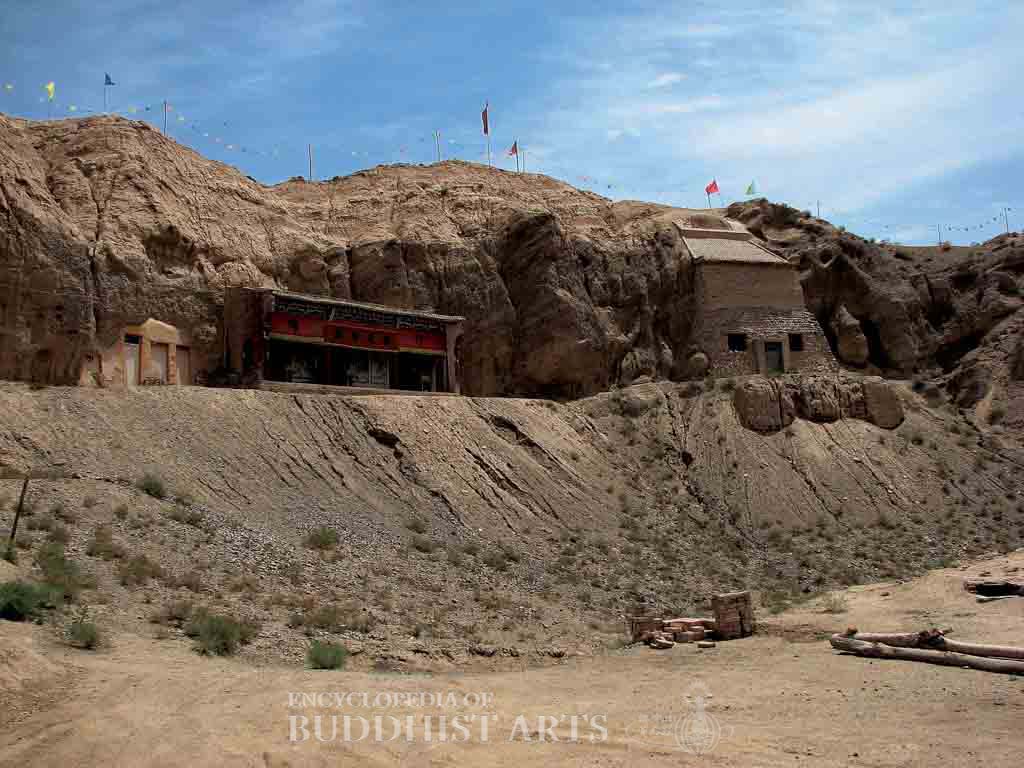
Wenshushan Thousand Buddha Cave
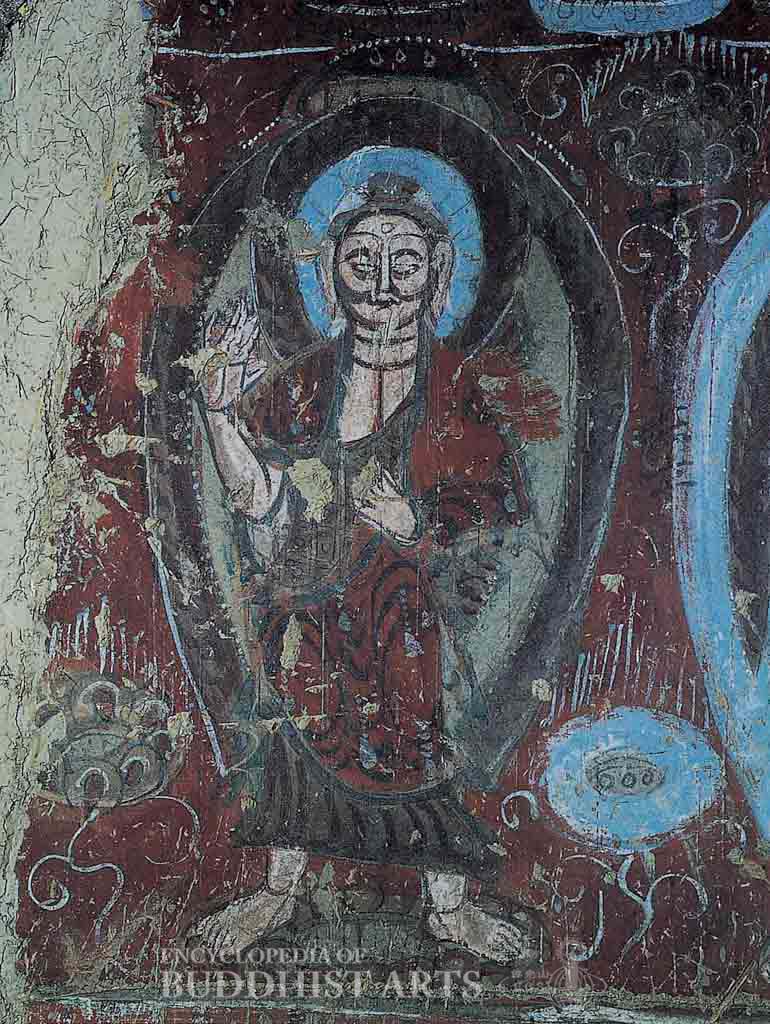
Wenshushan Thousand Buddha Cave: Standing Buddha (front wall)
Wenshushan Thousand Buddha Cave
CHINA, Gansu, Zhangye
This square cave faces west and measures 3.94 m in width, 3.6 m in height, and 3.8 m in depth. It is a central pillar cave with an antechamber and a main chamber. Within the main chamber is a square central pillar with three niches and a base platform at the bottom. The top niche contains a Buddha seated in full lotus position wearing a robe and forming the dhyana (meditation) mudra. The figure’s head is no longer present. Two attendant Bodhisattvas in repainted clothing are found outside the niche.
Both the top and the center niches of the central pillar have arches supported by columns with lotus capitals. A smaller niche is located at the bottom. The lintel is surrounded by images of the Buddhas of the Ten Directions. These were added during the Western Xia period (1032–1227). Depicted on the ceiling that surrounds the central pillar are six flying apsaras that hold musical instruments and offerings.
The murals of the Thousand Buddhas motif and the apsaras on the four walls and corridors were painted during the Northern Liang dynasty (397–439). The murals on the back (east) wall have crumbled, while three of the Thousand Buddha images remain on the south wall. The north wall murals can be divided into five registers. At the bottom, there is a border of honeysuckle patterns and inverted triangles. Nine rows of Thousand Buddhas seated in full lotus positions are depicted above the border. Above this are a Buddha and two attendant Bodhisattvas followed by a row of figures making offerings. One of the figures on the left wears a corseted gown with wide sleeves, while the rest wear clothing with a crossed collar. A valance is painted at the very top. The murals on the front (west) wall have a similar layout as those on the north wall. Throughout the cave the Buddhas, Bodhisattvas, and apsaras were painted using three-dimensional forms and show marked similarities to the murals in the Kizil Caves in Xinjiang and the Mogao Caves at Dunhuang.
For more details, go to the Encyclopedia of Buddhist Arts: Caves T-Z, page 1490.
Cite this article:
author = Hsingyun and Youheng and Johnson, Peter and Mankuang and Huntington, Susan and Edson, Gary and Neather, Robert,
booktitle = {Encyclopedia of Buddhist Arts: Caves T-Z},
pages = 1490,
title = {{Wenshushan Thousand Buddha Cave}},
volume = 9,
year = {2016}}