
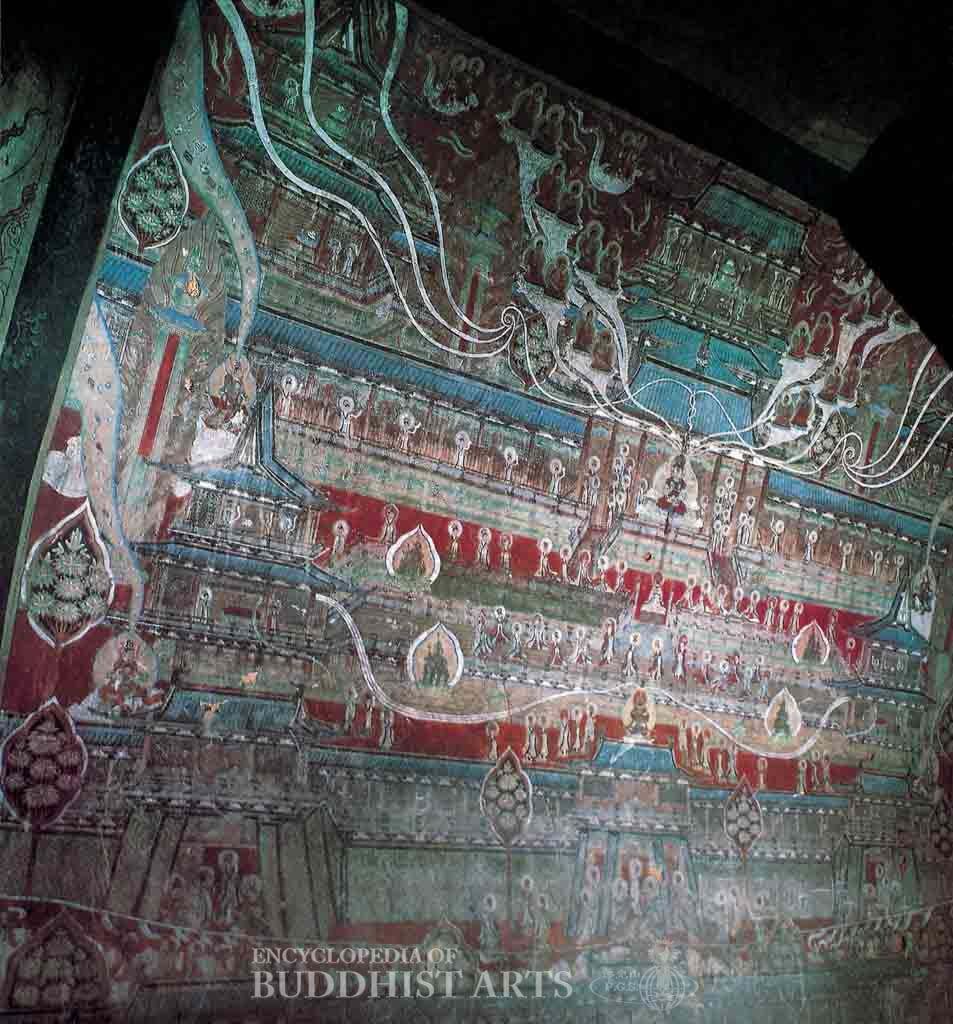
Wenshushan Ten Thousand Buddha Cave: Illustration of the Sutra on the Ascent of Maitreya
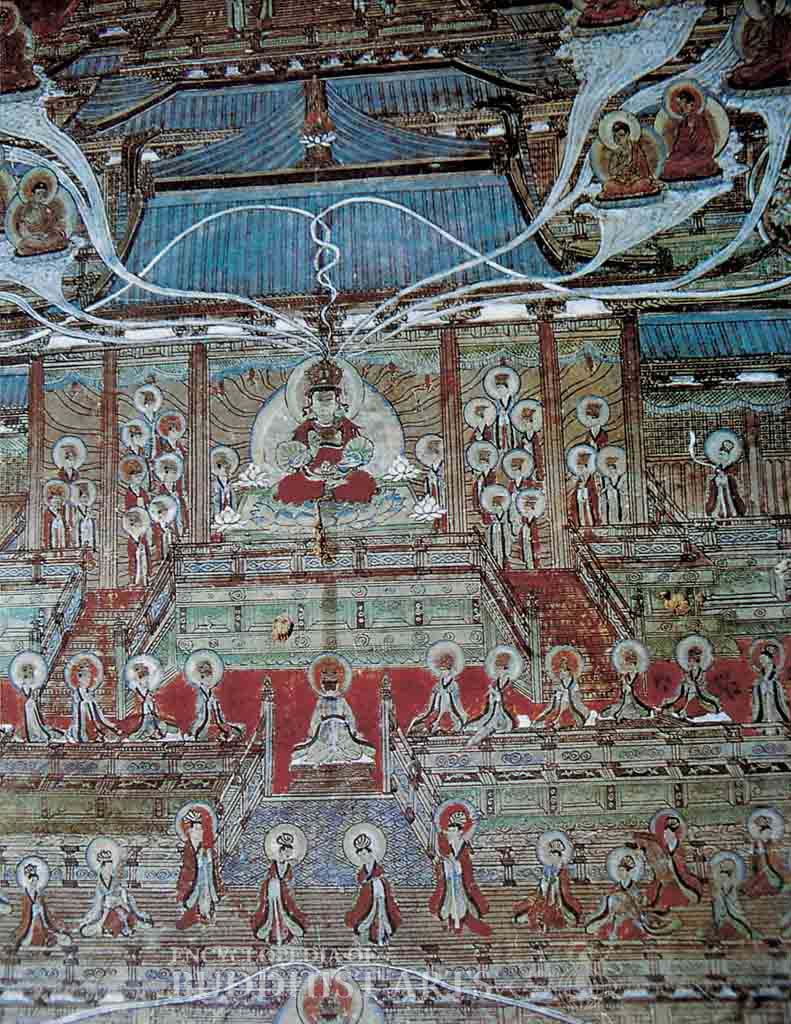
Wenshushan Ten Thousand Buddha Cave: Illustration of the Sutra on the Ascent of Maitreya (detail)
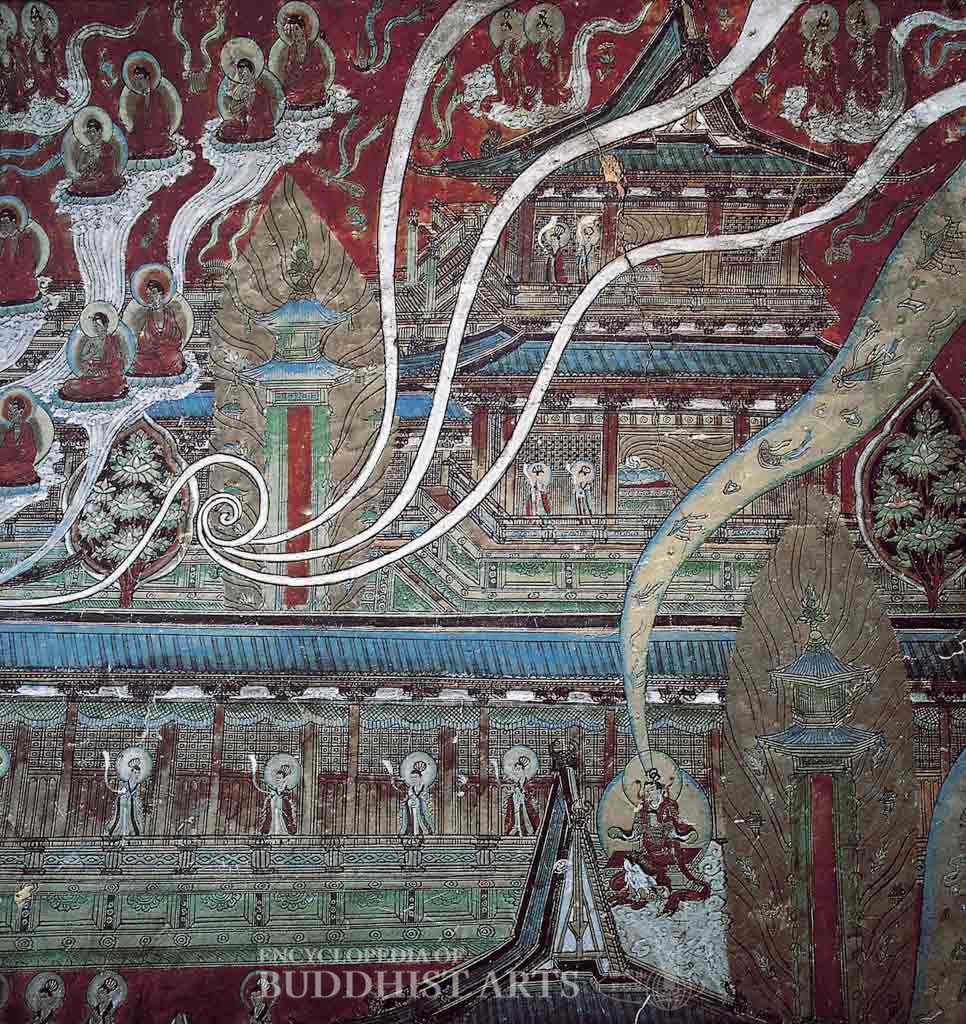
Wenshushan Ten Thousand Buddha Cave: Illustration of the Sutra on the Ascent of Maitreya (detail)
Wenshushan Ten Thousand Buddha Cave: Illustration of the Sutra on the Ascent of Maitreya
CHINA, Gansu, Zhangye; Western Xia period
This illustration is located on the east wall of the Ten Thousand Buddha Cave. The mural is based on the Sutra on the Ascent of Maitreya and illustrates the inner court of the Tusita Heaven, the residence of Maitreya before he attains Buddhahood. The mural is from the late Western Xia period (1032–1227) and contains Tibetan Buddhist themes. In the center of the mural is Maitreya Bodhisattva depicted in Tibetan garments. The Bodhisattva is seated in full lotus position upon a large lotus platform. Waves of light radiate from Maitreya’s head, while Buddhas of the Ten Directions and their retinues ride upon the clouds above.
There is an assembly of figures making offerings dispersed throughout the courtyard. The men wear crowns and long robes, and the women have their hair either in buns or braided upon their heads, while also wearing long robes. Sixteen apsaras are depicted on the stone bridge below Maitreya; some dance while others play the harp or pipa. Five heavenly guardians stand watch over the scene, one located above the main gate and the other four spread out over the four corners.
The figures appear small in relation to the buildings, which emphasize the grandeur of the structures. The halls, pavilions, eaves, windows, doors, the gardens and ponds are all depicted in great detail. The large scale mural is reminiscent of the famous Song dynasty (960–1279) painter Guo Zhongshu.
For more details, go to the Encyclopedia of Buddhist Arts: Caves T-Z, page 1488.
Cite this article:
author = Hsingyun and Youheng and Johnson, Peter and Mankuang and Huntington, Susan and Edson, Gary and Neather, Robert,
booktitle = {Encyclopedia of Buddhist Arts: Caves T-Z},
pages = 1488,
title = {{Wenshushan Ten Thousand Buddha Cave: Illustration of the Sutra on the Ascent of Maitreya}},
volume = 9,
year = {2016}}