
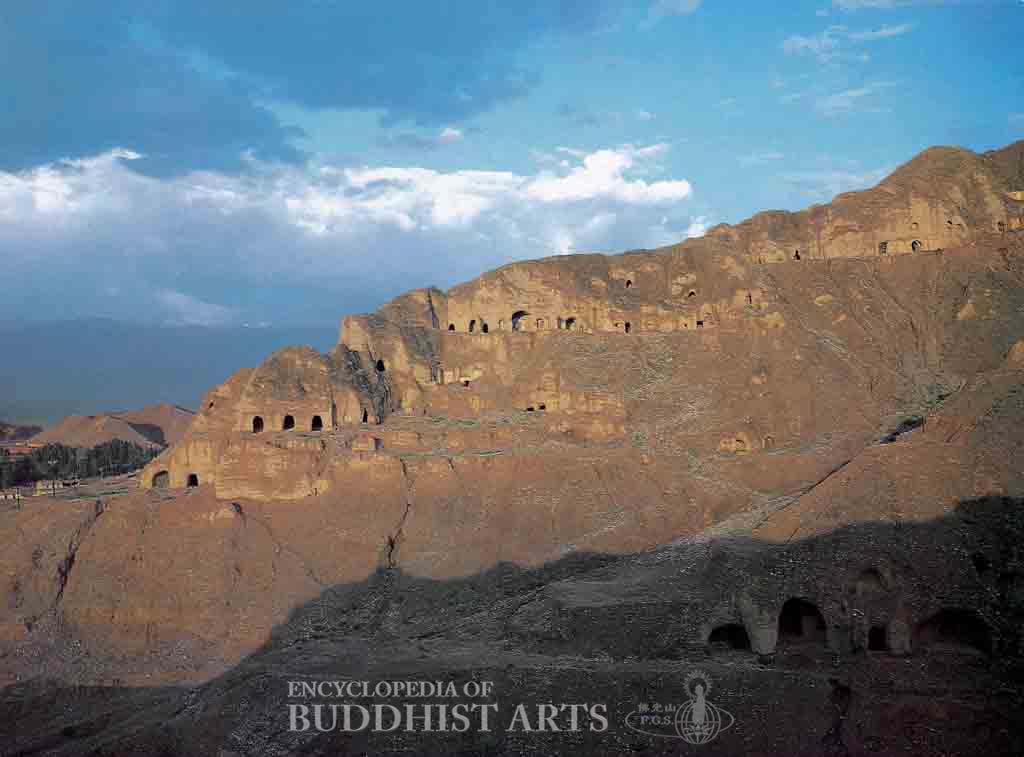
Wenshushan Caves
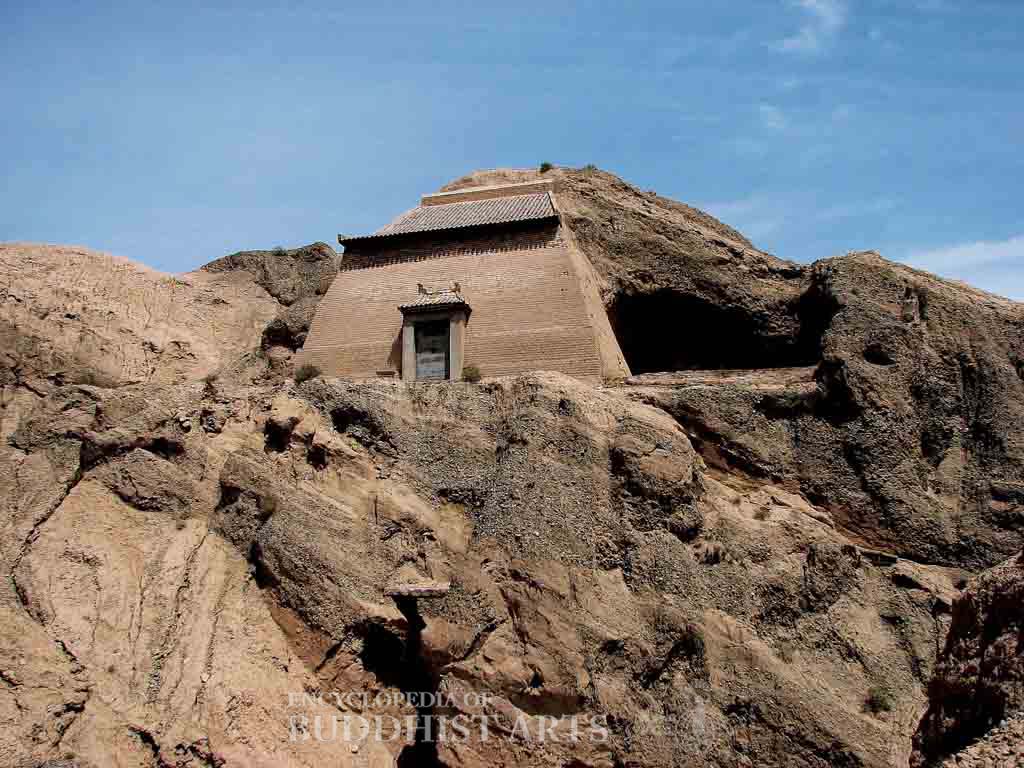
Wenshushan Caves: Ten Thousand Buddha Cave
Wenshushan Caves
CHINA, Gansu, Zhangye
These caves are located 15 km south of Jiuquan, within the valley of Wenshushan. Of the 73 remaining caves, 15 have central pillars and 3 are meditation caves. The temple ruins, which stand in front of the caves, once formed 28 separate structures. The caves are now empty, with most of the artwork either lost or destroyed. The two caves that still contain statues and murals are referred to as the Thousand Buddha Cave and the Ten Thousand Buddha Cave.
The thirteen stone stupas discovered in Jiuquan date to the Northern Liang dynasty (397–439) and are the earliest known Buddhist structures in the area. The similar layout and characteristics of the murals suggest that Wenshushan Caves were created around the same period. This early form of Buddhism and its corresponding style of artwork spread from Central Asia through the Hexi Corridor. The caves were listed as a National Cultural Heritage Site in 2001.
The Thousand Buddha Cave, located in the hills on the northwest side of Wenshushan, has a square layout and measures approximately 3.9 m in width, 3.6 m in height, and 3.8 m in depth. Two small niches are still visible on the back wall of what remains of the antechamber. The cave has a long barrel-vaulted ceiling which extends from a corridor forming the front entrance. The central pillar is separated into two levels and contains sculptures within two arched niches. The arched niches are supported by columns with lotus capitals and beams engraved with bundled lotuses. On the ceiling of the cave surrounding the central pillar there are six large depictions of apsaras. Although most of the murals within the cave have been destroyed, those that remain are colorful and impressive. An illustration of the Buddha teaching the Dharma is depicted on the back (east) wall, above which the Thousand Buddhas motif is enclosed by murals of standing Buddhas.
The Ten Thousand Buddha Cave is located approximately 100 m above the Thousand Buddha Cave. The styles of these caves are simlar. There are two tiers of niches on all four sides of the central pillar. In every niche there is a Buddha with two attendant Bodhisattvas but the statues have been badly damaged. A mural of Avalokitesvara Bodhisattva, surrounded by the Thousand Buddhas motif can be found in the center of the north wall. The east and west walls have large sutra illustrations, but only a row of monks can still be deciphered from what is left of the west wall. Illustrations from Jataka tales can be found along the bottom of the east, west, and north walls. Heavenly Kings are painted in the four corners. Most of the murals within the cave were painted during the Western Xia period (1032–1227) and then repainted during the Yuan dynasty (1271–1368).
The inscriptions within the caves are written in Uighur, Mongolian, Tibetan, and Chinese. The majority of these were written during the Yuan and Ming (1368–1644) dynasties and are found in the Ten Thousand Buddha Caves. The earliest Chinese inscription found within the cave was written in 1297 during the Yuan dynasty.
For more details, go to the Encyclopedia of Buddhist Arts: Caves T-Z, page 1486.
Cite this article:
author = Hsingyun and Youheng and Johnson, Peter and Mankuang and Huntington, Susan and Edson, Gary and Neather, Robert,
booktitle = {Encyclopedia of Buddhist Arts: Caves T-Z},
pages = 1486,
title = {{Wenshushan Caves}},
volume = 9,
year = {2016}}