
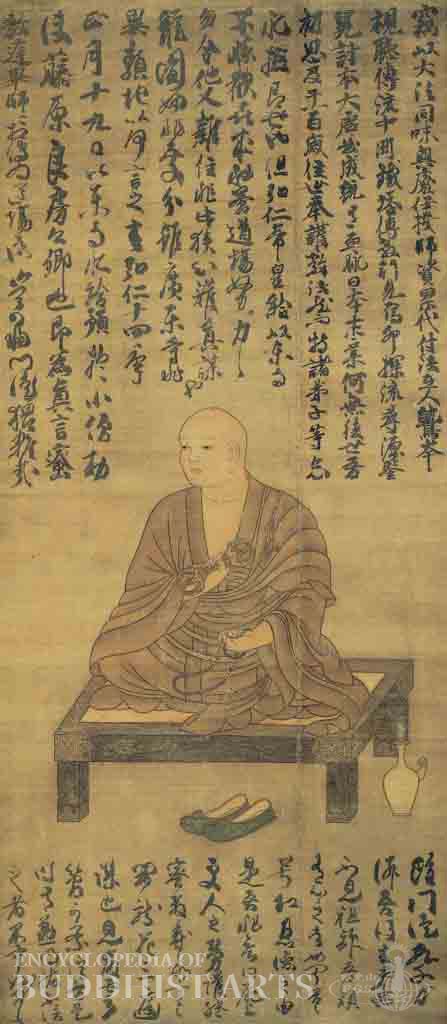
Master Kukai; Kamakura period
Ink and color on silk
Kukai
JAPAN, Kagawa; Heian period
Master Kukai was a monk and artist, in addition to the founder of the Shingon school of Japanese Buddhism. He is also well-known by his posthumous titles Master Kobo or Master Koya. Kukai studied Confucianism and Chinese literature at a young age, but rejected his future as an official in favor of renouncing in 793 under Master Gonso Daitoku at Makinoosanji Temple. He later traveled to China in 804 and studied the teachings of esoteric Buddhism under Master Huiguo at Qinglong Temple in Shaanxi. He was initiated into the Womb and Diamond Realms and was consecrated as an Acharya, or Shingon instructor. At this time, he was given the title Henjo Kongo.
Master Kukai returned to Japan in 806 with a large number of sutras, Dharma instruments, and Buddhist artwork. During the following years, he learned the art of esoteric Buddhist painting while staying at Kanzeonji Temple in Fukuoka. He held a consecration ceremony for the transmission of the esoteric teachings at Jingoji Temple in Kyoto in 812; the first of such ceremonies in Japan. In 816, Master Kukai received rights from Emperor Saga to build a temple on Koyasan. This would become the headquarters of Shingon Buddhism in Japan. He was later granted Toji Temple in Kyoto in 823 for further esoteric propagation. Master Kukai is regarded as one of the greatest contributors to the cultural and Buddhist histories of the Heian period.
In addition to being a profound and influential Dharma propagator, Master Kukai mastered many forms of Buddhist art, in particular, calligraphy. His style was heavily influenced by Wang Xizhi and Yan Zhengqing, and he excelled in all scripts including Hihaku, a splash-pattern style of writing kanji. In addition, Master Kukai is credited with the development of kana, the Japanese syllabary. His scripts were rich and lively, and his distinct form became referred to as Daishi style. Alongside Emperor Saga and Tachibana no Hayanari, he was renowned as one of the Three Calligraphy Masters of the Heian period.
Master Kukai’s earliest calligraphic piece was the two fascicles of Indications of the Goals of the Three Teachings, written when he was 24 years old and now kept at Kongobuji Temple in Wakayama. Another well-known work is Letters from Master Kukai, also known as Fushinjo, which consisted of three letters to the famous Tendai school patriarch, Master Saicho. These letters were later mounted onto a scroll and are kept at Toji Temple in Kyoto. The remnants of Master Kukai’s Diamond Sutra Commentary are preserved in both Nara National Museum and Kyoto National Museum, and the Thirty Booklets, which he transcribed while in China, are now collected at Ninnaji Temple in Kyoto. His Commentary on the Vairocana Tantra is kept at Daigoji Temple in Kyoto and Record of Initiations is collected in Jingoji Temple. All the mentioned works are currently listed as National Treasures of Japan.
For more details, go to the Encyclopedia of Buddhist Arts: People, page 146.
Cite this article:
author = Hsingyun and Youheng and Youlu and Pokorski, Stefanie and Yichao and Mankuang and Miaohsi,
booktitle = {Encyclopedia of Buddhist Arts: People },
pages = 146,
title = {{Kukai}},
volume = 19,
year = {2016}}