
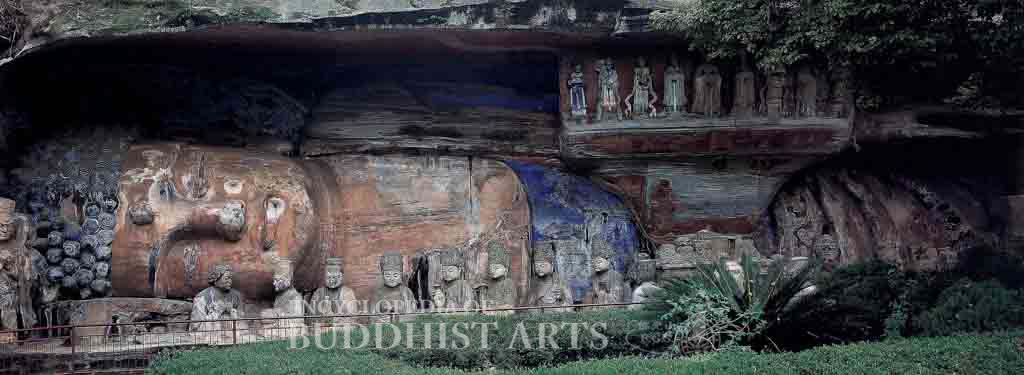
Dazu Rock Carvings Baodingshan Great Buddha Bay Niche 11: Reclining Buddha
Stone
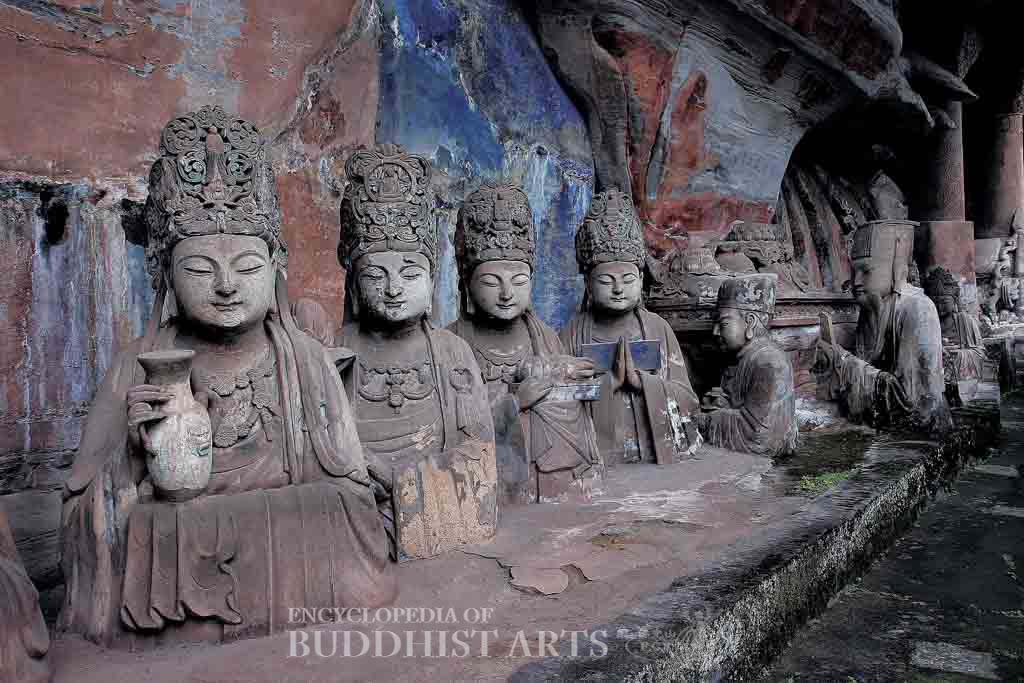
Dazu Rock Carvings Baodingshan Great Buddha Bay Niche 11: Reclining Buddha - Disciples
Dazu Rock Carvings Baodingshan Great Buddha Bay Niche 11: Reclining Buddha
CHINA, Chongqing, Dazu; Southern Song dynasty
This niche in the east cliff is 31.6 m wide and 7 m high. The Reclining Buddha contained in the niche is 31 m long, with the head alone measuring 6.5 m. The carving is oriented with the head to the north and the feet to the south, facing towards the west, corresponding with the descriptions of the Buddha’s pose and orientation at the time of his parinirvana in the Mahaparinirvana Sutra. The Buddha has a usnisa and partially closed eyes. His feet are hidden in the cliff, which is symbolic of the immeasurable nature of the Buddha.
Disciples in mourning and Heavenly Kings are in the foreground. Only the upper bodies of these figures have been carved, giving the impression that they are emerging from the ground. The figure standing in front of the Buddha’s head is Zhao Zhifeng; with clasped hands, he turns to face the other disciples. Liu Benzun stands behind Zhao, holding what appears to be a pumpkin. Disciples wearing intricately carved headdresses are lined up behind him. They hold objects such as a vase, bowl, lotus, plate of fruit, or sutra in their hands. They appear pious and solemn, which is a departure from the description of this scene in the Mahaparinirvana Sutra, where the disciples outwardly display their grief.
An altar table with plates for offering can be seen in front of the Buddha’s waist. A Heavenly King is carved on each side and in front of the table. A rocky outcrop supports nine figures directly above the table. In the middle is the Buddha’s mother, Queen Maya; directly beside her on the right is his aunt, Mahaprajapati; and on the left is Yasodhara, who was the Buddha’s wife before he became an ascetic. All of them stand with clasped hands. Three heavenly beings are depicted on each side of the three central figures. Some of the heavenly beings hold flowers or offer fruit, while some hold incense burners.
Running along the length of the niche in front of the figures is a depiction of the “Nine Bend River.” According to Dazu folklore, when the Buddha was about to pass into parinirvana, Ananda implored the Buddha to bring him along. Since Ananda was not perfect enough, the Buddha pushed him away and drew a river between them. Liu Benzun, Zhao Zhifeng, and the Nine Bend River are local Dazu elements that have been incorporated into this scene.
For more details, go to the Encyclopedia of Buddhist Arts: Caves A-E, page 244.
Cite this article:
author = Hsingyun and Youheng and Johnson, Peter and Mankuang and Huntington, Susan and Edson, Gary and Neather, Robert,
booktitle = {Encyclopedia of Buddhist Arts: Caves A-E},
pages = 244,
title = {{Dazu Rock Carvings Baodingshan Great Buddha Bay Niche 11: Reclining Buddha}},
volume = 5,
year = {2016}}