
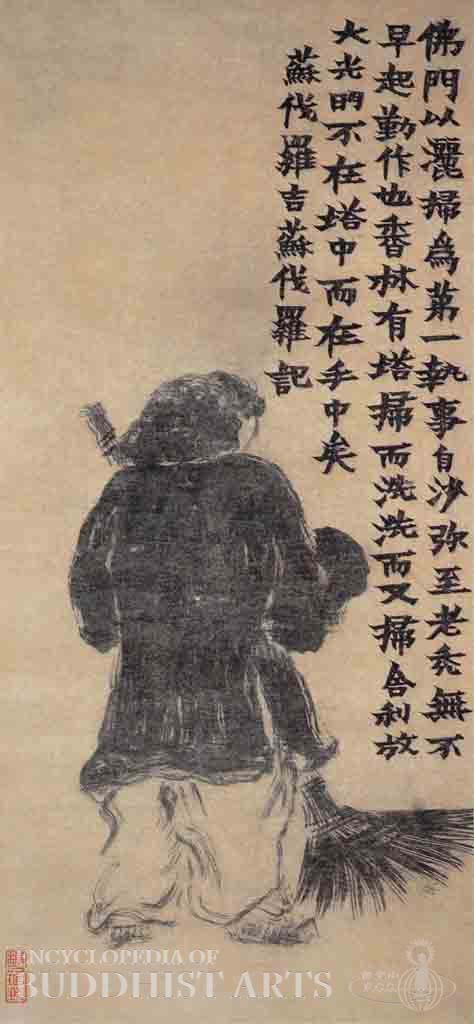
Relics are Not Found in Stupas
Ink on paper
Relics are Not Found in Stupas
CHINA; Qing dynasty
Jin Nong was a Qing dynasty (1644–1911) painter, calligrapher, and poet. This inscription, written by Jin on his painting of a person sweeping, was intended to convey the message that “real relics are not found in stupas, but in hard work” in other words, the simple daily chore of sweeping is a form of spiritual practice. The calligraphy was later engraved onto the Stele Wall at Fo Guang Shan Monastery in Kaohsiung, Taiwan.
Written in regular script, the calligraphy in this piece appears predominantly long and flat in form. The horizontal strokes commence with considerably heavy pressure, followed by an immediate stroke to the right in a similar and consistent rhythm. Jin used this technique to express the beautiful ancient style of calligraphy that he learned from his predecessors. Regarded as the most cultivated among the Eight Eccentrics of Yangzhou, Jin Nong was also known to have created the unique style of lacquer script.
For more details, go to the Encyclopedia of Buddhist Arts: Calligraphy, page 201.
Cite this article:
author = Hsingyun and Youheng and Youlu and Pokorski, Stefanie and Mankuang and Edson, Gary,
booktitle = {Encyclopedia of Buddhist Arts: Calligraphy },
pages = 201,
title = {{Relics are Not Found in Stupas}},
volume = 17,
year = {2016}}