
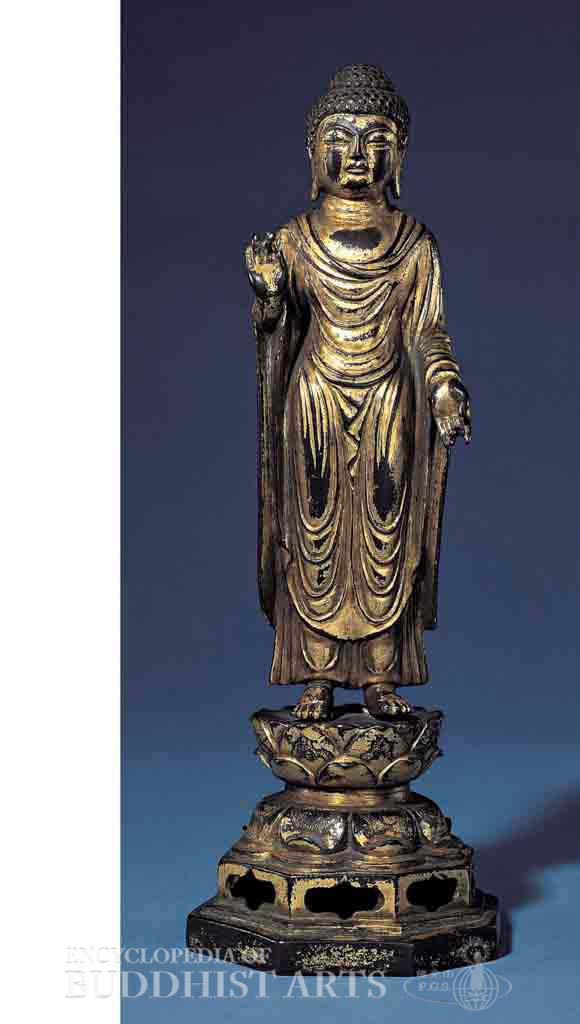
Standing Buddha
Gilt bronze
Standing Buddha
KOREA; Unified Silla dynasty
Although the statue has characteristics of Chinese Tang dynasty (618–907) sculptures, the statue is recognizably of Korean origin, particularly in its treatment of the monastic robe. The robe covers both shoulders, its folds rippling down the slim body to pool over the thighs and then descend separately over the legs in the style of Unified Silla dynasty. An incised line defines the eyebrows, and a sharp, straight line above a small down-turned mouth defines the nose. The eyes appear half closed. One hand is raised and the other lowered, both in mudras. The figure stands on a lotus pedestal balanced upon an inverted lotus that is mounted on an octagonal openwork base.
For more details, go to the Encyclopedia of Buddhist Arts: Sculpture St-Z, page 1142.
Cite this article:
author = Hsingyun and Youheng and Lovelock, Yann and Chou, Yuan and Huntington, Susan and Edson, Gary and Neather, Robert,
booktitle = {Encyclopedia of Buddhist Arts: Sculpture St-Z},
pages = 1142,
title = {{Standing Buddha}},
volume = 13,
year = {2016}}