
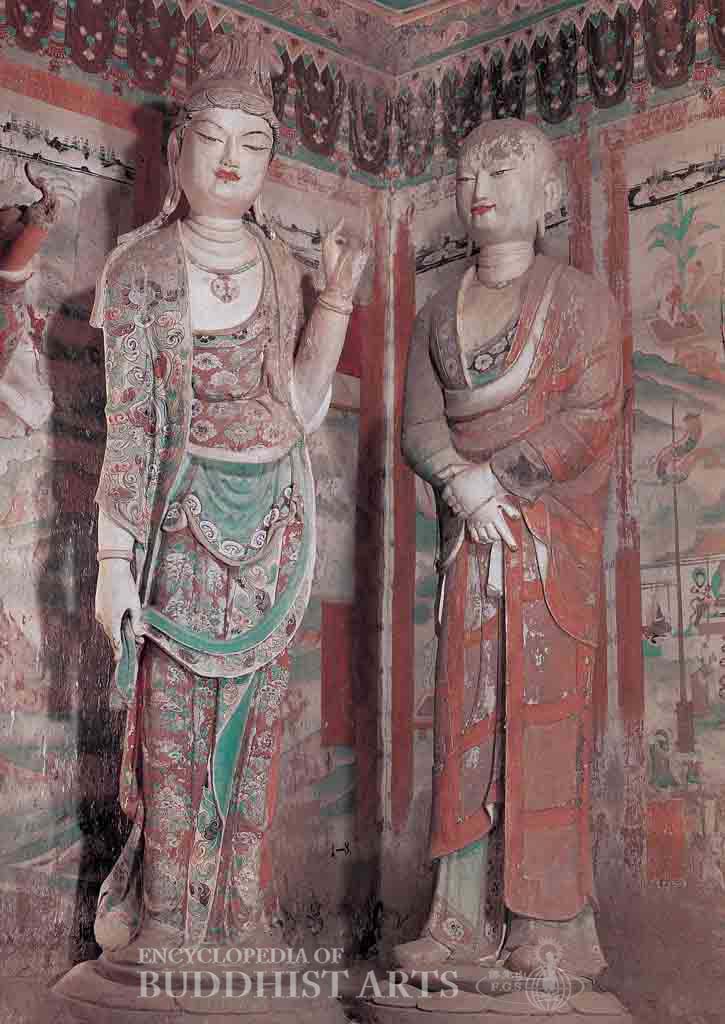
Mogao Cave 159: Bodhisattva and Disciple (back wall niche, left side)
Clay
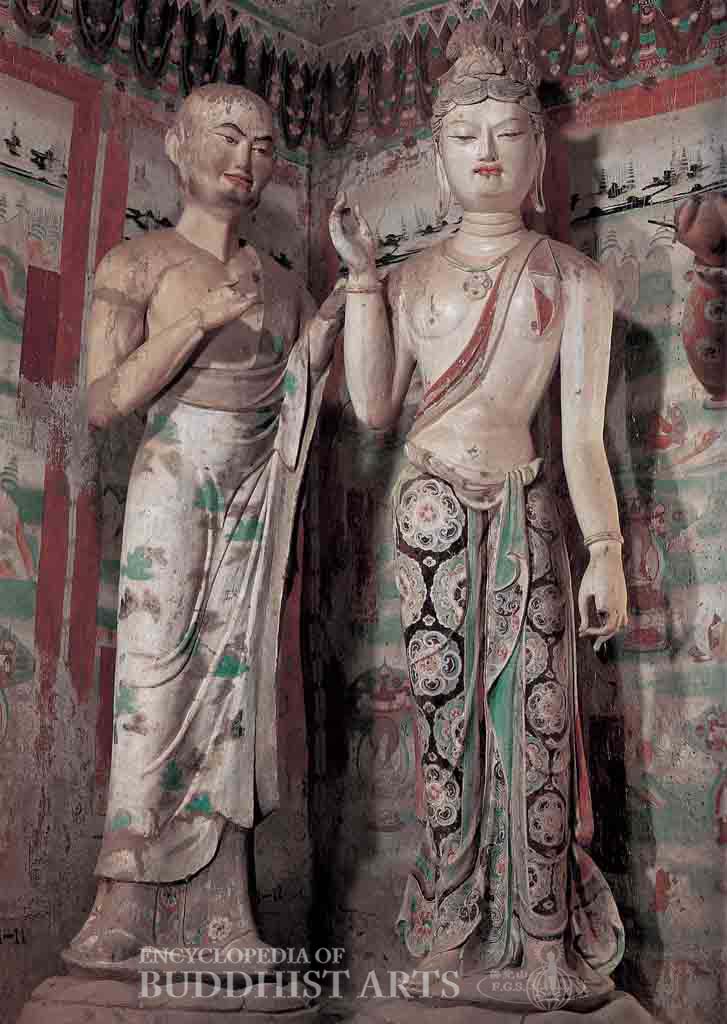
Mogao Cave 159: Bodhisattva and Disciple (back wall niche, right side)
Mogao Cave 159: Bodhisattvas and Disciples
CHINA, Gansu, Dunhuang; Tang dynasty
These Mid-Tang period (756–846) sculptures are enshrined within the niche on the back (west) wall of the main chamber of Cave 159. They are meant to flank a central Buddha statue that is now missing. The disciple Ananda is to the left of where the Buddha once stood. Ananda appears youthful, with a round face and gentle gaze. He clasps his right hand in his left before his lower abdomen, and stands barefoot on a lotus pedestal. A green inner robe with a floral-patterned hem is visible beneath the patched red outer robe. The disciple Mahakasyapa stands to the right of the missing Buddha. Differing from usual portrayals of Mahakasyapa as an aged man, this figure is relatively youthful. He has deep set eyes, thick eyebrows, and a thin smile with the mouth slightly open. Mahakasyapa wears a robe draped across the left shoulder that is decorated with green and brown leaves. He stands barefoot with both hands raised to chest level. The fingers of both hands are damaged.
Next to each disciple, a Bodhisattva stands barefoot on a lotus pedestal. The Bodhisattva beside Ananda has a high topknot and wears long, flowing robes. A celestial garment decorated with a tea flower pattern and scrolling leaves is draped over the shoulders. The left hand is raised to shoulder level, while the right hand is lowered and clasps the end of a stole. The other Bodhisattva, to the right of Mahakasyapa, has a red stole draped across the chest and wears a black lower garment embellished with circular cloud and lotus patterns.
For more details, go to the Encyclopedia of Buddhist Arts: Caves M-Mo, page 988.
Cite this article:
author = Hsingyun and Youheng and Johnson, Peter and Mankuang and Huntington, Susan and Edson, Gary and Neather, Robert,
booktitle = {Encyclopedia of Buddhist Arts: Caves M-Mo},
pages = 988,
title = {{Mogao Cave 159: Bodhisattvas and Disciples}},
volume = 7,
year = {2016}}