
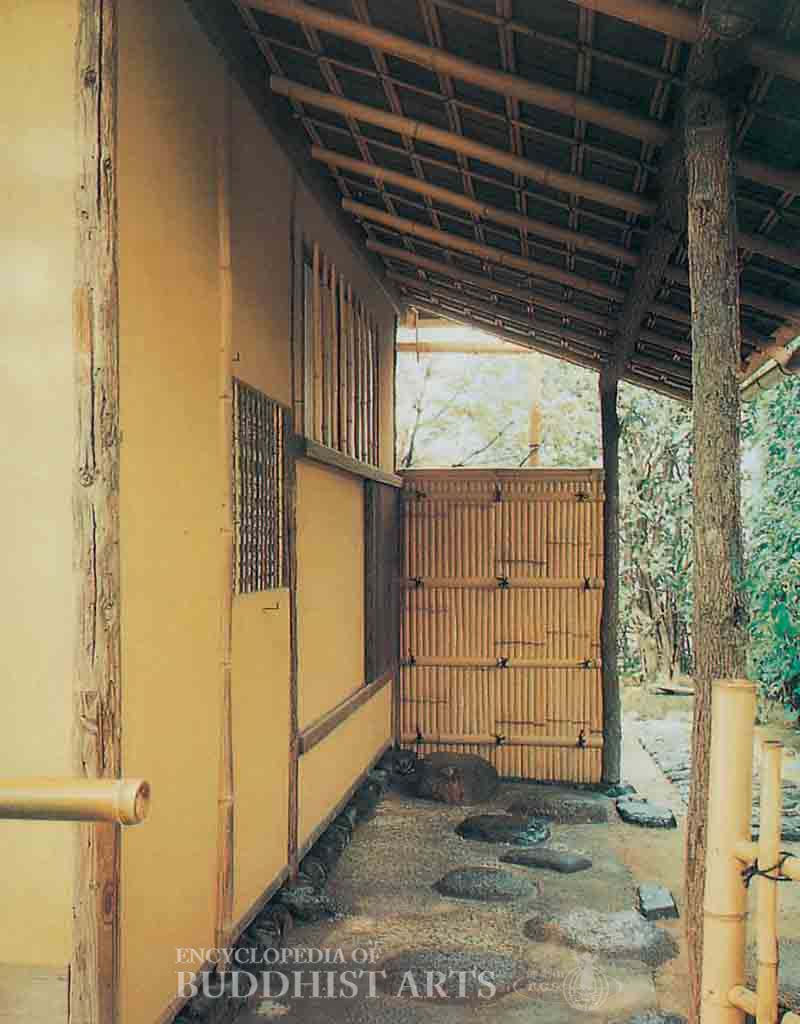
Myokian Temple Tea House: Side Entrance
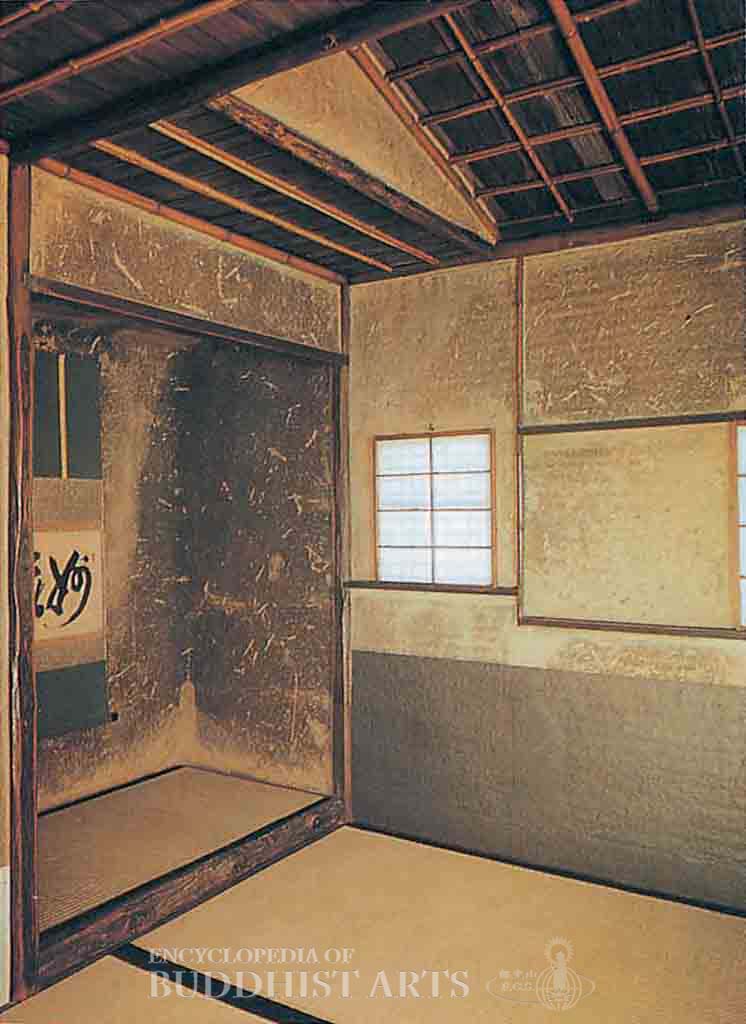
Myokian Temple Tea House (interior)
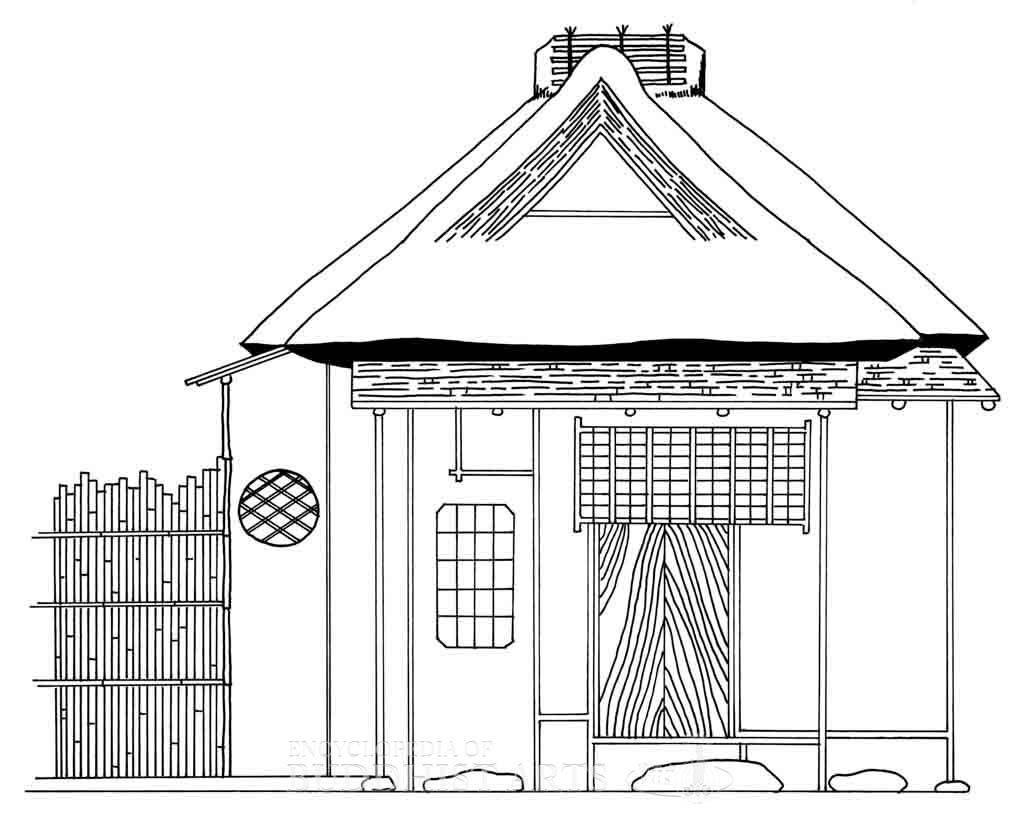
Myokian Temple Tea House (elevation drawing)
Myokian Temple Tea House
JAPAN, Kyoto
This tea house at Myokian Temple was built during the Azuchi-Momoyama period (1573–1615) by Sen no Rikyu, founder of the Japanese tea ceremony, under the instruction of General Toyotomi Hideyoshi. It was listed as a National Treasure in 1951.
The construction of tea houses originates from the tradition of tea-drinking among Zen Buddhist monks. This tea house has a single-eave hip-and-gable roof covered with cypress bark. The overhanging eaves are half the width of the room. There are stepping-stones that lead to the entrance. The low entrance means that the visitor has to bow down in respect for the tea ceremony host. This tea house has a rustic simplicity: its walls are made of clay mixed with straw, the window frames are formed from bamboo, the columns consist of plain wood, and the roof structure is exposed. There is a hanging scroll in the alcove inside the room.
For more details, go to the Encyclopedia of Buddhist Arts: Architecture M-S, page 761.
Cite this article:
author = Hsingyun and Youheng and Johnson, Peter and Mankuang and Lancaster, Lewis,
booktitle = {Encyclopedia of Buddhist Arts: Architecture M-S},
pages = 761,
title = {{Myokian Temple Tea House}},
volume = 3,
year = {2016}}