
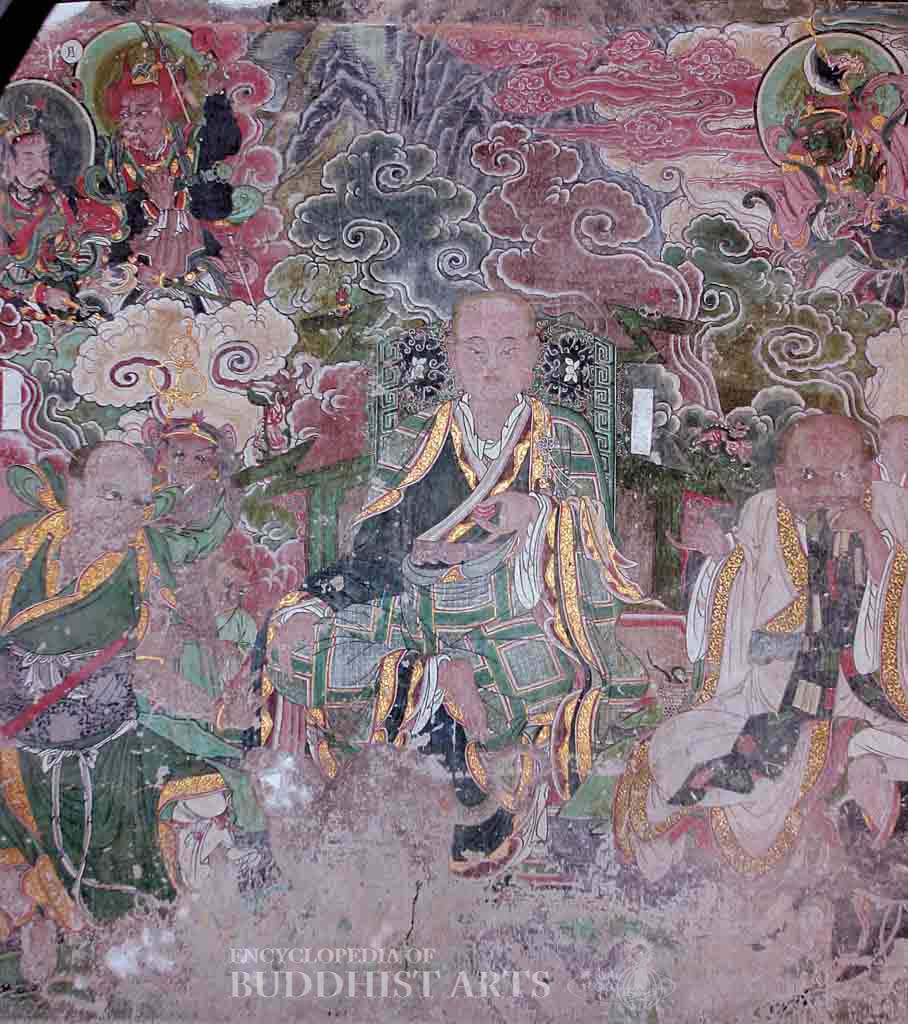
Baofan Temple Great Hero Hall: Arhats (detail)

Baofan Temple Great Hero Hall: Arhats (detail)

Baofan Temple Great Hero Hall: Arhats (detail)

Baofan Temple Great Hero Hall: Arhats (detail)
Baofan Temple Great Hero Hall: Arhats
CHINA, Sichuan, Suining; Ming dynasty
These murals, also known as the Western Pure Land Murals, are painted on the east and west walls of the Great Hero Hall in Baofan Temple. The temple was founded during the Northern Song dynasty (960–1127) and reconstructed during the Ming (1368–1644) and Qing (1644–1911) dynasties. The Great Hero Hall was rebuilt in 1450. According to historical documents, these murals were commissioned in 1466 by the monks Qingcheng and Jingyuan. They were repainted during the Qing dynasty. There are ten murals in the hall that are fairly well preserved and an additional two that are damaged.
The Arhats are portrayed according to descriptions in the Records of Nandimitra’s Discourse on Abiding Dharma. In the text, the Arhats are described thus: “the Sixteen Arhats and their subordinates travel to different places, appear in different forms to hide their identities, receive offerings, and reward good deeds. The Sixteen Arhats are not only the protectors of the Dharma, they have great love for the world as well.”
The first picture features an Arhat holding a pearl between his left thumb and forefinger. He wears a monastic robe and sits on a decorated chair. The Arhat on the left appears to be subduing a leaping tiger that has been obscured by damage. On the right, an Arhat holds a robe in one hand and a needle in the other as if he has just finished sewing and is now putting away the needle and cutting the thread. In the other images, the Arhats are usually shown in pairs conversing with one another. Heavenly beings and attendants stand in various poses beside them. The heavenly beings have nimbuses and stand on clouds. They resemble kings, ministers, or generals, wear long robes with wide sleeves, armor, or celestial garments, and hold imperial court batons or swords, or join their palms in reverence. Each heavenly being has a unique facial expression.
The detailed figures are set against a background of mountains, rocks, and decorative clouds. A clear hierarchy is presented, with the Arhats as the tallest and largest figures, followed by the heavenly beings and the attendants. The murals are painted in rich hues supplemented with gold foil. The bright, contrasting colors and the intricate details make these murals some of the finest artworks found in Sichuan.
For more details, go to the Encyclopedia of Buddhist Arts: Painting A-H, page 90.
Cite this article:
author = Hsingyun and Youheng and Youlu and Wilson, Graham and Manho and Mankuang and Huntington, Susan,
booktitle = {Encyclopedia of Buddhist Arts: Painting A-H},
pages = 90,
title = {{Baofan Temple Great Hero Hall: Arhats}},
volume = 14,
year = {2016}}