
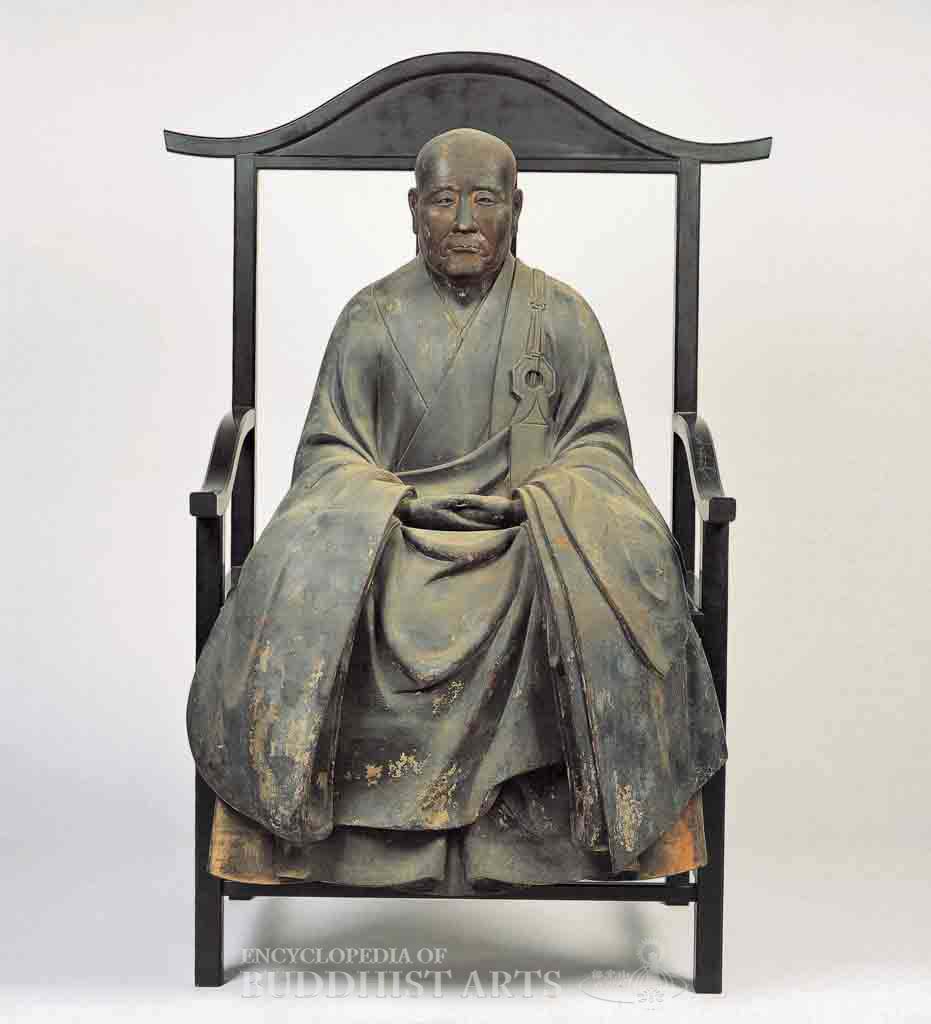
Zekkai Chushin; Muromachi period
Wood
Zekkai Chushin
JAPAN; Muromachi period
Zekkai Chushin, posthumously known as National Master Bucchi Kosho, was a Zen master of the Rinzai school as well as a calligrapher. He entered Tenryuji Temple in Kyoto at the age of 13 as an attendant to Zen Master Muso Soseki, later joining the monastic order when he turned 15 and receiving his ordination precepts under Shunoku Myoha. At age 18, he went on to study under Ryuzan Tokken at Kenninji Temple in Kyoto, and later under Hogyu Korin who had recently returned from studying under the influential literary monk Gulin Qingmao.
Master Zekkai went to China in 1368 and studied poetry and literature under monk Jitan Zongle, monk Quanshi, and Song Jinglian. He was thus known, along with Gido Shushin, as the Twin Jade of the Literature of the Five Mountains, among being the highest ranking monk, or Soroku. When he returned to Japan in 1376, he became the trusted adviser to Shogun Ashikaga Yoshimitsu and the abbot of Tojiji Tempole and Shokokuji Temple.
His painting style was greatly influenced by the Chinese style. Master Zekkai learned calligraphy from Chan Master Qingyuan Huaiwei and his calligraphic style resembled that of Zhao Mengfu. The characters were solid and well disposed, and the compositions vertically structured and sparse, appearing dignified. His extant calligraphic works include the Ten Ox Herding Verses and Inscription to the Landscape Painting of Hanshan’s Journey, both of which are listed as Important Cultural Properties and kept at Shokokuji Temple in Kyoto; Letter of Appointment, kept at Engakuji Temple in Kanagawa; and Poem by Master Xuefeng Dongshan, kept at Rinkoin Temple in Kyoto. His poetry works include Shokenshu and the Words of Zekkai Chushin.
For more details, go to the Encyclopedia of Buddhist Arts: People, page 331.
Cite this article:
author = Hsingyun and Youheng and Youlu and Pokorski, Stefanie and Yichao and Mankuang and Miaohsi,
booktitle = {Encyclopedia of Buddhist Arts: People },
pages = 331,
title = {{Zekkai Chushin}},
volume = 19,
year = {2016}}