
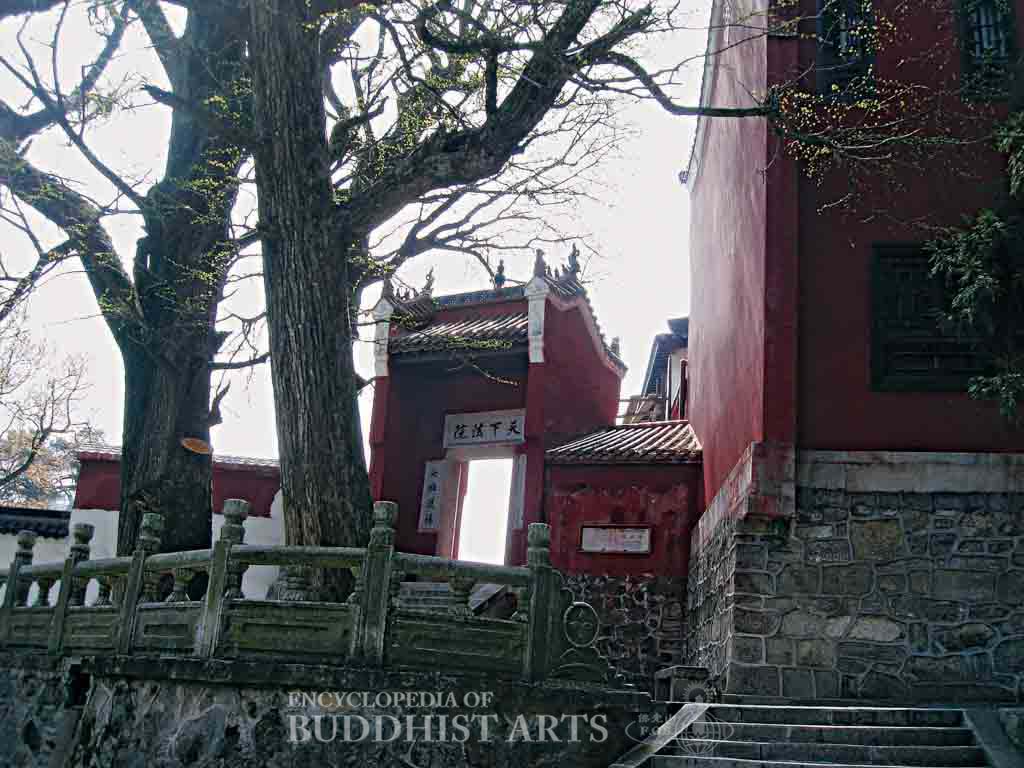
Fuyan Temple: Main Temple Gate
Fuyan Temple
CHINA, Hunan, Hengyang
Fuyan means Blessed and Solemn. The temple is located beneath Zhibo Peak in Nanyue, Hengyang. It is considered to be the first among the Five Major Temples of Hengshan. The temple was established in 567 during the Chen dynasty by Master Huisi, the Second Patriarch of the Tiantai school. Master Huairang started propagating the Sudden School of Chinese Chan Buddhism at this temple in 713 during the Tang dynasty. Toward the end of the Tang dynasty (618–907), Master Huairang’s Chan teachings laid the foundations for the Guiyang and Linji schools. The disciples of the Southern Chan school later viewed this temple as their court of Dharma succession. It was expanded during the early years of the Northern Song dynasty (960–1127), but was later destroyed. The temple was rebuilt in 1870 during the Qing dynasty. It was listed as a key Buddhist temple in the Han region of China in 1983.
The temple was built into the terrain. The principal buildings include the main temple gate, reception hall, Mountain Deity Shrine, Great Hero Hall, Patriarch Hall, abbot’s quarters, and Dharma Hall. The main temple gate consists of a single doorway with a flush gable roof.
The Three Lives Pagoda in front of the temple was built in memory of Master Huisi. A mountain spring called Tiger Run is located on the east side of the temple. Next to the spring there is a stone stele recording the history of Huisi’s construction of the temple. Nearby, there is the Grinding Stone Platform, whose origins derive from Huairang’s aphorism that “grinding a stone cannot turn it into a mirror; similarly, sitting meditation cannot produce enlightenment.” He used this aphorism to teach his disciple Mazu Daoyi. In 1984 the Buddhist statues within the temple were completely reconstructed. It is currently a temple for nuns.
For more details, go to the Encyclopedia of Buddhist Arts: Architecture A-F, page 348.
Cite this article:
author = Hsingyun and Youheng and Johnson, Peter and Mankuang and Lancaster, Lewis,
booktitle = {Encyclopedia of Buddhist Arts: Architecture A-F},
pages = 348,
title = {{Fuyan Temple}},
volume = 1,
year = {2016}}