
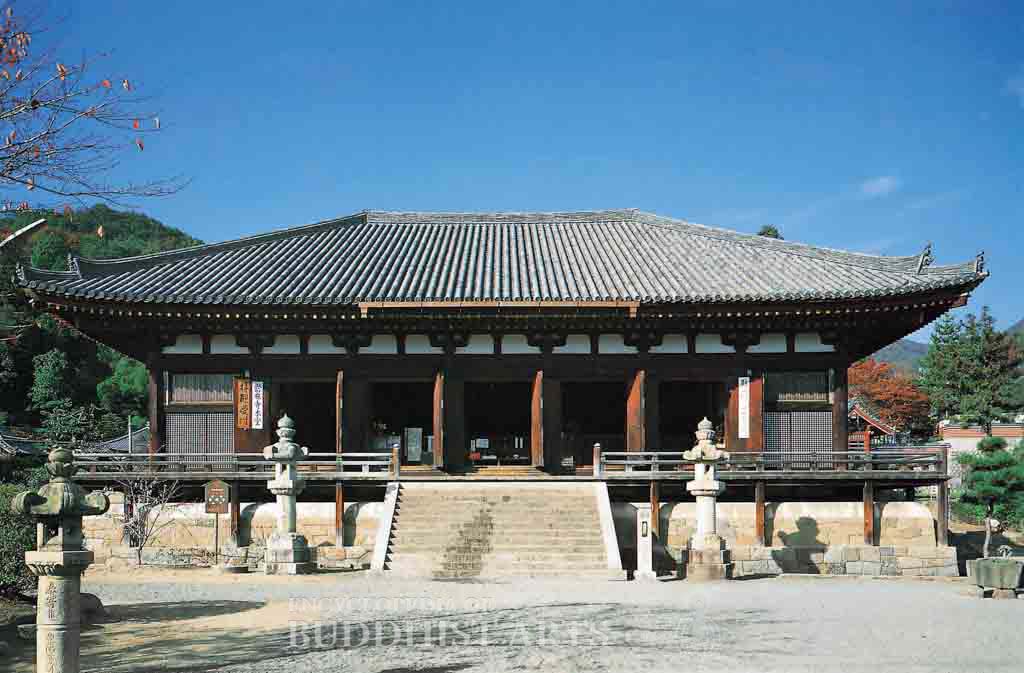
Taimadera Temple: Main Hall
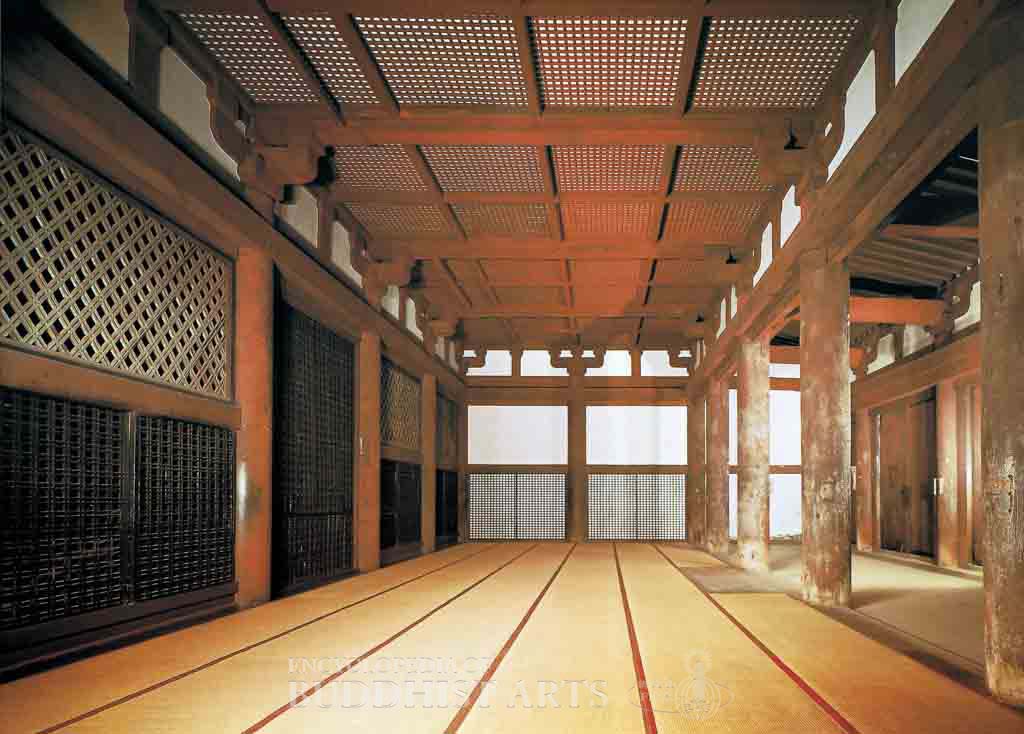
Taimadera Temple: Main Hall (interior)
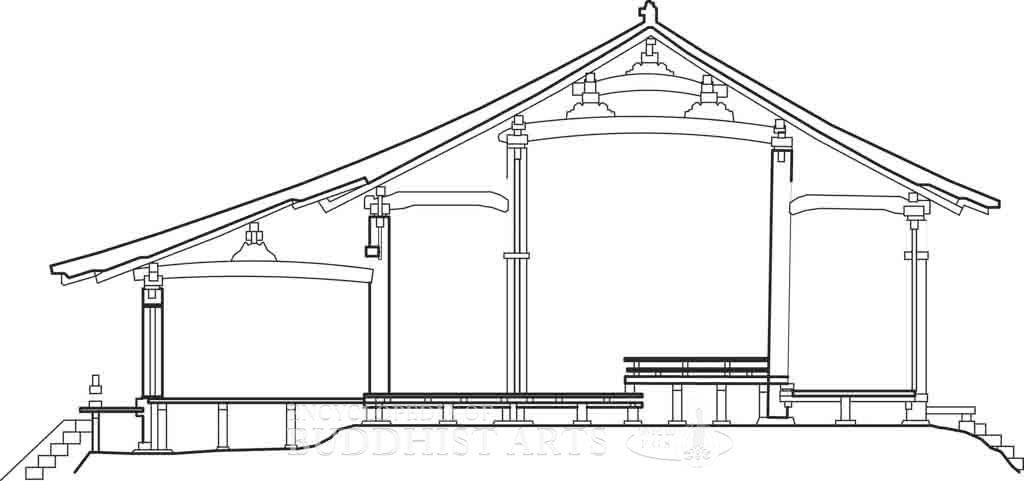
Taimadera Temple: Main Hall (section drawing)
Taimadera Temple
JAPAN, Nara, Katsuragi
Also known as Nijosan Zenrinji, the temple belongs to both the Shingon and Pure Land schools of Japanese Buddhism. It is said that Prince Maroko built a temple named Zenrinji in Kawachi in 612. It was subsequently moved to Nara in 682 during the Hakuho period, and was renamed Taimadera the following year. It was the family temple of the wealthy Taima family and a statue of Maitreya Buddha was enshrined there. A disastrous fire destroyed the temple in 1180, during the Heian period. It was rebuilt by Minamoto no Yoritomo during the Kamakura period (1185–1333).
The principal buildings of the temple include the Gate of Benevolent Kings, the Medicine Buddha Hall, Golden Hall, lecture hall, Great Master Hall, Amitabha Hall, and abbot’s quarters, as well as east pagoda, west pagoda, and main hall, which were listed as National Treasures in 1952.
The main hall was constructed between the late Nara (710–794) and early Heian (794–1185) periods and underwent a major renovation in 1161. The seven-by-six bay hall retains most of the original building material. It has a single-eave hip roof covered with cylindrical tiles. At the front there is an extension serving as an area for worship. The interior of the hall has a framework supporting the roof consisting of double rainbow beams separated by frog-leg struts. The Taima Mandala, which is a representation of the Pure Land, is enshrined within the hall and for this reason it is also known as the Mandala Hall.
The five-by-four bay Golden Hall, rebuilt during the Kamakura period, has a hip-and-gable roof covered with cylindrical tiles. It has an earthen floor. Statues of a seated Maitreya Buddha and the Four Heavenly Kings are enshrined within the hall. The statue of the Maitreya Buddha was listed as a National Treasure.
For more details, go to the Encyclopedia of Buddhist Arts: Architecture T-Z, page 1077.
Cite this article:
author = Hsingyun and Youheng and Johnson, Peter and Mankuang and Lancaster, Lewis,
booktitle = {Encyclopedia of Buddhist Arts: Architecture T-Z},
pages = 1077,
title = {{Taimadera Temple}},
volume = 4,
year = {2016}}