
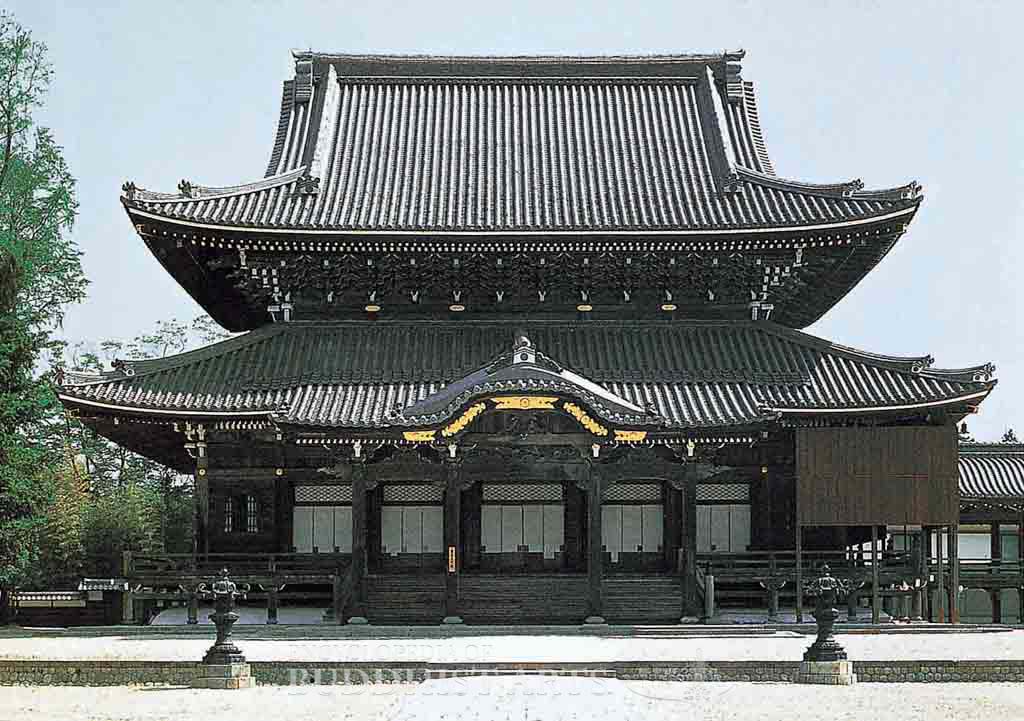
Senjuji Temple: Tathagata Hall
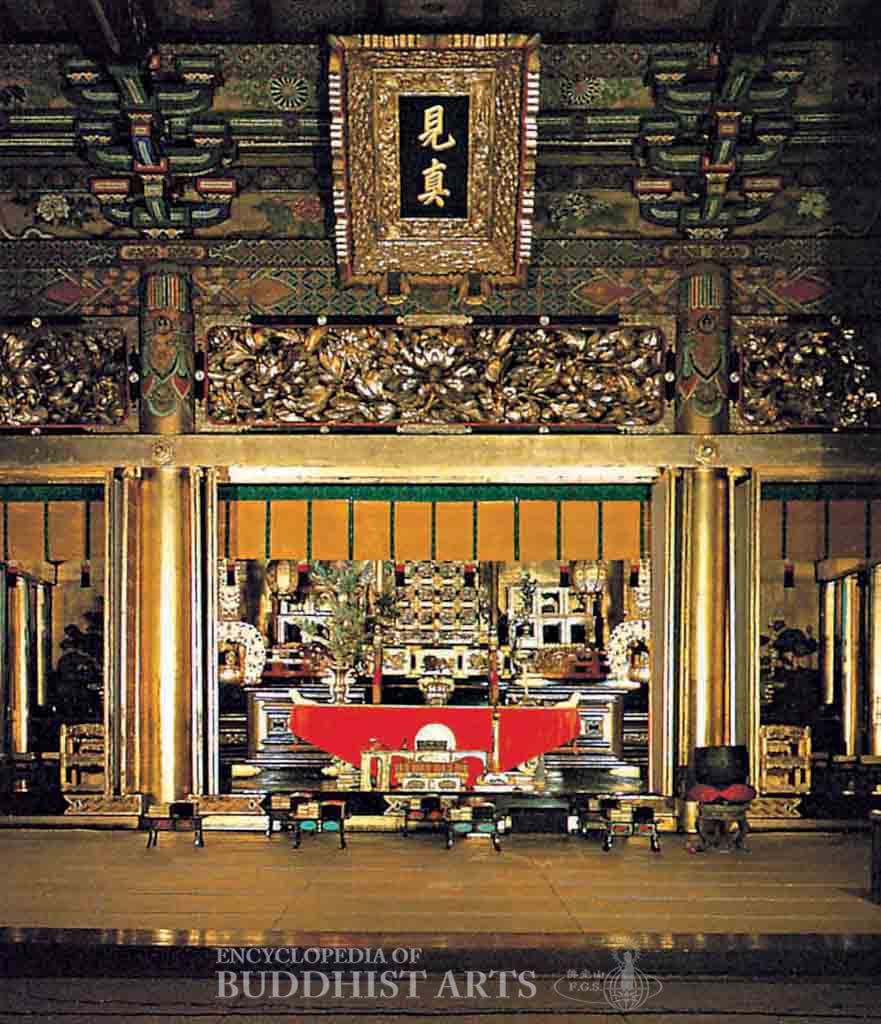
Senjuji Temple: Founder's Hall (interior)
Senjuji Temple
JAPAN, Mie, Tsu
Senjuji means Specific Practice Temple. It is the head temple of the Takada branch of Shinshu school of Japanese Buddhism. It was founded in 1226 during the Kamakura period by Shinran. After it was burned down during the rule of Emperor Go-Kashiwabara (reigned 1500–1526), the temple was relocated to Muryojuji Temple by Master Shinran’s disciple. The temple was named after Master Shinran’s practice of reciting the Buddha’s name. It underwent repeated fires and in 1658 during the Edo period, the temple was re-established by Todo Takatsugu.
The temple buildings include the mountain gate, Chinese gate, drum tower gate, as well as the founder’s hall and Tathagata Hall, which were listed as Important Cultural Properties in 1961. The founder’s hall and Tathagata Hall stand next to each other and are connected by a walkway. The nine-by-nine bay founder’s hall is the main hall and was built in 1666 during the Edo period. The floor is laid with 725 tatami mats. The beams and bracket sets are colorfully painted and exquisitely decorated. A wooden sculpture of Master Shinran is enshrined within the hall.
The seven-by-six bay Tathagata Hall, completed in 1748 during the Edo period, has a hip-and-gable roof. The hall’s rafters and complicated bracket sets are features of Zen Buddhist architecture. A statue of Amitabha Buddha is enshrined in the center, along with statues of Prince Shotoku and eminent monks of the Pure Land school on either side of the hall. National treasures, such as copies of Master Shinran’s Three Collections of Praising Hymns and Collection of Passages Expounding the Pure Land are housed within the temple.
For more details, go to the Encyclopedia of Buddhist Arts: Architecture M-S, page 952.
Cite this article:
author = Hsingyun and Youheng and Johnson, Peter and Mankuang and Lancaster, Lewis,
booktitle = {Encyclopedia of Buddhist Arts: Architecture M-S},
pages = 952,
title = {{Senjuji Temple}},
volume = 3,
year = {2016}}