
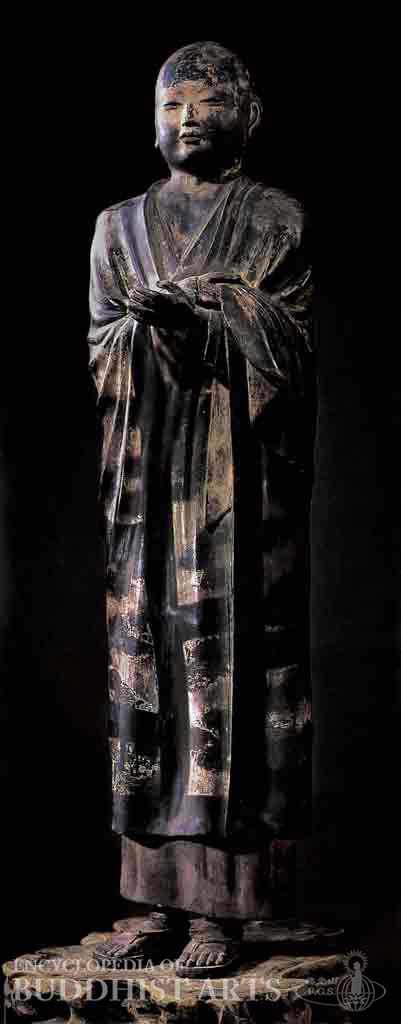
Kofukuji Temple: Ten Great Disciples - Subhuti
Dry lacquer
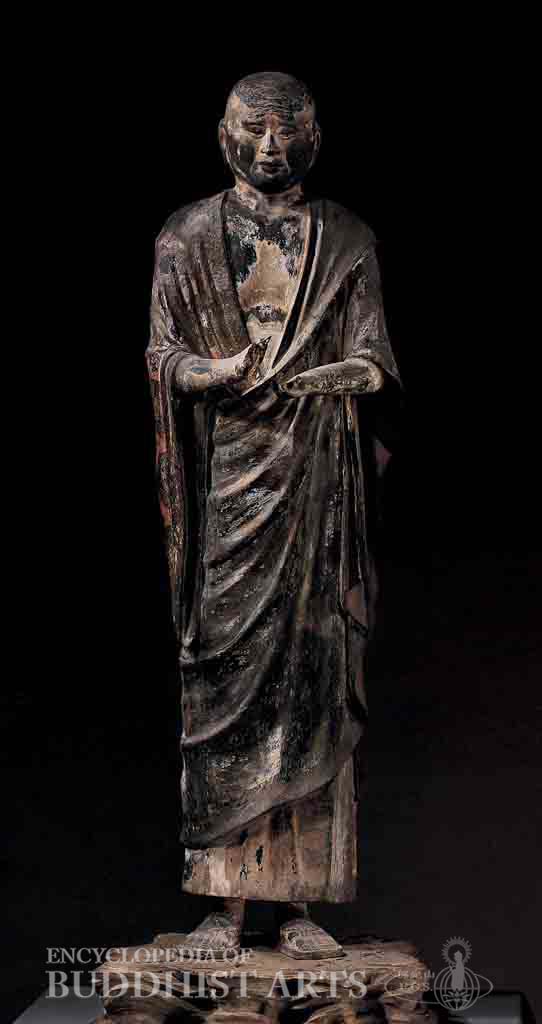
Kofukuji Temple: Ten Great Disciples - Maudgalyayana
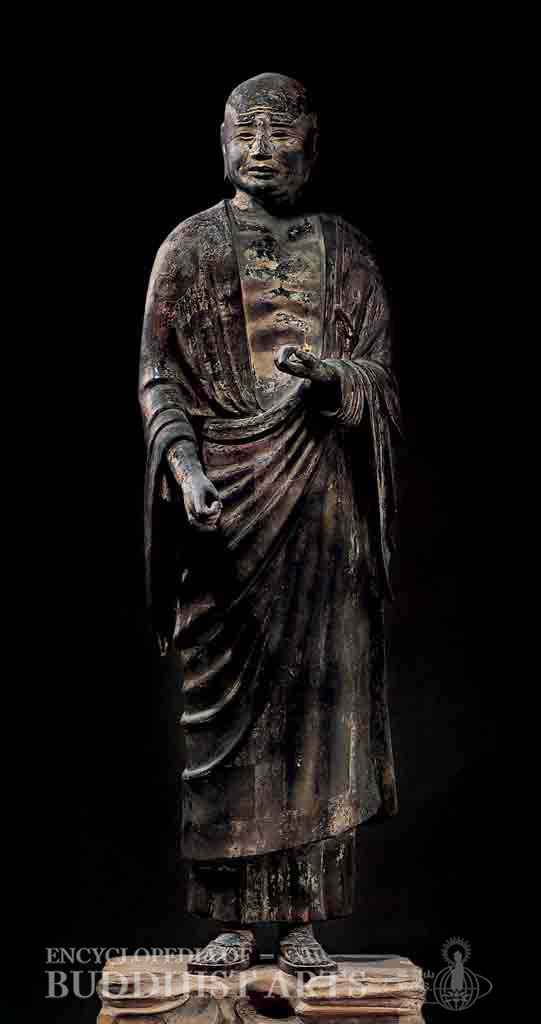
Kofukuji Temple: Ten Great Disciples - Purna
Kofukuji Temple: Ten Great Disciples
JAPAN, Nara; Nara period
These statues of the Buddha’s disciples originally surrounded the figure of Sakyamuni Buddha in the West Golden Hall of Kofukuji Temple, they are now kept at the National Treasure Museum. They were commissioned by the Empress Komyo in 734 on the first anniversary of her mother’s death, and were sculpted by Shogun Manpuku. Of the original ten, only six now remain: Sariputra, Maudgalyayana, Subhuti, Purna, Katyayana, and Rahula. They were listed as National Treasures in 1951.
The statues were created by the hollow dry-lacquer technique and reinforced with a wooden framework. The figures are realistically posed and the flowing lines of their monastic robes are vividly sculpted. For the most part, they face frontwards and have slender builds and small heads but each is individually characterized. Of those pictured here, the youthful Subhuti extends his left hand while holding his robe in place with the right hand. Maudgalyayana’s arms have been damaged; the eyes are lowered in his lined face. Purna looks even older and his exposed chest is wasted as he looks slightly to one side. Renowned as “pre-eminent in teaching,” his hands are lightly flexed as if expounding some doctrinal point.
For more details, go to the Encyclopedia of Buddhist Arts: Sculpture G-M, page 541.
Cite this article:
author = Hsingyun and Youheng and Lovelock, Yann and Chou, Yuan and Huntington, Susan and Edson, Gary and Neather, Robert,
booktitle = {Encyclopedia of Buddhist Arts: Sculpture G-M},
pages = 541,
title = {{Kofukuji Temple: Ten Great Disciples}},
volume = 11,
year = {2016}}