
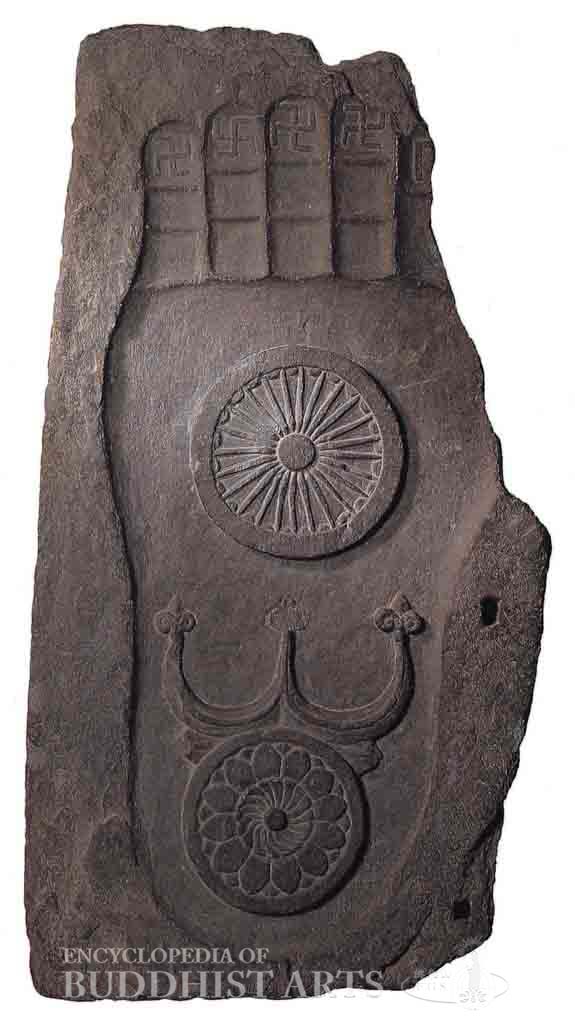
Sikri: Footprint of the Buddha
Schist
Sikri: Footprint of the Buddha
PAKISTAN, Balochistan, Sikri; Kushan period
This carving is the largest Gandharan footprint found so far. The upper joints of the toes are marked with the auspicious swastika, with the symbol on the fourth toe reversed. A large Dharma wheel is located on the sole, while beneath it is the triratna, the symbol of the triple gem, which is balanced on a lotus at the heel.
For more details, go to the Encyclopedia of Buddhist Arts: Sculpture N-Sr, page 1092.
Cite this article:
Hsingyun, et al. "Sikri: Footprint of the Buddha." Encyclopedia of Buddhist Arts: Sculpture N-Sr, vol. 12, 2016, pp. 1092.
Hsingyun, Youheng, Yann Lovelock, Yuan Chou, Susan Huntington, Gary Edson, and Robert Neather. 2016. "Sikri: Footprint of the Buddha" In Encyclopedia of Buddhist Arts: Sculpture N-Sr, 12:1092.
Hsingyun, Youheng, Lovelock, Y., Chou, Y., Huntington, S., Edson, G., & Neather, R.. (2016). Sikri: Footprint of the Buddha. In Encyclopedia of Buddhist Arts: Sculpture N-Sr (Vol. 12, pp. 1092).
@misc{Hsingyun2016,
author = Hsingyun and Youheng and Lovelock, Yann and Chou, Yuan and Huntington, Susan and Edson, Gary and Neather, Robert,
booktitle = {Encyclopedia of Buddhist Arts: Sculpture N-Sr},
pages = 1092,
title = {{Sikri: Footprint of the Buddha}},
volume = 12,
year = {2016}}
author = Hsingyun and Youheng and Lovelock, Yann and Chou, Yuan and Huntington, Susan and Edson, Gary and Neather, Robert,
booktitle = {Encyclopedia of Buddhist Arts: Sculpture N-Sr},
pages = 1092,
title = {{Sikri: Footprint of the Buddha}},
volume = 12,
year = {2016}}