
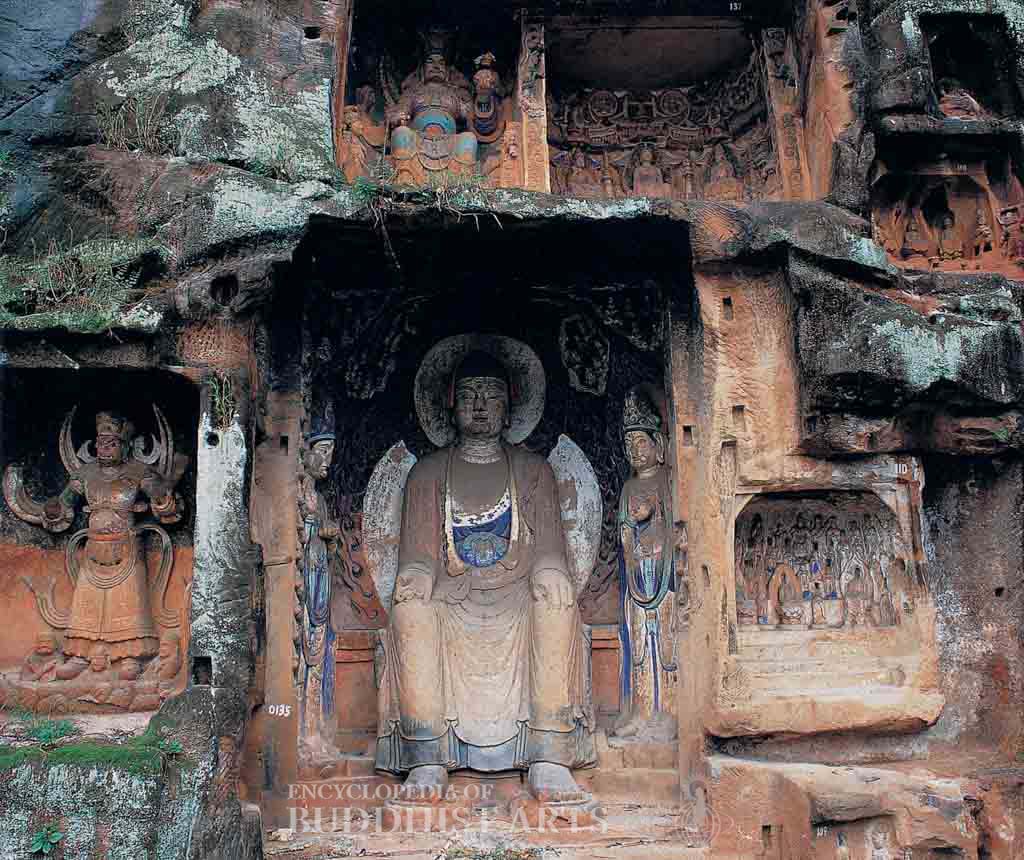
Jiajiang Thousand Buddha Rock Carvings: Niche 135
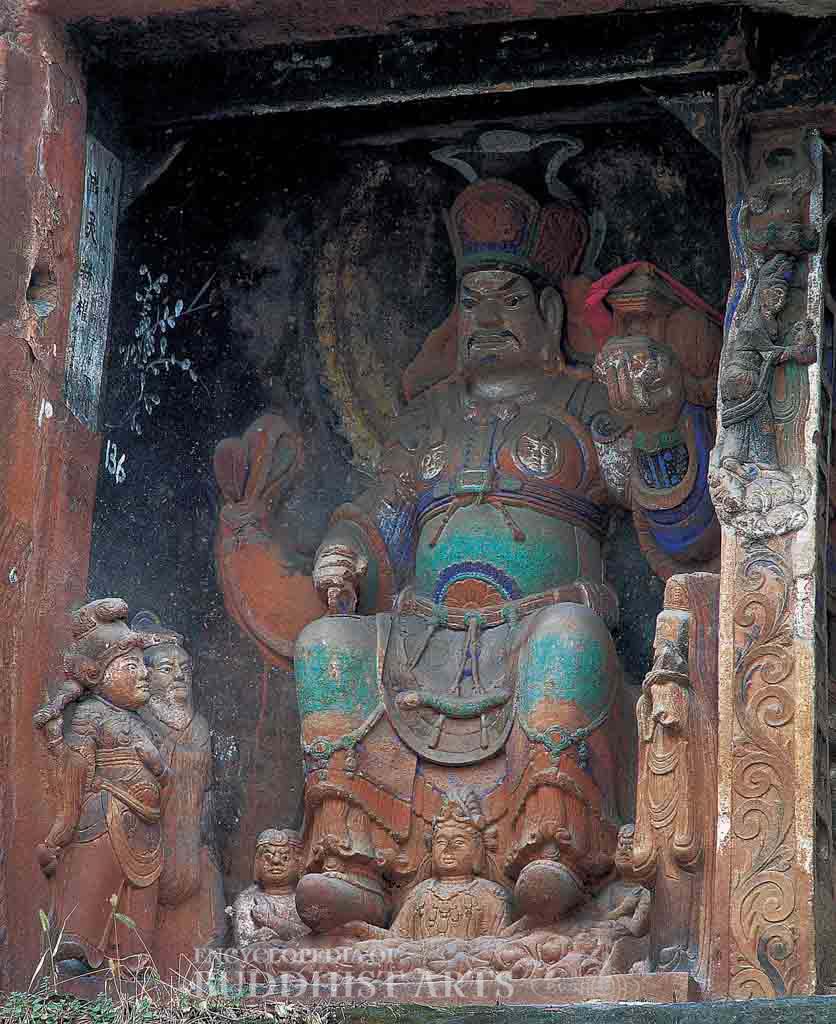
Jiajiang Thousand Buddha Rock Carvings: Niche 136 - Vaisravana
Jiajiang Thousand Buddha Rock Carvings
CHINA, Sichuan, Leshan
Also known as the “West Cliff,” the Jiajiang Thousand Buddha Rock Carvings are located among the cliffs on the banks of the Qingyi River, 2.5 km west of Jiajiang county. Featuring numerous towering peaks and steep cliffs carved with thousands of Buddhist sculptures, construction of this site took place throughout the Tang dynasty (618–907), and even continued after the persecution of Buddhism during the rule of Emperor Wuzong (reigned 840–846). The site was listed as a National Cultural Heritage Site in 2006.
There were originally 162 niches, but currently, 153 remain. In total, there are approximately 2,500 sculptures within these niches. Either square or oblong with flat ceilings, the arrangement of niches include: a Buddha and two Bodhisattvas, three or four Buddhas, a single Buddha with two Bodhisattvas and two warriors, a Buddha triad with two disciples and two warriors, a single Avalokitesvara Bodhisattva, or a depiction of Vaisravana.
The main images of Niche 4 feature the Avatamsaka Triad, which include Vairocana Buddha, Samantabhadra Bodhisattva, and Manjusri Bodhisattva. Similarly, Niche 99 illustrates the Western Pure Land featuring the Amitabha Buddha Triad. Although the heads of the figures in this triad are damaged, the niche still retains vivid reliefs of the main shrine, with a double-eave hip-and-gable roof, sutra pillars, apsaras, and heavenly beings who are listening attentively to the Dharma. Niches 136 and 159 primarily feature a seated Vaisravana, whose image was a popular depiction during the Tang dynasty. Niche 91 houses the Masters of Sizhou, and Niche 135 contains an exquisite and well-proportioned 2.7 m high Maitreya Buddha.
For more details, go to the Encyclopedia of Buddhist Arts: Caves R-L, page 432.
Cite this article:
author = Hsingyun and Youheng and Johnson, Peter and Mankuang and Huntington, Susan and Edson, Gary and Neather, Robert,
booktitle = {Encyclopedia of Buddhist Arts: Caves R-L},
pages = 432,
title = {{Jiajiang Thousand Buddha Rock Carvings}},
volume = 6,
year = {2016}}