
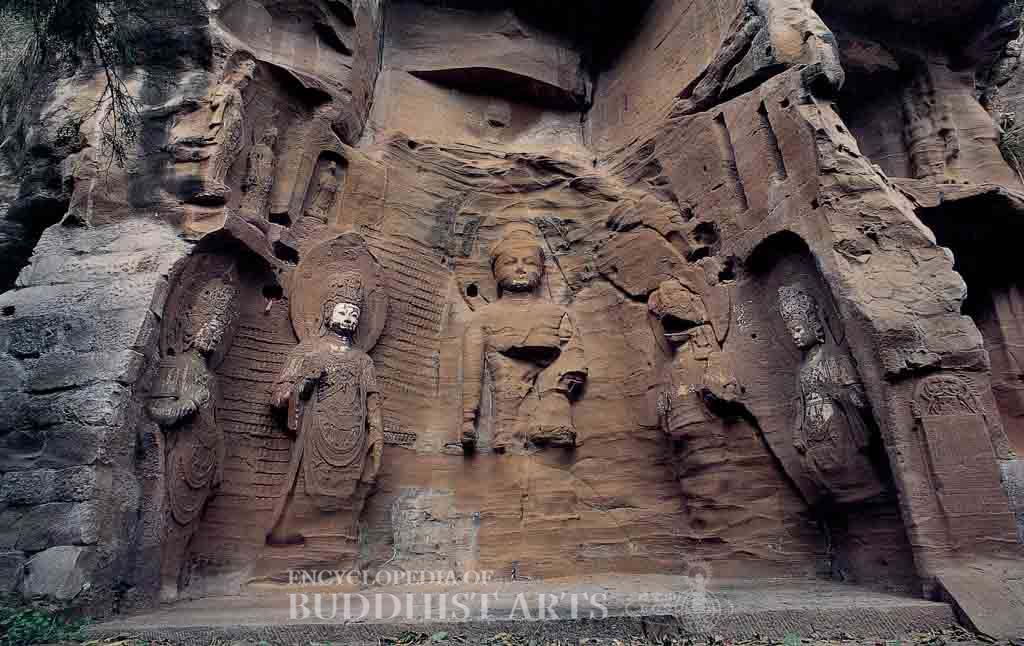
Anyue Rock Carvings: Qianfozhai Cave 56 - Buddha and Four Bodhisattvas
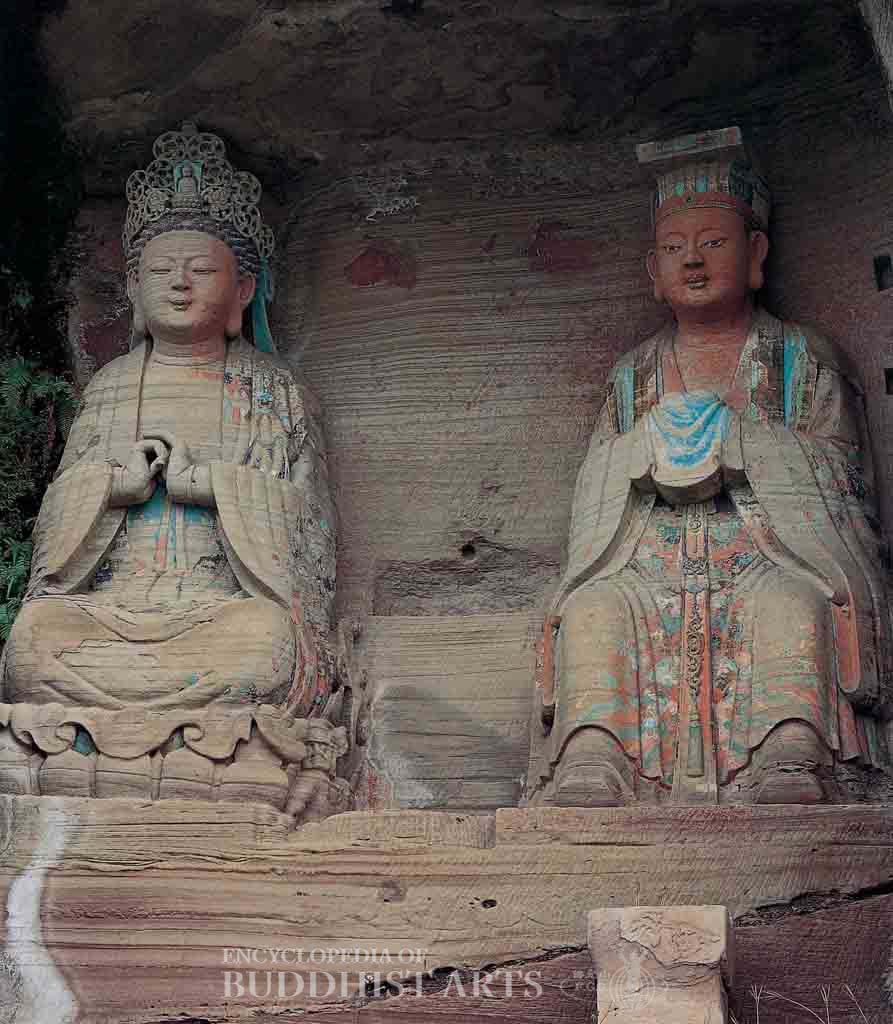
Anyue Rock Carvings: Mingshan Temple Cave 1 - Vairocana Buddha and Deity of the East Mountain
Anyue Rock Carvings
CHINA, Sichuan, Ziyang
The Anyue Rock Carvings are scattered over a number of geographical locations: Wofogou (Reclining Buddha Valley), Yunjushan (Cloud Dwelling Mountain), Dayunshan (Great Cloud Mountain), Jueshan (Stone Mountain), Xianggaishan (Box Lid Mountain), and Hutoushan (Tiger Head Mountain). The earliest carvings were created during the Tang dynasty (618–907), but the site’s popularity peaked during the Song dynasty (960–1279). In total, the Anyue Rock Carvings are comprised of 105 cliff carvings, 1,298 niches, and more than 20,000 sculptures. During the middle of the Northern Song dynasty (960–1127), many of the artists formerly working at Anyue moved to other sites, particularly Dazu; there is therefore a strong connection in style between the rock carvings of Anyue and Dazu.
The majority of the sculptures are within the sites of: Wofo (Reclining Buddha) Temple, Yuanjue (Perfect Enlightenment) Caves, Qianfozhai (Thousand Buddha Village), Vairocana Caves, Huayan (Avatamsaka) Caves, Mingshan (Tea Mountain) Temple, and Houjiawan. Other sculptures are scattered in Xuanmiao Daoist Temple, Muyushan (Wooden Fish Mountain), Jinghuiyan (Pure Wisdom Cliff), Tapo (Stupa Slope), Gaoshenghuofoyan (Rising Fire Buddha Cliff), Peacock Cave, and Antang Temple. Many of these areas are listed as National Cultural Heritage Sites, while the rest of them are listed at the provincial or county level.
Wofo Temple is situated in Wofogou, and houses 139 niches of various sizes and more than 1,600 sculptures in total. The focal point of the site is the 23 m long reclining Sakyamuni Buddha in Niche 3. Also of particular interest at this site are 15 sutra caves on the southern cliff of the valley, covering a total of 130 sq m and containing approximately 400,000 characters.
The Yuanjue Caves are named after the Twelve Yuanjue (Perfect Enlightenment) Bodhisattvas carved at the site. The caves are located on the northern and southern slopes of Yunjushan. They were first carved during the Tang dynasty, but now contain sculptures made primarily during the Five Dynasties (907–960) and Song dynasty. There are currently 103 niches and 1,933 sculptures of different sizes at the site. A large majority of the images are Buddhist, but there are also depictions of Daoist figures. Of particular interest is Buddha Holding a Flower, Thousand-Armed Avalokitesvara, Padmapani Avalokitesvara, and the Sixteen Arhats.
Qianfozhai, situated on Dayunshan, has a total of 105 niches and 3,061 sculptures, most of which were made between the Tang and Northern Song dynasties. Cave 56 contains the most highly regarded Tang sculptures: a Buddha and four Bodhisattvas each measuring over 3 m high. Of the Song sculptures at the site, the illustration of the Medicine Buddha Sutra at Cave 96 is the finest.
The Vairocana Caves are located on Jueshan and were excavated between 936 and 944 during the Later Jin dynasty. This site has a total of 20 caves and niches, though 6 are now empty. There are also 465 sculptures of different sizes, and 32 cliff carvings and stele inscriptions. It is believed that this used to be the main practice center of the monk Liu Benzun. Sculptures of particular interest at this site include the depictions of Liu Benzun and his ascetic practices in Caves 8 and 10, as well as Cave 19’s Water-Moon Avalokitesvara, considered to be an artistic treasure among Northern Song rock carvings.
The construction of the Huayan Caves, located on Xianggaishan, likely started as early as the Northern Song dynasty and lasted until the Ming dynasty (1368–1644). The existing region includes Cave 1 and Cave 2, with a total of 159 sculptures.
Mingshan Temple, situated on Hutoushan, comprises 20 niches containing 63 images, as well as 19 stele inscriptions and four cliff carvings. The sculptures, showing the integration of Buddhism, Daoism, and Confucianism, were mainly constructed during the early Northern Song dynasty and restored during the Ming and Qing (1644–1911) dynasties. Featured among the sculptures is the 6.3 m high Vairocana Buddha. Cave 1 is representative of the combination of Buddhism and Daoism in the region, with a Ming dynasty sculpture of Vairocana Buddha on the right side of the cave and a Qing dynasty sculpture of the Deity of the East Mountain on the left. Both statues measure 3.4 m in height.
Houjiawan, located in Tapo in Lingfeng town, has 15 niches with sculptures carved during the mid to late Tang dynasty. Most of the main figures at the site are of Maitreya Buddha seated with legs pendent.
For more details, go to the Encyclopedia of Buddhist Arts: Caves A-E, page 63.
Cite this article:
author = Hsingyun and Youheng and Johnson, Peter and Mankuang and Huntington, Susan and Edson, Gary and Neather, Robert,
booktitle = {Encyclopedia of Buddhist Arts: Caves A-E},
pages = 63,
title = {{Anyue Rock Carvings}},
volume = 5,
year = {2016}}