
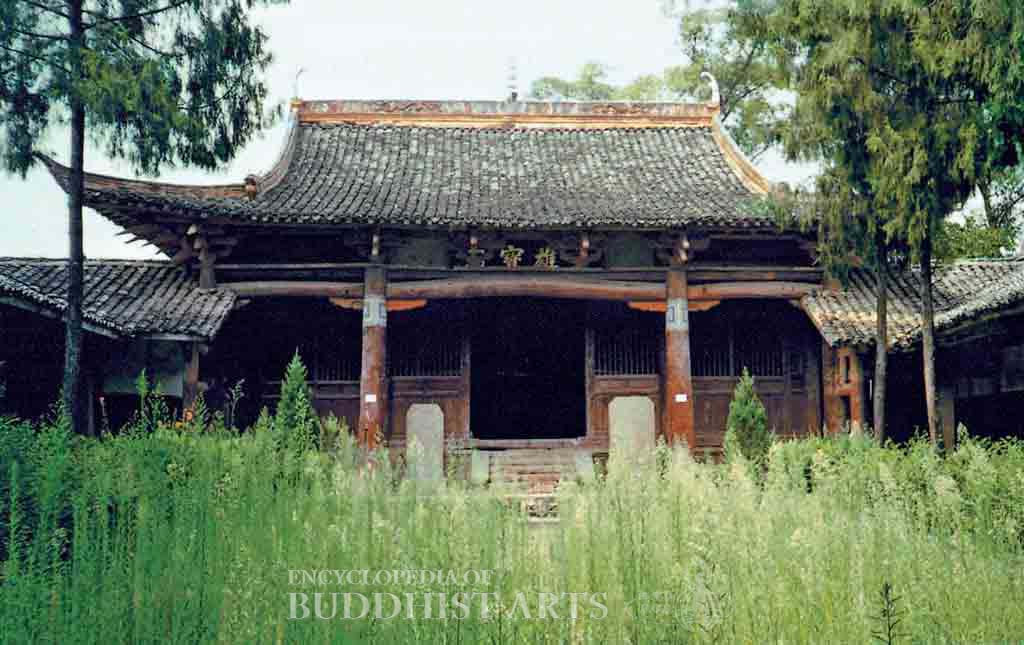
Yong’an Temple: Great Hero Hall
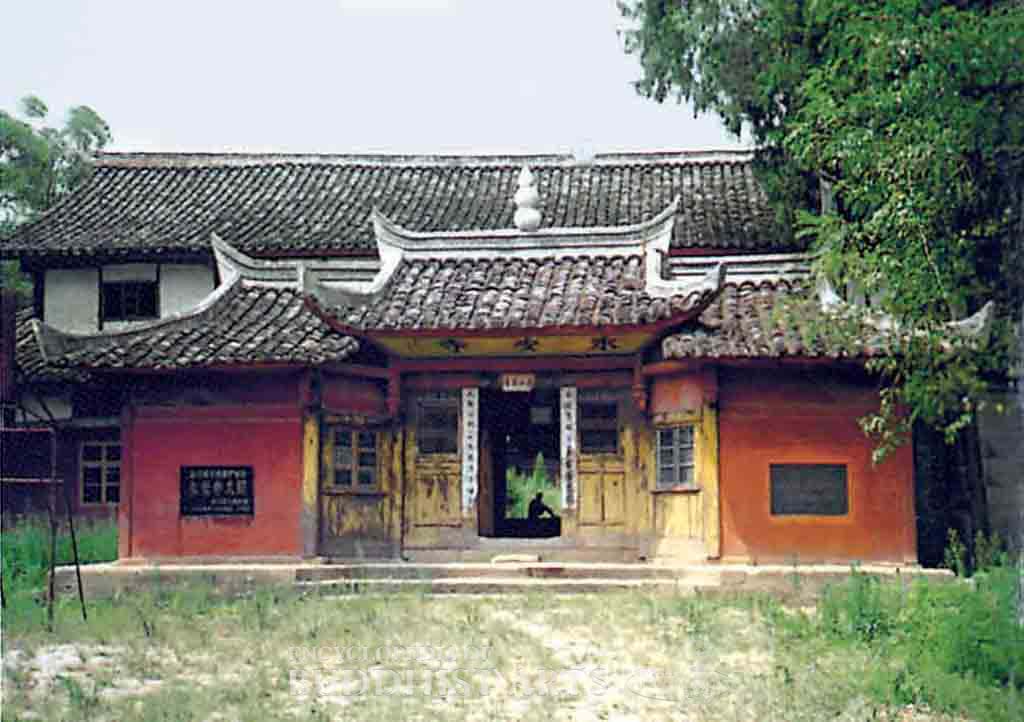
Yong’an Temple: Main Temple Gate
Yong’an Temple
CHINA, Sichuan, Nanchong
Yong’an means Eternal Stability. The temple was established during the Tang dynasty (618–907) and has been repaired a number of times throughout its history. It was listed as a National Cultural Heritage Site in 2001.
The temple faces south and occupies 1.3 ha, with the buildings taking up 1,200 sq m. Along the central axis there are the main temple gate, Avalokitesvara Hall, and the Great Hero Hall, with subsidiary buildings along the sides. The Great Hero Hall was built in 1333 during the Yuan dynasty, while the other buildings were built either during the Ming (1368–1644) or Qing (1644–1911) dynasties.
The main temple gate has lotus-shaped pendills hanging from the architraves. The three-by-three bay Great Hero Hall has a wooden single-eave hip-and-gable roof. Below the eaves, there are three-tier bracket sets and downward-pointing cantilevers supporting the eaves. The roof framework is exposed inside the hall. The structure has retained architectural features from the Yuan (1271–1368) and previous dynasties, which is rare in the south of China.
For more details, go to the Encyclopedia of Buddhist Arts: Architecture T-Z, page 1353.
Cite this article:
author = Hsingyun and Youheng and Johnson, Peter and Mankuang and Lancaster, Lewis,
booktitle = {Encyclopedia of Buddhist Arts: Architecture T-Z},
pages = 1353,
title = {{Yong’an Temple}},
volume = 4,
year = {2016}}