
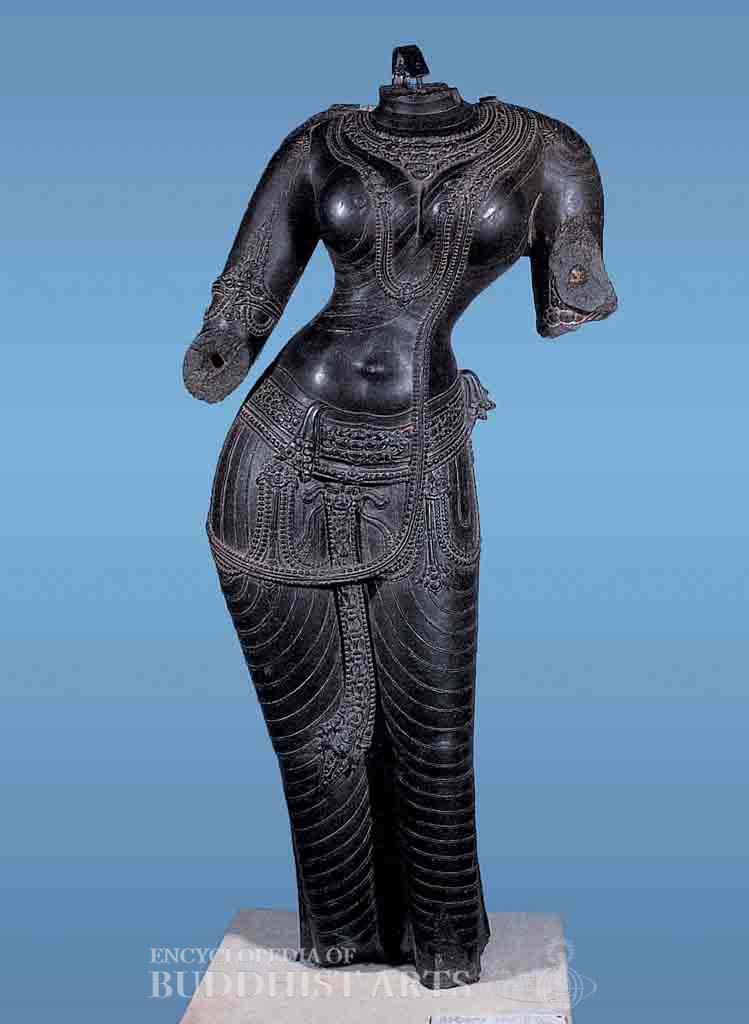
Nalanda: Tara
Basalt
Nalanda: Tara
INDIA, Bihar
The statue of Tara shown here is considered one of the most beautiful female depictions of Vajrayana Buddhism from the Pala period (circa 8th–12th century) and has been called the “Venus de Milo of India” on account of the damage to the arms. The story is that Tara was born from the tears shed by Avalokitesvara for the suffering in the world and as a consequence represents active compassion.
Tara’s female attributes are prominently on display as she stands in the undulating tribhanga posture with one leg advanced and the waist swaying to the left. The stole is represented by fine incisions across the body, over which are molded a jeweled necklet, a beaded necklace and a similarly patterned sacred thread. A florally patterned belt with pendants and beaded loops secure a diaphanous skirt through which the rounded shape of the knees appears.
For more details, go to the Encyclopedia of Buddhist Arts: Sculpture N-Sr, page 752.
Cite this article:
author = Hsingyun and Youheng and Lovelock, Yann and Chou, Yuan and Huntington, Susan and Edson, Gary and Neather, Robert,
booktitle = {Encyclopedia of Buddhist Arts: Sculpture N-Sr},
pages = 752,
title = {{Nalanda: Tara}},
volume = 12,
year = {2016}}