
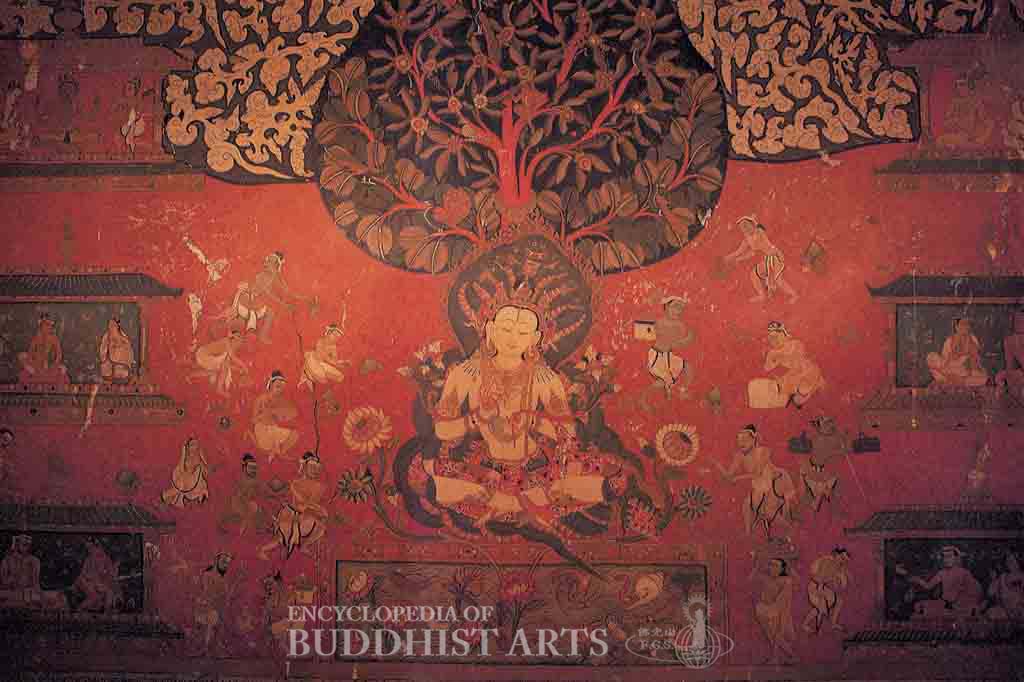
Shalu Monastery Central Hall Murals: Circumambulation Passage - Teaching by Naga King (west wall)
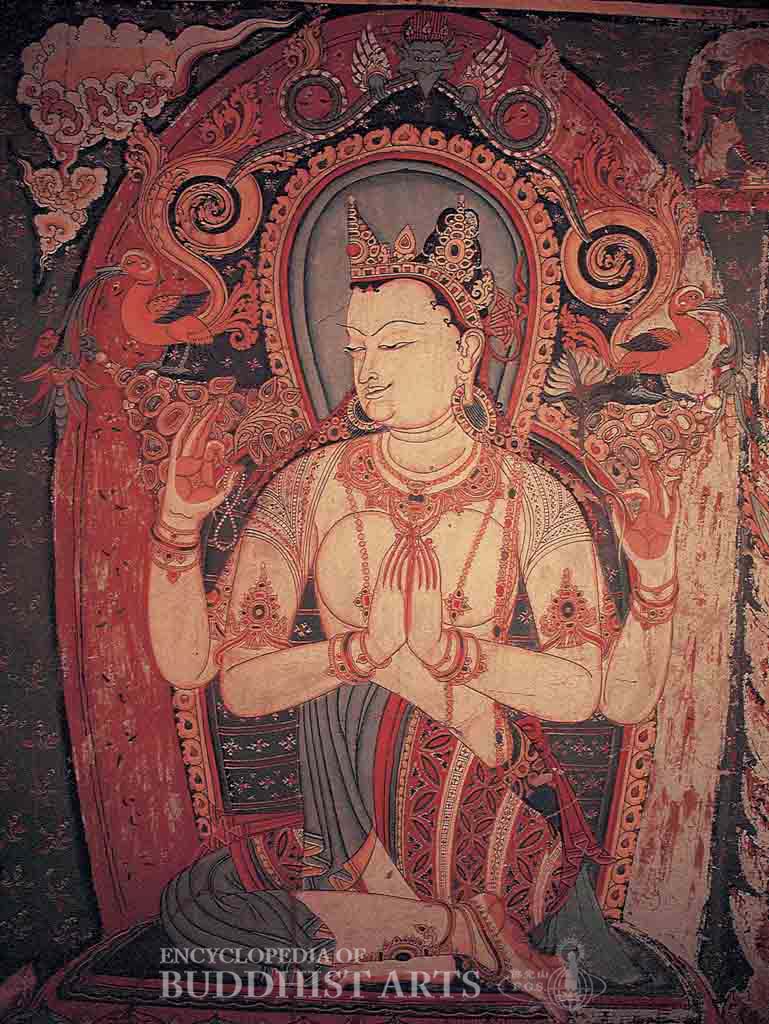
Shalu Monastery Central Hall Murals: Avalokitesvara Shrine - Four-Armed Avalokitesvara
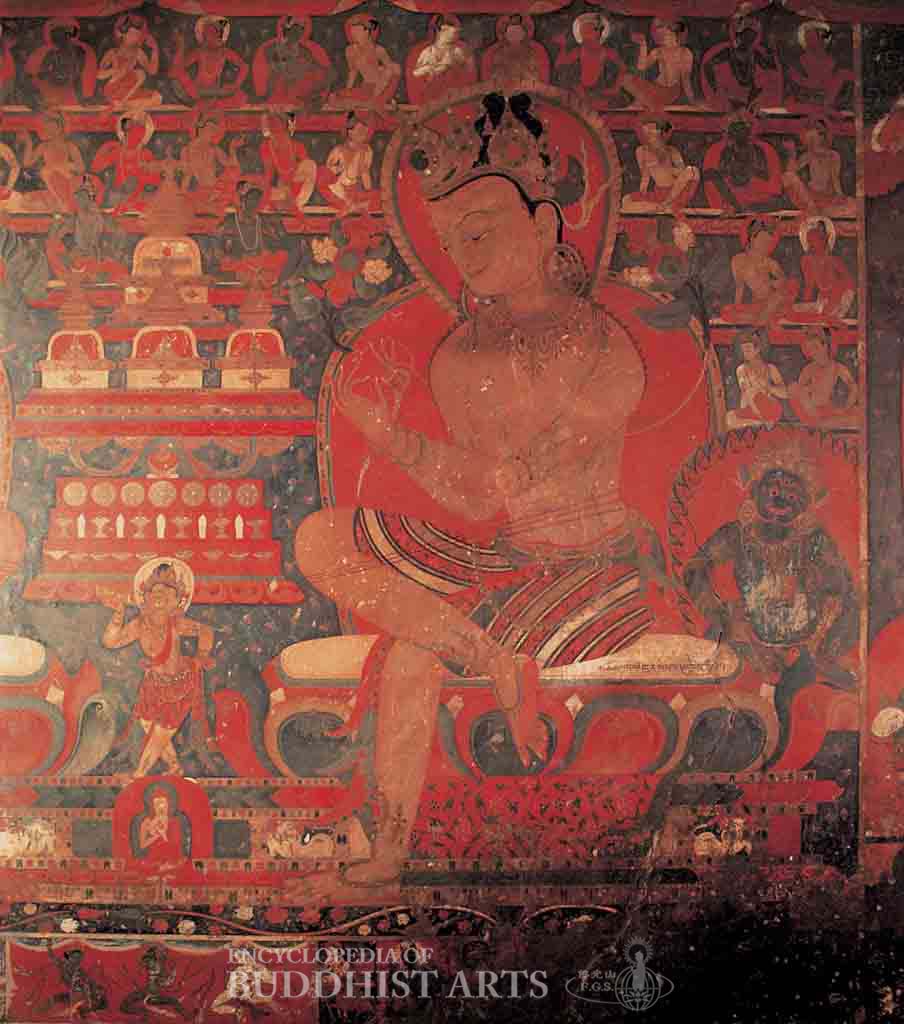
Shalu Monastery Central Hall Murals: Prajnaparamita Shrine South Corridor - Bodhisattva Making an Offering (north wall, left side)
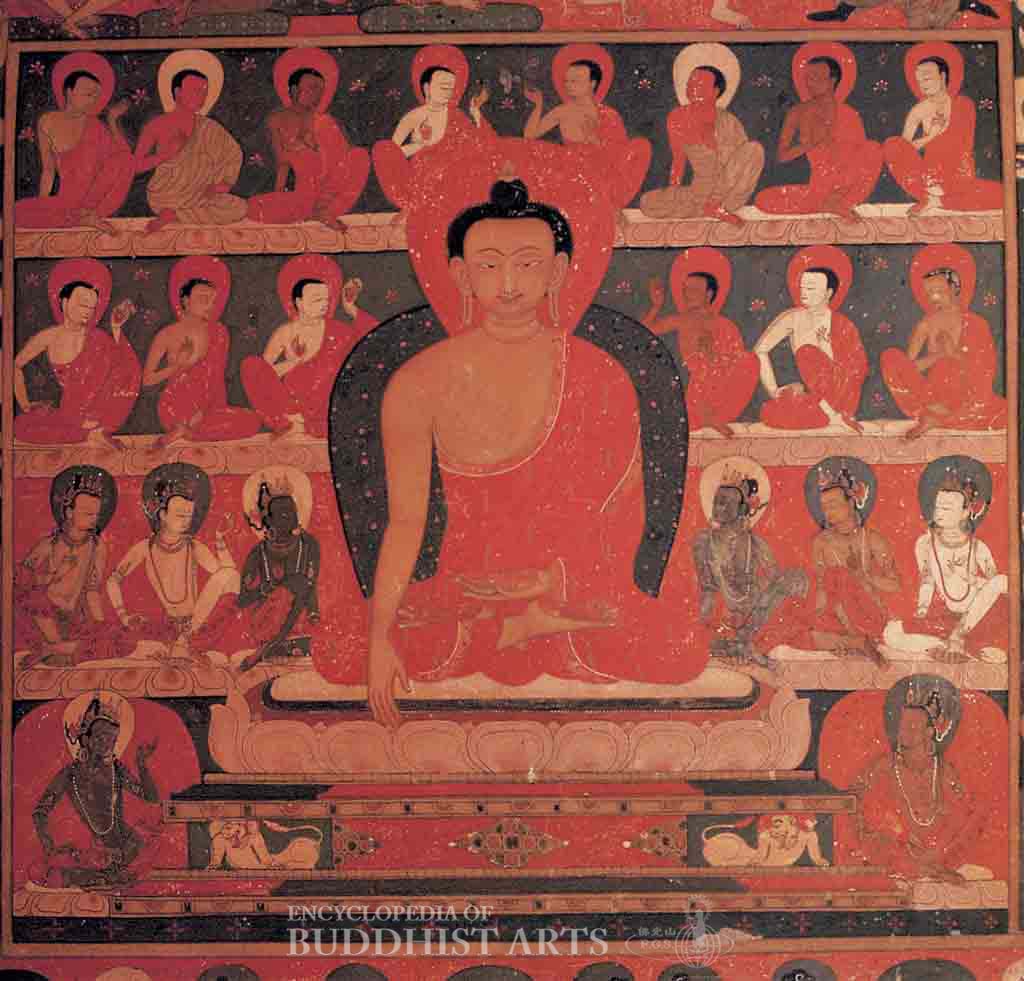
Shalu Monastery Central Hall Murals: Prajnaparamita Shrine East Corridor - Miracle at Sravasti (east wall)

Shalu Monastery Central Hall Murals: Circumambulation Passage - Teaching by Naga King (detail) (west wall)
Shalu Monastery Central Hall Murals
CHINA, Tibet, Shigatse
The central hall in Shalu Monastery is a large two story building containing an assembly hall, several shrines, and circumambulation passages. Murals were first painted in 1087 when the monastery was constructed by Chetsun Sherab Jungnay. More were added in 1320 when the monastery was expanded under the abbot Buton Rinchen Drub. They are some of the most diverse and best preserved murals among the monasteries in Tibet.
Both the Segoma Shrine and the Gosum Shrine contain images of the Five Dhyani Buddhas. A portrait of Chetsun Sherab Jungnay is painted on the north wall of the Gosum Shrine. Along the exterior of the circumambulation passage around the assembly hall, murals depict stories from the Life of the Buddha, Jataka tales, and karma stories. On the west wall, there are dancing figures and an image of the Teaching by Naga King. The passage is also linked to the Avalokitesvara Shrine, which is painted with the Six-Syllable Mandala, Four-Armed Avalokitesvara, and Hayagriva on the north and south walls.
The corridor that leads to the entrance of the Prajnaparamita Shrine is covered with images of Buddha Teaching the Dharma. The exterior north, south, and east walls of the circumambulation passage around the shrine are decorated with illustrations of Sumagadha’s Invitation and other stories from Buddhist sutras. These murals measure about 200 cm high. The illustration of Sumagadha’s Invitation on the south wall measures 1,100 cm in length, while a depiction of the Miracles at Sravasti on the left side of the east wall is 525 cm long.
The Protector Shrine is filled with images of fierce Dharma protectors, dignified Bodhisattvas, and earnest disciples listening to the Dharma. There are also illustrations of the Twenty-Eight Mansions. The murals represent a fusion of Indian, Nepali, and Chinese Yuan dynasty (1271–1368) styles. Those painted in 1087 when the monastery was first built are particularly influenced by styles from outside Tibet. The murals from 1320 display more of a Chinese influence.
For more details, go to the Encyclopedia of Buddhist Arts: Painting P-Z, page 809.
Cite this article:
author = Hsingyun and Youheng and Youlu and Wilson, Graham and Manho and Mankuang and Huntington, Susan,
booktitle = {Encyclopedia of Buddhist Arts: Painting P-Z},
pages = 809,
title = {{Shalu Monastery Central Hall Murals}},
volume = 16,
year = {2016}}