
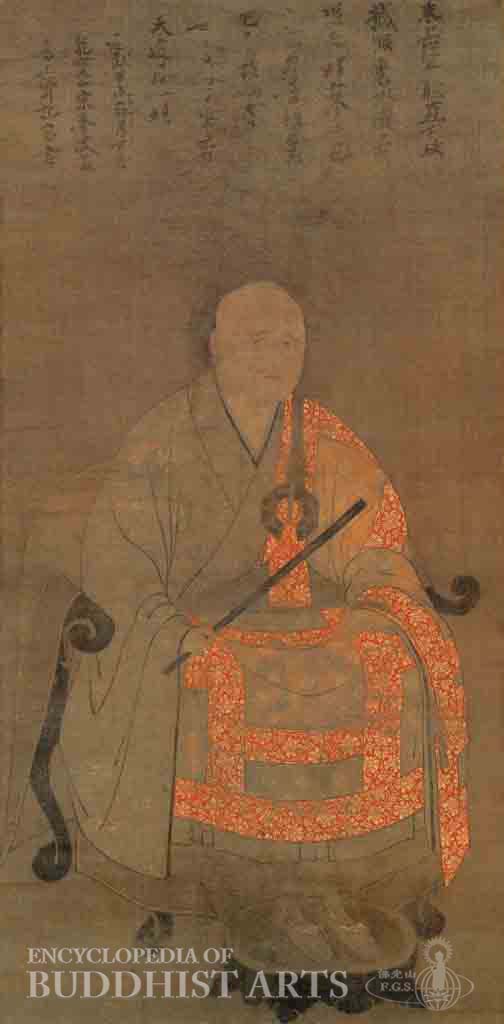
Master Shuho Myocho; Nanbokucho period, dated 1334
Ink and color on silk
Shuho Myocho
JAPAN, Hyogo; Kamakura to Nanbokucho period
Shuho Myocho, also known as Ki Myocho, was a calligrapher and master of the Rinzai school of Japanese Zen Buddhism. He was born in Harima (present day Hyogo) and was bestowed the titles National Master Daito and Kosho Seito. He began his studies at Engyoji Temple on Shoshazan at the age of 11 under Master Kaishin. Thereafter, he traveled to various temples in Kyoto and Kamakura to learn from different masters, eventually becoming a disciple of Zen Master Nanpo Jomyo. After his teacher’s passing, Master Shuho lived in seclusion at Unkyoan Hermitage in Kyoto and lived on alms as practice for several years.
In 1326, Master Shuho established Daitokuji Temple, where Emperor Hanazono (reigned 1308–1318) and Emperor Go-Daigo (reigned 1318–1339) of the Kamakura period took refuge under him. Together with National Master Muso Soseki, they were known as the Two Great Zen Masters. Master Shuho’s disciple, Kanzan Egen, was the founder of Myoshinji Temple in Kyoto.
Calligraphy by Master Shuho is reminiscent of the works of Mi Fu and Huang Tingjian. Brushstrokes are sharp and structured, imparting the elegance of Zen nature. His renowned masterpieces include Characters - Kanzan and Certificate of Attainment, both of which were written for his disciple Egen and are collected at Myoshinji Temple in Kyoto. Sutra Announcement Board, displayed in the monks’ quarters of Shinjuan Temple in Kyoto, is written with Dharma words, teachings, sutras, and mantras. Another piece, Teachings of Master Sogo, expounds the truth about enlightenment and is kept at Daisenin Temple in Kyoto. Collected at the Masaki Art Museum in Osaka are two other works entitled, Creek Verse and Nanyue Verse, both abstracted from Record of Master Xutang. The above mentioned works are all listed as National Treasures of Japan.
For more details, go to the Encyclopedia of Buddhist Arts: People, page 239.
Cite this article:
author = Hsingyun and Youheng and Youlu and Pokorski, Stefanie and Yichao and Mankuang and Miaohsi,
booktitle = {Encyclopedia of Buddhist Arts: People },
pages = 239,
title = {{Shuho Myocho}},
volume = 19,
year = {2016}}